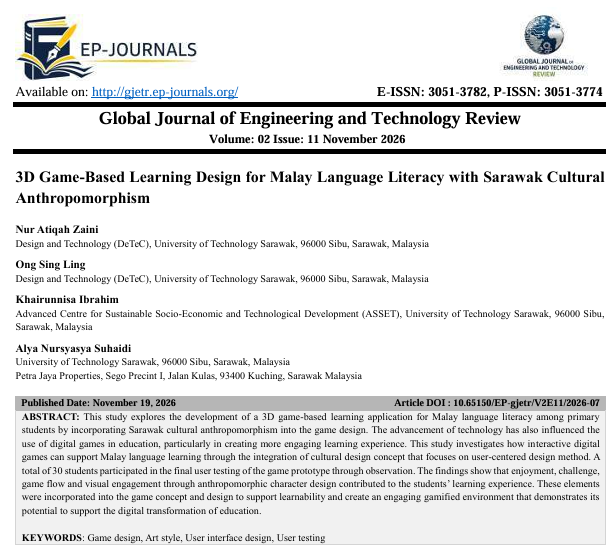
3D Game-Based Learning Design for Malay Language Literacy with Sarawak Cultural Anthropomorphism
DOI:
https://doi.org/10.65150/EP-gjetr/V2E11/2026-07Keywords:
Game design, Art style, User interface design, User testingAbstract
This study explores the development of a 3D game-based learning application for Malay language literacy among primary students by incorporating Sarawak cultural anthropomorphism into the game design. The advancement of technology has also influenced the use of digital games in education, particularly in creating more engaging learning experience. This study investigates how interactive digital games can support Malay language learning through the integration of cultural design concept that focuses on user-centered design method. A total of 30 students participated in the final user testing of the game prototype through observation. The findings show that enjoyment, challenge, game flow and visual engagement through anthropomorphic character design contributed to the students’ learning experience. These elements were incorporated into the game concept and design to support learnability and create an engaging gamified environment that demonstrates its potential to support the digital transformation of education.
References
1) Akhmetova, A. I., Seitenova, S. S., Khodjaev, B. K., Jamoldinova, O. R., Yerkebaeva, S. Z., & Kazybayeva, K. U. (2025). Evolution of game-based learning research: A cross-database bibliometric analysis and visualization study (2015-2024). In Contemporary Educational Technology, 17(3). Bastas. https://doi.org/10.30935/cedtech/16451
2) Banseng, S., Gerry, D., Zarina, P., Khalid, M., & Faaizah, N. (2023). The Influence of Iban Students’ Motivation on the Achievement in the Malay Language Subject as a Second Language. International Journal of Education, Information Technology and Others (IJEIT), 6((3)), 1–8. https://doi.org/10.5281/zenodo.8262440
3) Bayrak, T. (2025). Digital Games and Cultural Dynamics: An Examination of The Social and Cultural Impacts of Popular Games in Türkiye Through Steam. İletişim Kuram ve Araştırma Dergisi, (69), 69–95. https://doi.org/10.47998/ikad.1567089
4) Diego Wisnu, A., & Adelaide Gracegefa, P. (2025). The Effect of Digital Technology on Traditional Game Culture Preservation, Behavior Change, and Community Participation. Knowledge Garden, 3(1), 1–25. https://doi.org/10.21776/ub.knowledgegarden.2025.3.1.34
5) Ekawardhani, Y. A., Rizky, A. D. D., Bekti, P. N., & Kasmana, K. (2025). The Implementation of Anthropomorphism in Indonesian Folktale Character Design, 220–234. https://doi.org/10.2991/978-2-38476-442-6_20
6) Husain, R., & Prentice, C. (2025). Anthropomorphism and Consumer Experience—Review and Future Research Agenda. International Journal of Consumer Studies, 49(5). https://doi.org/10.1111/ijcs.70117
7) Kristensen, J. K., Torkildsen, J. v. K., & Andersson, B. (2024). Repeated mistakes in app-based language learning: Persistence and relation to learning gains. Computers and Education, 210. https://doi.org/10.1016/j.compedu.2023.104966
8) Li, Q., Juithong, S., & Sangway, S. (2024). Educational Game Teaching Methods on Communicative English Listening and Speaking Abilities for Early Childhood Students. International Journal of Sociologies and Anthropologies Science Reviews, 4(3), 207–218. https://doi.org/10.60027/ijsasr.2024.4042
9) Ng, Y. Y. ng, Nathan, R. J., & Khong, C. W. (2025). Assessing player engagement in local indie games: A qualitative study of affective game design elements. Entertainment Computing, 54. https://doi.org/10.1016/j.entcom.2025.100945
10) Olubunmi, O. M. (2021). Using Procedural And Conceptual Colour Stimulation-Game As an Instructional Gizmo For Nigerian Students. Journal of Games, Game Art, and Gamification, 3(2), 37–42. https://doi.org/10.21512/jggag.v3i2.7253
11) Ong Long, O. A. H., Abd Halim, N. D., & Abdul Hanid, M. F. (2025). Global Trends and Research Frontiers in Game-Based Learning: A 2009 – 2025 Bibliometric Perspective. International Journal of Academic Research in Progressive Education and Development, 14(4). https://doi.org/10.6007/ijarped/v14-i4/26740
12) Ongoro, C. A., & Fangjiang, Y. Y. (2023). Digital Game-Based Technology for English Language Learning in Preschools and Primary Schools: A Systematic Analysis. IEEE Transactions on Learning Technologies. https://doi.org/10.1109/TLT.2023.3268282
13) Ortiz-Ospino, L., González-Sarmiento, E., & Roa-Perez, J. (2025). Technology trends in the creative and cultural industries sector: a systematic literature review. In Journal of Innovation and Entrepreneurship,14(1). Springer Science and Business Media Deutschland GmbH. https://doi.org/10.1186/s13731-025-00497-6
14) Othman, I. W., Abu Bakar, A. L., & Esa, M. S. (2022). Empowerment of The Malay Language: Issues, Rationales And Challenges Of The Malaysian Ministry Of Education. International Journal of Education, Psychology and Counseling, 7(47), 773–792. https://doi.org/10.35631/ijepc.747057
15) Utami, A., & Crescenzi-Lanna, L. (2025). Research design and implementation of digital play and digital games-based learning in early development (0 to 6 years): a systematic review. Education 3-13. https://doi.org/10.1080/03004279.2025.2537102
16) Xia, G., Henry, P., Chen, Y., Queiroz, F., Westland, S., & Cheng, Q. (2023). The effects of colour attributes on cognitive performance and intellectual abilities in immersive virtual environments. Computers in Human Behavior, 148. https://doi.org/10.1016/j.chb.2023.107853
17) Yang, H., & Hong, S. W. (2025). Creating an Anthropomorphic Folktale Animal: A Pilot Study on Character Design Creativity Derived From Autonomous Behavior Generation Powered by Reinforcement Learning. Computer Animation and Virtual Worlds, 36(1). https://doi.org/10.1002/cav.70013
18) Yau, J., Harris, R., Hollins, P., Garg, A., Hewage, P., Ower, J., Schuur, J., Griffiths, D., Watson, P., Iwendi, C., & Drachsler, H. (2025). The Reach of Digital Games and Their Potential as Global Communication Tools. European Conference on Games Based Learning, 19(2), 910–917. https://doi.org/10.34190/ecgbl.19.2.3874
19) Zaini, A., Fowler, A., Amor, R., & Wünsche, B. C. (2025). Character-Driven Storytelling Design for Digital Games: A Scoping Review. Games and Culture. https://doi.org/10.1177/15554120251380423
Downloads
Published
Issue
Section
License
Copyright (c) 2026 Nur Atiqah Zaini, Ong Sing Ling, Khairunnisa Ibrahim, Alya Nursyasya Suhaidi (Author)

This work is licensed under a Creative Commons Attribution 4.0 International License.