Development and Evaluation of Mobile Phone-Enabled and Solar PV-Powered Lighting Control System with GSM-Based Automatic Switching Technology
DOI:
https://doi.org/10.65150/EP-gjetr/V2E11/2026-06Keywords:
solar photovoltaic system, GSM-based automation, lighting control system, energy efficiency, usability, acceptabilityAbstract
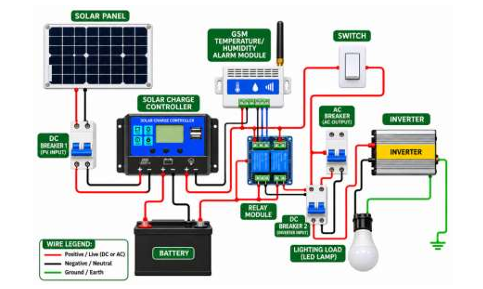
Conventional lighting systems still rely on manual switching and grid electricity, contributing to unnecessary energy use and limited remote-control capabilities. Despite advances in automated lighting, the integration of solar photovoltaic power, GSM communication, and automatic switching in affordable, small-scale systems remains insufficiently explored. This study developed and evaluated a mobile phone-enabled, solar PV-powered lighting control system with GSM/3G/4G Temperature, Humidity, and Power Status Monitoring T200 module automatic switching technology. A developmental-evaluative research design was employed involving 100 respondents comprising 65 students, 25 faculty members, and 10 community users, selected through purposive and convenience sampling. Data were gathered using a survey questionnaire and prototype performance tests, and descriptive statistics and F-tests were used for analysis. Results indicated 96% functionality, 95% reliability, and 95% accuracy, with average response times of 5.30 seconds for ON commands and 8.40 seconds for OFF commands. Respondents reported high perceived usefulness (M = 4.62) and ease of use (M = 4.49), alongside favorable acceptability ratings for user-friendliness, innovativeness, durability, and service efficiency. Age, respondent type, and educational attainment differed significantly in usability and acceptability assessments (p = 0.001), whereas sex did not. The findings support the system’s potential for accessible, renewable-energy-based lighting management while highlighting opportunities to improve communication reliability and long-term performance.
References
1) Alias, M. E. M., & Salimin, S. (2023). Smart Lighting System for a Classroom using Solar PV and Internet of Things (IoT). Evolution in Electrical and Electronic Engineering, 4(1), 128-138. https://periodical.uthm.edu.my/index.php/eeee/article/view/10404
2) Askola, J., Kärhä, P., Baumgartner, H., Porrasmaa, S., & Ikonen, E. (2022). Effect of adaptive control on the LED street luminaire lifetime and on the lifecycle costs of a lighting installation. Lighting Research & Technology, 54(1), 75-89.
https://doi.org/10.1177/14771535211008179
3) Aussat, Y., Rosmanis, A., & Keshav, S. (2022). A power-efficient self-calibrating smart lighting system. Energy and Buildings, 259,
111874. https://doi.org/10.1016/j.enbuild.2022.111874
4) Belloni, E., Massaccesi, A., Moscatiello, C., & Martirano, L. (2024). Implementation of a new solar-powered street lighting system: Optimization and technical-economic analysis using artificial intelligence. IEEE Access, 12, 46657-46667.
https://doi.org/10.1109/ACCESS.2024.3382191
5) Bisht, M. S., & Borah, H. C. (2018). Performance analysis of valve regulated lead-acid battery in solar street light system under field conditions in India. Invertis Journal of Renewable Energy, 8(1), 16–23. https://doi.org/10.5958/2454-7611.2018.00003.6
6) Blut, M., Chong, A. Y. L., Tsigna, Z., & Venkatesh, V. (2022). Meta-analysis of the unified theory of acceptance and use of technology (UTAUT): Challenging its validity and charting a research agenda in the red ocean. Journal of the Association for Information Systems, 23(1), 13–95. https://doi.org/10.17705/1jais.00719
7) Bruner, G. C., Kumar, A., & Heppner, C. (2007). Predicting innovativeness: development of the technology adoption scale. Progress in Wireless Communications Research, 30(4), 292-299.
8) Chang, S., & Nam, K. (2021). Smart home adoption: the impact of user characteristics and differences in perception of benefits. Buildings, 11(9), 393. https://doi.org/10.3390/buildings11090393
9) Chiradeja, P., & Yoomak, S. (2023). Development of public lighting system with smart lighting control systems and internet of thing (IoT) technologies for smart city. Energy Reports, 10, 3355-3372. https://doi.org/10.1016/j.egyr.2023.10.027
10) Davis, F. D. (1989). Perceived usefulness, perceived ease of use, and user acceptance of information technology. MIS quarterly, 319-340. https://parsmodir.com/wp-content/uploads/2018/11/TAM-Davis-1989.pdf
11) Delmastro, C., Harmsen, S., & Rey, T. (2026, March 6). The next wave of LED lighting: Smarter, circular and more efficient. International
Energy Agency. https://www.iea.org/commentaries/the-next-wave-of-led-lighting-smarter-circular-and-more-efficient
12) Deursen, A. J. M. V., de Boer, P. S., & Van Rompay, T. J. (2025). Smart devices require skilled users: Home automation performance tests among the Dutch population. International Journal of Human–Computer Interaction, 41(2), 1688-1699.
https://doi.org/10.1080/10447318.2024.2364470
13) DeWaters, J. E., & Powers, S. E. (2011). Energy literacy of secondary students in New York State (USA): A measure of knowledge, affect, and behavior. Energy policy, 39(3), 1699-1710. https://doi.org/10.1016/j.enpol.2010.12.049
14) DeWaters, J., Qaqish, B., Graham, M., & Powers, S. (2013). Designing an energy literacy questionnaire for middle and high school youth. The Journal of Environmental Education, 44(1), 56-78. https://doi.org/10.1080/00958964.2012.682615
15) Etikan, I., Musa, S. A., & Alkassim, R. S. (2016). Comparison of convenience sampling and purposive sampling. American Journal of Theoretical and Applied Statistics, 5(1), 1–4. https://doi.org/10.11648/j.ajtas.20160501.11
16) Fashina, A. A., Azeko, S. T., Asare, J., Ani, C. J., Anye, V. C., Rwenyagila, E. R., ... & Dyeris, M. A. (2017). A study on the reliability and performance of solar powered street lighting systems. International Journal of Scientific World, 5(2), 110-116.
https://doi.org/10.14419/ijsw.v5i2.8109
17) Gbadega, P. A., Sun, Y., Mazibuko, N., & Akindeji, K. T. (2024, April). Design and Implementation of a GSM-Based Remote Control for a Smart Home Energy Management System with Surge Protection. In 2024 International Conference on Science, Engineering and Business for Driving Sustainable Development Goals (SEB4SDG) (pp. 1-7). IEEE. https://doi.org/10.1109/SEB4SDG60871.2024.10629881
18) Ghani, M. T. A., Hamzah, M., Ramli, S., Ab, W., Daud, A. W., Romli, T. R. M., & Mokhtar, N. N. M. (2019). A questionnaire-based approach on technology acceptance model for mobile digital game-based learning. Journal of Global Business and Social Entrepreneurship (GBSE), 5(14), 11-21. http://gbse.my/V5%20NO.14%20(MARCH%202019)/Paper-199-.pdf
19) Goswami, A. D., Das, B., & Mazumdar, S. (2022). Development of a gsm based Arduino Controlled Smart Street Lighting System. Light & Engineering, 30(1), 82-90. https://doi.org/10.33383/2021-029
20) Gubbi, J., Buyya, R., Marusic, S., & Palaniswami, M. (2013). Internet of Things (IoT): A vision, architectural elements, and future directions. Future generation computer systems, 29(7), 1645-1660. https://doi.org/10.1016/j.future.2013.01.010
21) Islam, S. N. (2026). A Machine Learning Approach to Intelligent Streetlight Control for Sustainable Energy Management in Smart Cities. American Journal of Advanced Technology and Engineering Solutions, 6(01), 650-689. https://doi.org/10.63125/gxwn1g63
22) Moore, G. C., & Benbasat, I. (1991). Development of an instrument to measure the perceptions of adopting an information technology innovation. Information systems research, 2(3), 192-222. https://www.jstor.org/stable/23010883
23) Okubanjo, A. A., Okandeji, A. A., Abolade, O. R., & Alao, O. P. (2021). Development of GSM based home automation system using Arduino Uno microcontroller. FUW Trends Sci. Technol. J, 6(2), 599-606.
24) Olusakin, A. A., Akaninyene, A. O., Abdulgafar, I. A., Joseph, O. E., Solomon, A. C., & Benson, U. J. (2025). Implementing an SMS-Controlled Smart Home Automation System with a GSM Network. Asian Journal of Advanced Research and Reports, 19(10), 218-227.
https://doi.org/10.9734/ajarr/2025/v19i101188
25) Pal, D., Funilkul, S., Vanijja, V., & Papasratorn, B. (2018). Analyzing the elderly users' adoption of smart-home services. IEEE Access, 6, 51238–51252. https://doi.org/10.1109/ACCESS.2018.2869599
26) Parasuraman, A., Zeithaml, V. A., & Malhotra, A. (2005). ES-QUAL: A multiple-item scale for assessing electronic service quality. Journal of service research, 7(3), 213-233. https://doi.org/10.1177/1094670504271156
27) Qiang, G., Tang, S., Hao, J., Di Sarno, L., Wu, G., & Ren, S. (2023). Building automation systems for energy and comfort management in green buildings: A critical review and future directions. Renewable and Sustainable Energy Reviews, 179, 113301.
https://doi.org/10.1016/j.rser.2023.113301
28) Rafi, S., Akbar, M. A., & Khan, A. A. (2025, June). Assessing software product quality in devops: An iso 25010: 2023 perspective. In Proceedings of the 2025 29th International Conference on Evaluation and Assessment in Software Engineering Companion (pp. 10-16).
https://doi.org/10.1145/3727967.3756847
29) Rajaperumal, T. A., & Columbus, C. C. (2025). Transforming the electrical grid: the role of AI in advancing smart, sustainable, and secure energy systems. Energy Informatics, 8(1), 51. https://doi.org/10.1186/s42162-024-00461-w
30) Sovacool, B. K., Martiskainen, M., & Del Rio, D. D. F. (2021). Knowledge, energy sustainability, and vulnerability in the demographics of smart home technology diffusion. Energy Policy, 153, 112196. https://doi.org/10.1016/j.enpol.2021.112196
31) Tamakloe, E., & Kommey, B. (2022). A smart GSM-based home electrical appliances remote control system. IPTEK The Journal for Technology and Science, 33(1), 1-12. https://doi.org/10.12962/j20882033.v33i1.3150
32) Tural, E., Lu, D., & Austin Cole, D. (2021). Safely and actively aging in place: Older adults’ attitudes and intentions toward smart home technologies. Gerontology and geriatric medicine, 7, 23337214211017340. https://doi.org/10.1177/23337214211017340
33) Venkatesh, V., Morris, M. G., Davis, G. B., & Davis, F. D. (2003). User acceptance of information technology: Toward a unified view1. MIS quarterly, 27(3), 425-478. https://doi.org/10.2307/30036540
34) Wagiman, K. R., Abdullah, M. N., Hassan, M. Y., Radzi, N. H. M., Bakar, A. H. A., & Kwang, T. C. (2020). Lighting system control techniques in commercial buildings: Current trends and future directions. Journal of Building Engineering, 31, 101342.
https://doi.org/10.1016/j.jobe.2020.101342
35) Williams, A., Atkinson, B., Garbesi, K., Page, E., & Rubinstein, F. (2012). Lighting controls in commercial buildings. Leukos, 8(3), 161-180. https://doi.org/10.1582/LEUKOS.2012.08.03.001
36) Zocchi, G., Hosseini, M., & Triantafyllidis, G. (2024). Exploring the synergy of advanced lighting controls, building information modelling and internet of things for sustainable and energy-efficient buildings: A systematic literature review. Sustainability, 16(24),
Downloads
Published
Issue
Section
License
Copyright (c) 2026 Kent Clark M. Montero, Gerwine J. Medio, Marsan P. Dua, Ralph Guiller Lawas, Jade Rhey N. Canteveros, Sergiane H. Dua, Anne Strawberry Dua, Annalyn P. Rosell, John Rafael M. Almendras III, Romel C. Mutya (Author)

This work is licensed under a Creative Commons Attribution 4.0 International License.