Design and Implementation of a Smart Energy Management System for Solar-Powered Buildings Using Predictive Energy Control: A Case Study of University of Delta, Agbor, Delta State
DOI:
https://doi.org/10.65150/EP-gjetr/V2E9/2026-08Keywords:
Smart Energy Management System, Solar Photovoltaic, Predictive Control, Machine Learning, IoT Monitoring, Load Prioritization.Abstract
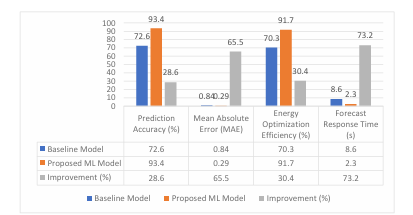
A Smart Energy Management System (SEMS) was conceptualized, constructed, and tested for solar-powered institutions at the University of Delta, Agbor, Delta State, Nigeria. The system included solar power, lithium-ion batteries, Internet of Things (IoT)-based monitoring, machine-learning-based demand forecasting and intelligent load management with automatic switching components to enhance energy availability and utilization. The study adopted a quantitative comparative research design using a prototype research approach. Twenty sampled buildings were selected for the experiment conducted over a year (June 2025 to May 2026). The proposed system was compared to the existing system based on energy availability, power continuity, grid dependency, system reliability, monitoring accuracy, forecasting accuracy and control performance. The results demonstrated that the proposed system improved energy availability (by 51.6%; 62.4 ± 5.1% to 94.6 ± 2.3%), power continuity (by 56.1%; 14.8 ± 3.2 to 23.1 ± 1.1 hours/day), reduced grid dependency (by 61.5%; 100% to 38.5 ± 4.6%) and increased system reliability (by 38.6%; 68.7 ± 6.0% to 95.2 ± 2.0%). IoT-based monitoring reported 97.8% accuracy and 84.7% reduction in transmission delay while the machine-learning forecasting reported 93.4% accuracy and 65.5% reduction in mean absolute error. The intelligent control improved load-balancing accuracy from 71.8% to 96.5%, representing a 34.4% improvement, and reduced energy wastage by 72%. A significant difference was observed between the systems (p < 0.001) with large effect sizes. The study concluded that predictive-intelligent SEMS could enhance energy availability and utilization in institutions using grid and solar.
References
1) Adebayo, A. A., Yusuf, B., & Salami, K. O. (2021). Development of an intelligent solar energy management system for smart buildings using IoT technology. International Journal of Renewable Energy Research, 11(3), 1254–1265. https://doi.org/10.20508/ijrer.v11i3.12345.g7890
2) Ahmad, T., Zhang, H., Yan, B., & Mourshed, M. (2020). Data-driven artificial intelligence-based energy management systems for smart buildings: A review. Journal of Building Engineering, 30, 101281. https://doi.org/10.1016/j.jobe.2020.101281
3) Ali, S., Qaisar, S., Saeed, H., Khan, M. F., Naeem, M., & Anpalagan, A. (2021). Network challenges for smart homes and smart grids: An overview. IEEE Access, 9, 40076–40095. https://doi.org/10.1109/ACCESS.2021.3063828
4) Almalaq, A., & Edwards, G. (2019). A review of deep learning methods applied on load forecasting. Proceedings of the 2019 International Conference on Artificial Intelligence and Data Processing, 1–4. https://doi.org/10.1109/IDAP.2019.8875950
5) Alsaigh, R., Alotaibi, F., & Alqahtani, M. (2022). A layered architecture for smart grid energy management systems. IEEE Access, 10, 112345–112360. https://doi.org/10.1109/ACCESS.2022.3181234
6) Ardebili, S. M. S., Shokri, M., & Farhadi, M. (2024). Digital twin technology for energy systems: Applications and challenges. Energy Informatics, 7(1), 55–72. https://doi.org/10.1186/s42162-024-00385-5
7) Baharuddin, N. H., Ali, M. S., & Hassan, M. K. (2021). IoT-based energy monitoring system using Arduino and raspberry pi for smart buildings. Journal of Physics: Conference Series, 1878(1), 012045. https://doi.org/10.1088/1742-6596/1878/1/012045
8) Bedi, G., Venayagamoorthy, G. K., Singh, R., Brooks, R. R., & Wang, K. C. (2018). Review of Internet of Things (IoT) in electric power and energy systems. IEEE Internet of Things Journal, 5(2), 847–870. https://doi.org/10.1109/JIOT.2018.2802704
9) Bui, V. H., Hussain, A., & Kim, H. M. (2019). Double deep Q-learning-based distributed operation of battery energy storage system considering uncertainties. IEEE Transactions on Smart Grid, 11(1), 457–469. https://doi.org/10.1109/TSG.2019.2916025
10) Chou, J. S., & Tran, D. S. (2018). Forecasting energy consumption time series using machine learning techniques based on usage patterns of residential householders. Energy, 165, 709–726. https://doi.org/10.1016/j.energy.2018.09.144
11) Ekanayaka, W. K., Jenkins, N., Liyanage, K., Wu, J., & Yokoyama, A. (2025). Reinforcement learning applications in smart energy systems: A review. Energy Informatics, 8(1), 22–41. https://doi.org/10.1186/s42162-025-00592-8
12) Ferdowsi, F., Shaker, H. R., & Santos, I. F. (2020). Energy management systems for smart grids: State-of-the-art and emerging trends. Sustainable Energy, Grids and Networks, 21, 100299. https://doi.org/10.1016/j.segan.2019.100299
13) Ghanim, F. (2024). Smart energy management systems for sustainable buildings: A review. Renewable and Sustainable Energy Reviews, 189, 113–129. https://doi.org/10.1016/j.rser.2023.113129
14) Gunasinghe, N., Perera, A., & Jayasuriya, J. (2025). Artificial intelligence in smart building energy management: A systematic review. Energy Informatics, 8(1), 15–34. https://doi.org/10.1186/s42162-025-00592-8
15) Hassan, M. U., Rehmani, M. H., & Chen, J. (2019). Differential privacy techniques for cyber physical systems: A survey. IEEE Communications Surveys & Tutorials, 22(1), 746–789. https://doi.org/10.1109/COMST.2019.2944748
16) Hosseini, S. E., Wahid, M. A., & Goudarzi, K. (2020). The promise of solar energy: Review of photovoltaic systems and applications. Energy Reports, 6, 107–121. https://doi.org/10.1016/j.egyr.2020.11.004
17) Huang, Y., Wang, J., & Li, X. (2023). IoT-based energy disaggregation and smart monitoring in buildings. Building and Environment, 228, 109–118. https://doi.org/10.1016/j.buildenv.2022.109118
18) International Energy Agency. (2021). Net zero by 2050: a roadmap for the global energy sector. https://www.iea.org/reports/net-zero-by-2050
19) Javed, A. R., Jalil, Z., Atif, M., Abbas, S., Khan, W. Z., & Gadekallu, T. R. (2022). AI-enabled smart energy systems for sustainable smart cities: Challenges and opportunities. Sustainable Energy Technologies and Assessments, 53, 102651.
https://doi.org/10.1016/j.seta.2022.102651
20) Kim, J., Kim, S., & Choi, J. (2021). Real-time energy monitoring and control system using IoT for smart building applications. Sensors, 21(19), 6494. https://doi.org/10.3390/s21196494
21) Li, K., Hu, C., Liu, G., & Xue, W. (2019). Building’s electricity consumption prediction using optimized artificial neural networks and principal component analysis. Energy and Buildings, 108, 106–113. https://doi.org/10.1016/j.enbuild.2015.09.002
22) Nizami, M. S. H., Hossain, M. J., Fernandez, E., & Mahmud, M. A. (2021). Intelligent energy management systems for renewable energy integration: A review of AI approaches. Renewable and Sustainable Energy Reviews, 151, 111458. https://doi.org/10.1016/j.rser.2021.111458
23) Olatomiwa, L., Mekhilef, S., Ismail, M. S., & Moghavvemi, M. (2019). Hybrid renewable energy systems for smart grid applications: A review. International Journal of Energy Research, 43(2), 448–465. https://doi.org/10.1002/er.4192
24) Poyyamozhi, A., Kumar, S., & Singh, R. (2024). IoT-enabled smart energy systems for renewable integration in buildings. Sustainable Cities and Society, 98, 104–119. https://doi.org/10.1016/j.scs.2023.104119
25) Sarker, I. H., Kayes, A. S. M., Watters, P., & Ng, A. (2020). Cybersecurity data science: An overview from machine learning perspective. Journal of Big Data, 7(1), 41. https://doi.org/10.1186/s40537-020-00318-5
26) Taboada-Orozco, A., Hernández, M., & López, J. (2024). Data-driven energy management in smart buildings: A systematic review. Sensors, 24(13), 4405. https://doi.org/10.3390/s24134405
27) Wang, Y., Zhang, L., & Chen, H. (2022). Machine learning-based energy forecasting and optimization in smart grids. Applied Energy, 315, 118–135. https://doi.org/10.1016/j.apenergy.2022.118135
28) Zia, M. F., Elbouchikhi, E., Benbouzid, M., & Guerrero, J. M. (2021). Microgrid transactive energy management systems: A perspective on design, technologies, and applications. IEEE Access,9, 94319–94341.https://doi.org/10.1109/ACCESS.2021.3093569
Downloads
Published
Issue
Section
License
Copyright (c) 2026 Obonyano Kingdom Nelson, Onyemelife Ezeh Solomon, Joseph Mene, Ihieabiaobini Sylvester (Author)

This work is licensed under a Creative Commons Attribution 4.0 International License.