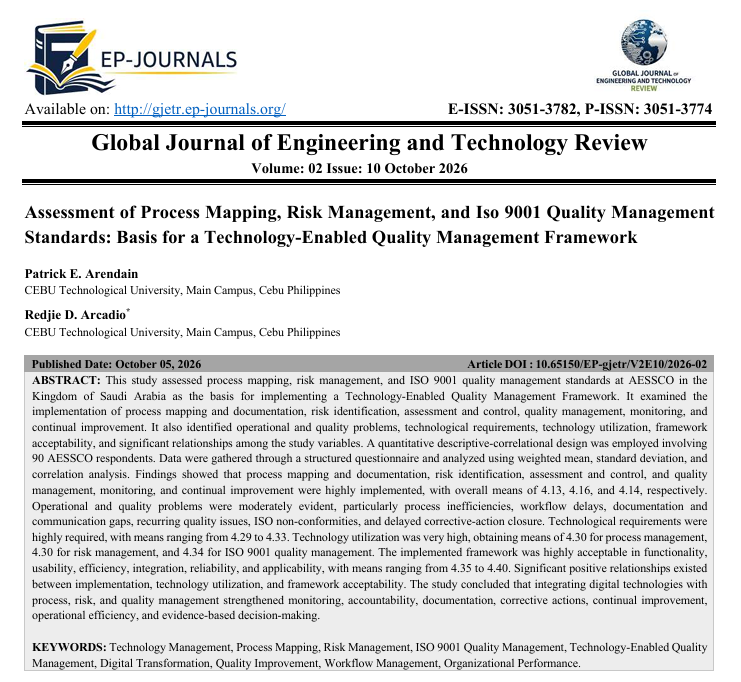
Assessment of Process Mapping, Risk Management, and Iso 9001 Quality Management Standards: Basis for a Technology-Enabled Quality Management Framework
DOI:
https://doi.org/10.65150/EP-gjetr/V2E10/2026-02Keywords:
Technology Management, Process Mapping, Risk Management, ISO 9001 Quality Management, Technology-Enabled Quality Management, Digital Transformation, Quality Improvement, Workflow Management, Organizational Performance.Abstract
This study assessed process mapping, risk management, and ISO 9001 quality management standards at AESSCO in the Kingdom of Saudi Arabia as the basis for implementing a Technology-Enabled Quality Management Framework. It examined the implementation of process mapping and documentation, risk identification, assessment and control, quality management, monitoring, and continual improvement. It also identified operational and quality problems, technological requirements, technology utilization, framework acceptability, and significant relationships among the study variables. A quantitative descriptive-correlational design was employed involving 90 AESSCO respondents. Data were gathered through a structured questionnaire and analyzed using weighted mean, standard deviation, and correlation analysis. Findings showed that process mapping and documentation, risk identification, assessment and control, and quality management, monitoring, and continual improvement were highly implemented, with overall means of 4.13, 4.16, and 4.14, respectively. Operational and quality problems were moderately evident, particularly process inefficiencies, workflow delays, documentation and communication gaps, recurring quality issues, ISO non-conformities, and delayed corrective-action closure. Technological requirements were highly required, with means ranging from 4.29 to 4.33. Technology utilization was very high, obtaining means of 4.30 for process management, 4.30 for risk management, and 4.34 for ISO 9001 quality management. The implemented framework was highly acceptable in functionality, usability, efficiency, integration, reliability, and applicability, with means ranging from 4.35 to 4.40. Significant positive relationships existed between implementation, technology utilization, and framework acceptability. The study concluded that integrating digital technologies with process, risk, and quality management strengthened monitoring, accountability, documentation, corrective actions, continual improvement, operational efficiency, and evidence-based decision-making.
References
1) Ahmad, N., Iteng, R., Taib, F. M., & Nor, M. N. (2017). Risk-based thinking in ISO 9001:2015 implementation and its impact on organizational performance.
2) Antonacci, F., Lennox, C., Barlow, J., Evans, S., & Reed, J. (2021). Process mapping and workflow improvement in organizational systems.
3) Arena, M., Arnaboldi, M., & Azzone, G. (2020). Integrated risk management and organizational performance: Evidence from enterprise systems.
4) Bozeman, B. (2017). Technology management and innovation in public and private organizations.
5) COSO. (2017). Enterprise risk management—Integrating with strategy and performance. Committee of Sponsoring Organizations of the Treadway Commission.
6) Dumas, M., La Rosa, M., Mendling, J., & Reijers, H. A. (2018). Fundamentals of business process management. Springer.
7) Evans, J. R., & Lindsay, W. M. (2018). Managing for quality and performance excellence. Cengage Learning.
8) Fonseca, L. M., & Domingues, J. P. (2017). ISO 9001 quality management systems and organizational performance improvement.
9) Fraser, J., & Simkins, B. J. (2018). Enterprise risk management: Today’s leading research and best practices.
10) Goetsch, D. L., & Davis, S. B. (2021). Quality management for organizational excellence.
11) ISO. (2015). ISO 9001:2015 quality management systems—Requirements. International Organization for Standardization.
12) ISO. (2018). ISO 31000:2018 risk management—Guidelines. International Organization for Standardization.
13) Liao, Y., et al. (2020). Digital transformation and organizational process efficiency.
14) Mele, C., Pels, J., & Polese, F. (2017). A brief review of systems theories and their managerial applications.
15) Nambisan, S., Lyytinen, K., Majchrzak, A., & Song,M. (2021). Digital innovation and transformation in organizations.
16) Oakland, J. S. (2019). Total quality management and operational excellence.
17) Power, M. (2016). Risk governance and enterprise risk management systems.
18) Rakhmawati, T., Widianti, E., Damayanti, R., et al. (2024). Technology-enabled quality management systems in modern organizations.
19) Saida, S., & Taibi, M. (2021). ISO 9001 as a tool for continuous improvement and competitiveness.
20) Salcedo Anaya, J., Huaman Montoya, L., & Ovalle, P. (2024). Integration of quality management and organizational performance improvement.
21) Sfreddo, L. S., Vieira, G. B. B., Vidor, G., & Santos, R. C. (2021). ISO 9001 implementation and operational efficiency outcomes.
Downloads
Published
Issue
Section
License
Copyright (c) 2026 Patrick E. Arendain, Redjie D. Arcadio (Author)

This work is licensed under a Creative Commons Attribution 4.0 International License.