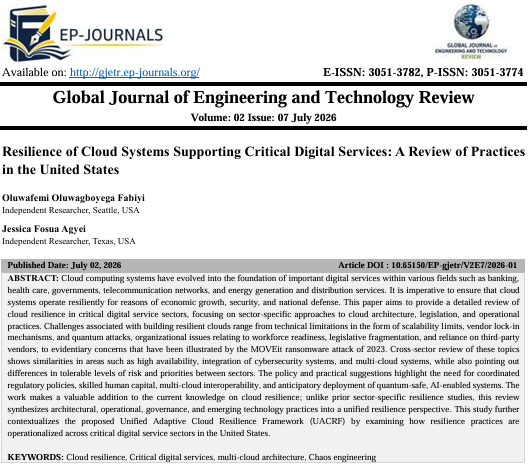
Resilience of Cloud Systems Supporting Critical Digital Services: A Review of Practices in the United States
DOI:
https://doi.org/10.65150/EP-gjetr/V2E7/2026-01Keywords:
Cloud resilience, Critical digital services, multi-cloud architecture, Chaos engineeringAbstract
Cloud computing systems have evolved into the foundation of important digital services within various fields such as banking, health care, governments, telecommunication networks, and energy generation and distribution services. It is imperative to ensure that cloud systems operate resiliently for reasons of economic growth, security, and national defense. This paper aims to provide a detailed review of cloud resilience in critical digital service sectors, focusing on sector-specific approaches to cloud architecture, legislation, and operational practices. Challenges associated with building resilient clouds range from technical limitations in the form of scalability limits, vendor lock-in mechanisms, and quantum attacks, organizational issues relating to workforce readiness, legislative fragmentation, and reliance on third-party vendors, to evidentiary concerns that have been illustrated by the MOVEit ransomware attack of 2023. Cross-sector review of these topics shows similarities in areas such as high availability, integration of cybersecurity systems, and multi-cloud systems, while also pointing out differences in tolerable levels of risk and priorities between sectors. The policy and practical suggestions highlight the need for coordinated regulatory policies, skilled human capital, multi-cloud interoperability, and anticipatory deployment of quantum-safe, AI-enabled systems. The work makes a valuable addition to the current knowledge on cloud resilience; unlike prior sector-specific resilience studies, this review synthesizes architectural, operational, governance, and emerging technology practices into a unified resilience perspective. This study further contextualizes the proposed Unified Adaptive Cloud Resilience Framework (UACRF) by examining how resilience practices are operationalized across critical digital service sectors in the United States.
References
1) Adel, A., Alani, N. H., Jan, T., & Prasad, M. (2025). A review of major ICT failures and recovery strategies: Strengthening digital resilience. Computers & Security, 104678.
2) Adewusi, B. A., Adekunle, B. I., Mustapha, S. D., & Uzoka, A. C. (2022). A conceptual framework for cloud-native product architecture in regulated and multi-stakeholder environments. Publication details unavailable.
3) Ajayi-Kaffi, O., Emmanuel, I., Azonuche, T. I., & Ijiga, O. M. (2025). Agile-Driven Digital Transformation Frameworks for Optimizing Cloud-Based Healthcare Supply Chain Management Systems. International Journal of Scientific Research and Modern Technology, 4(5), 138-156.
4) Alagic, G., Alagic, G., Apon, D., Cooper, D., Dang, Q., Dang, T., ... & Smith-Tone, D. (2022). Status report on the third round of the NIST post-quantum cryptography standardization process.
5) Argyroudis, S. A., Mitoulis, S. A., Chatzi, E., Baker, J. W., Brilakis, I., Gkoumas, K., ... & Linkov, I. (2022). Digital technologies can enhance climate resilience of critical infrastructure. Climate Risk Management, 35, 100387.
6) AWS (2026): AWS Prescriptive Guidance: Resilience lifecycle framework. https://docs.aws.amazon.com/pdfs/prescriptive-guidance/latest/resilience-lifecycle-framework/resilience-lifecycle-framework.pdf?
7) Bhalla, J. B. (2025). Building resilient cloud infrastructure: Key lessons from major outages. World Journal of Advanced Research and Reviews, 26, 4100-4106.
8) Butt, U. A., Mehmood, M., Shah, S. B. H., Amin, R., Shaukat, M. W., Raza, S. M., ... & Piran, M. J. (2020). A review of machine learning algorithms for cloud computing security. Electronics, 9(9), 1379.
9) Chauhan, M., & Shiaeles, S. (2023). An analysis of cloud security frameworks, problems and proposed solutions. Network, 3(3), 422-450.
10) Chelliah, P. R., & Surianarayanan, C. (2021). Multi-cloud adoption challenges for the cloud-native era: Best practices and solution approaches. International Journal of Cloud Applications and Computing (IJCAC), 11(2), 67-96.
11) Cho, H., Sung, J. H., Kang, H. J., Jang, J., & Shin, D. (2025). Quantifying cyber resilience: a framework based on availability metrics and AUC-based normalization. Electronics, 14(12), 2465.
12) Cotroneo, D., De Simone, L., Liguori, P., & Natella, R. (2021). Enhancing the analysis of software failures in cloud computing systems with deep learning. Journal of Systems and Software, 181, 111043.
13) Dias, J., Pinto, P., Santos, R., & Malta, S. (2025). 5G network slicing: security challenges, attack vectors, and mitigation approaches. Sensors, 25(13), 3940
14) Eboseremen, B. O., Ogedengbe, A. O., Obuse, E., Oladimeji, O., Ajayi, J. O., Akindemowo, A. O., ... & Erigha, E. D. (2022). Secure data integration in multi-tenant cloud environments: Architecture for financial services providers. Journal of Frontiers in Multidisciplinary Research, 3(1), 579-592.
15) Edo, O. C., Ang, D., Billakota, P., & Ho, J. C. (2024). A zero trust architecture for health information systems. Health and Technology, 14(1), 189-199.
16) Ganesan, P. (2024). Cloud-based disaster recovery: Reducing risk and improving continuity. Journal of Artificial Intelligence & Cloud Computing. SRC/JAICC-E162. DOI: doi. org/10.47363/JAICC/2024 (3) E162 J Arti Inte & Cloud Comp, 3(1), 2-4.
17) Gupta, S., & Tripathi, S. (2024). A comprehensive survey on cloud computing scheduling techniques. Multimedia Tools and Applications, 83(18), 53581-53634.
18) Hassan, A., Hassan, M. A., & Khan, M. A. (2023). Multi-Cloud Strategies for Scalable and Secure Fintech Applications. Journal of Educational Research in Developing Areas, 4(1), 123-133.
19) Ibraheem, I. O., & Bello-Ahmed, L. (2025). Green tech, safe networks: the role of cybersecurity in combating climate change. Discover Internet of Things, 5(1), 58.
20) Iyer, S. (2022). Operational Resilience for Financial Institutions (Doctoral dissertation, Trident University International).
21) Jain, M. (2025). SURVEY OF RESILIENCE STRATEGIES IN CLOUD PLATFORMS: FROM FAULT DETECTION TO AUTO-RECOVERY. Journal of Global Research in Mathematical Archives, 12(9).
22) Jassas, M. S., & Mahmoud, Q. H. (2022). Analysis of job failure and prediction model for cloud computing using machine learning. Sensors, 22(5), 2035.
23) Kambala, G. (2023). Designing resilient enterprise applications in the cloud: Strategies and best practices. World Journal of Advanced Research and Reviews, 17(03), 1078.
24) Kishan R. B (2025): “Data Privacy and Compliance in the Cloud (GDPR, HIPAA, CCPA).” Volume. 10 Issue.7, July-2025 International Journal of Innovative Science and Research Technology (IJISRT),2091-2097, https://doi.org/10.38124/ijisrt/25jul1264
25) Kornyo, O., Asante, M., Opoku, R., Owusu-Agyemang, K., Partey, B. T., Baah, E. K., & Boadu, N. (2023). Botnet attacks classification in AMI networks with recursive feature elimination (RFE) and machine learning algorithms. Computers & Security, 135, 103456.
26) Lawal, G. S. (2022). Enhancing Cloud Resilience through Predictive Disaster Recovery Analytics.
27) Liu, Y., Zhou, Y., Zhang, H., Chang, Z., Xu, S., Jia, Y., ... & Liu, Z. (2024). Rethinking software misconfigurations in the real world: an empirical study and literature analysis. arXiv preprint arXiv:2412.11121.
28) Malamuthu, B. K., Pandi, V. S., Jaber, A. H., Giri, J., & YP, R. (2025, July). Examining Multi-Cloud Architectures to Provide Enterprises with Resilient, Scalable, and Economical Cloud Computing Solutions. In 2025 International Conference on Engineering Innovations and echnologies (ICoEIT) (pp. 970-975). IEEE.
29) Meng, S., Luo, L., Qiu, X., & Dai, Y. (2022). Service-oriented reliability modeling and autonomous optimization of reliability for public cloud computing systems. IEEE Transactions on Reliability, 71(2), 527-538.
30) Mistry, H., Mavani, C., Patel, R., & Goswami, A. (2024). Cloud security risks and mitigation strategies: A review of current trends and future directions. Journal Title, 21(1), 1080. ISSN 1005-0930. DOI:10.10399/JBSE.2025295959
31) Nwachukwu, C., Durodola-Tunde, K., & Akwiwu-Uzoma, C. (2024). AI-driven anomaly detection in cloud computing environments. International Journal of Science and Research Archive, 13(2), 692-710.
32) Odejobi, O. D., Hammed, N. I., & Ahmed, K. S. (2023). Resilience and recovery model for business-critical cloud workloads. International Journal of Advanced Multidisciplinary Research and Studies, 3(1), 1491-1500.
33) Pang, Z., Yu, H., and Liu, Y., 2021. Incident Management in Cloud Environments: Best Practices and Challenges. IEEE Access, 9, Pp. 112234-112247.
34) Shahid, M. A., Islam, N., Alam, M. M., Mazliham, M. S., & Musa, S. (2021). Towards Resilient Method: An exhaustive survey of fault tolerance methods in the cloud computing environment. Computer Science Review, 40, 100398.
35) Welsh, T., & Benkhelifa, E. (2020). On resilience in cloud computing: A survey of techniques across the cloud domain. ACM computing surveys (CSUR), 53(3), 1-36.
Downloads
Published
Issue
Section
License
Copyright (c) 2026 Oluwafemi Oluwagboyega Fabiyi , Jessica Fosua Agyei (Author)

This work is licensed under a Creative Commons Attribution 4.0 International License.