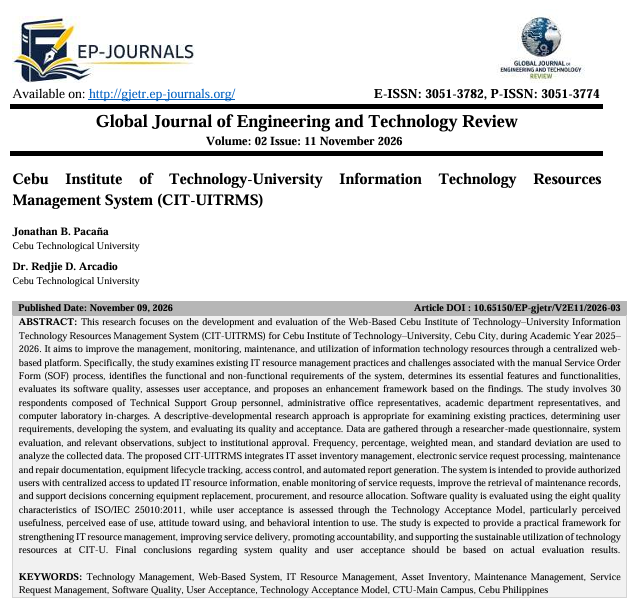
Cebu Institute of Technology-University Information Technology Resources Management System (CIT-UITRMS)
DOI:
https://doi.org/10.65150/EP-gjetr/V2E11/2026-03Keywords:
Technology Management, Web-Based System, IT Resource Management, Asset Inventory, Maintenance Management, Service Request Management, Software Quality, User Acceptance, Technology Acceptance Model, CTU-Main Campus, Cebu PhilippinesAbstract
This research focuses on the development and evaluation of the Web-Based Cebu Institute of Technology–University Information Technology Resources Management System (CIT-UITRMS) for Cebu Institute of Technology–University, Cebu City, during Academic Year 2025–2026. It aims to improve the management, monitoring, maintenance, and utilization of information technology resources through a centralized web-based platform. Specifically, the study examines existing IT resource management practices and challenges associated with the manual Service Order Form (SOF) process, identifies the functional and non-functional requirements of the system, determines its essential features and functionalities, evaluates its software quality, assesses user acceptance, and proposes an enhancement framework based on the findings. The study involves 30 respondents composed of Technical Support Group personnel, administrative office representatives, academic department representatives, and computer laboratory in-charges. A descriptive-developmental research approach is appropriate for examining existing practices, determining user requirements, developing the system, and evaluating its quality and acceptance. Data are gathered through a researcher-made questionnaire, system evaluation, and relevant observations, subject to institutional approval. Frequency, percentage, weighted mean, and standard deviation are used to analyze the collected data. The proposed CIT-UITRMS integrates IT asset inventory management, electronic service request processing, maintenance and repair documentation, equipment lifecycle tracking, access control, and automated report generation. The system is intended to provide authorized users with centralized access to updated IT resource information, enable monitoring of service requests, improve the retrieval of maintenance records, and support decisions concerning equipment replacement, procurement, and resource allocation. Software quality is evaluated using the eight quality characteristics of ISO/IEC 25010:2011, while user acceptance is assessed through the Technology Acceptance Model, particularly perceived usefulness, perceived ease of use, attitude toward using, and behavioral intention to use. The study is expected to provide a practical framework for strengthening IT resource management, improving service delivery, promoting accountability, and supporting the sustainable utilization of technology resources at CIT-U. Final conclusions regarding system quality and user acceptance should be based on actual evaluation results.
References
1) The following references are presented in APA 7th edition format and correspond to the citations used in the definitions above.
2) Davis, F. D. (1989). Perceived usefulness, perceived ease of use, and user acceptance of information technology. MIS Quarterly, 13(3), 319–340. https://doi.org/10.2307/249008
3) DeLone, W. H., & McLean, E. R. (2003). The DeLone and McLean model of information systems success: A ten-year update. Journal of Management Information Systems, 19(4), 9–30. https://doi.org/10.1080/07421222.2003.11045748
4) Gormantara, A., & Elisabeth, E. (2023). Evaluation of the success of the academic information system (SIAMIK) with the DeLone and McLean model. Jurnal Teknologi Informasi dan Pendidikan, 15(2), 99–109. https://doi.org/10.24036/jtip.v15i2.666
5) International Organization for Standardization. (2014). Asset management—Overview, principles and terminology (ISO Standard No. 55000:2014). https://www.iso.org/standard/55088.html
6) International Organization for Standardization. (2017). Information technology—IT asset management—Part 1: IT asset management systems—Requirements (ISO/IEC Standard No. 19770-1:2017). https://www.iso.org/standard/68531.html
7) International Organization for Standardization. (2018). Information technology—Service management—Part 1: Service management system requirements (ISO/IEC Standard No. 20000-1:2018). https://www.iso.org/standard/70636.html
8) International Organization for Standardization. (2023). Systems and software engineering—Systems and software quality requirements and evaluation (SQuaRE)—Product quality model (ISO/IEC Standard No. 25010:2023). https://www.iso.org/standard/78176.html
9) International Organization for Standardization. (2024). Asset management—Vocabulary, overview and principles (ISO Standard No. 55000:2024). https://www.iso.org/standard/83053.html
10) National Institute of Standards and Technology. (2024). The NIST cybersecurity framework (CSF) 2.0 (NIST CSWP 29).https://doi.org/10.6028/NIST.CSWP.29
11) Pamungkas, B. D., Ferdiansyah, M. A., Indrakusuma, A. H., & Panggayuh, V. (2024). Development of a web-based inventory information system for a university robotics laboratory: An agile development approach with ISO 25010 evaluation. JoEICT (Journal of Education and ICT), 8(2). https://jurnal.stkippgritulungagung.ac.id/index.php/joeict/article/view/9280
12) Rachmat, A., Hamzah, B., & Niswar, M. (2022). Evaluation of academic information system using DeLone and McLean success model: A case study of academic information system Hasanuddin University. Jurnal Sistem Informasi, 18(1), 62–75.https://doi.org/10.21609/jsi.v18i1.1114
13) Rahmansyah, F., & Hermaliani, E. H. (2023). Sistem informasi pengelolaan aset IT berbasis web pada PT. Trimitra Chitrahasta. Bianglala Informatika, 11(2). https://doi.org/10.31294/bi.v11i2.15479.g6199
14) Republic Act No. 6969. (1990). Toxic substances and hazardous and nuclear wastes control act of 1990. Official Gazette of the Republic of the Philippines.
15) United Nations Educational, Scientific and Cultural Organization. (2023). Global education monitoring report 2023: Technology in
education—A tool on whose terms? https://doi.org/10.54676/UZQV8501
16) Venkatesh, V., Morris, M. G., Davis, G. B., & Davis, F. D. (2003). User acceptance of information technology: Toward a unified view.
MIS Quarterly, 27(3), 425–478. https://doi.org/10.2307/30036540
17) World Health Organization. (2024, October 1). Electronic waste (e-waste).
https://www.who.int/vietnam/news/fact-sheets/detail/electronic-waste-%28e-waste%29
Downloads
Published
Issue
Section
License
Copyright (c) 2026 Jonathan B. Pacaña, Dr. Redjie D. Arcadio (Author)

This work is licensed under a Creative Commons Attribution 4.0 International License.