Industry Micro-Credential Infusion in PQF Level 5 Technology Diploma Programs: Opportunities and Challenges
DOI:
https://doi.org/10.65150/EP-gjetr/V2E10/2026-03Keywords:
Technology Management, Industry Micro-Credentials, Technology Infusion, PQF Level 5, Technology Diploma Programs, Curriculum Enhancement, CTU-Main Campus, Cebu, PhilippinesAbstract
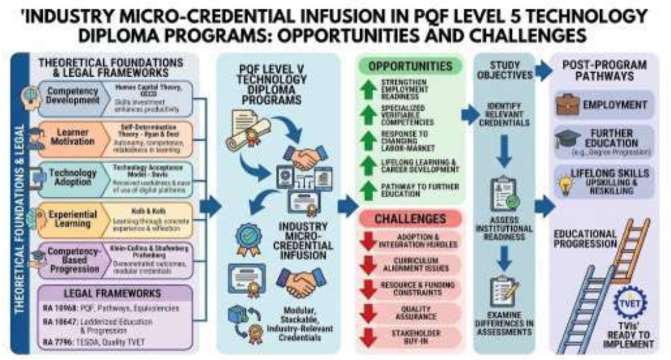
This study examined the integration of industry micro-credentials into the Philippine Qualifications Framework (PQF) Level 5 Technology Diploma Programs implemented by the Technical Education and Skills Development Authority (TESDA) Region VII and selected accredited Technical-Vocational Institutions (TVIs) during Fiscal Year 2025. It specifically assessed the extent of industry micro-credential development based on curriculum integration, alignment with competency standards, industry collaboration, learning delivery systems, and institutional readiness. It also examined the characteristics of micro-credential integration in terms of technology utilization, competency-based learning, stackability and portability, digital credentialing, and quality assurance; identified implementation opportunities and challenges; evaluated effectiveness based on learner competency development, curriculum relevance, employability, industry responsiveness, and program sustainability; determined the relationship between the level of micro-credential integration and its effectiveness; and developed a Technology Infusion Framework for strengthening PQF Level 5 Technology Diploma Programs. The study employed a descriptive-correlational research design involving 200 respondents consisting of TESDA officials, TVET administrators, trainers, curriculum developers, industry partners, graduates, and current learners from TESDA Region VII and selected accredited TVIs. Data were gathered through a validated researcher-developed questionnaire and analyzed using frequency, percentage, weighted mean, standard deviation, and Pearson product-moment correlation. Findings indicated that the development and characteristics of industry micro-credential integration were rated at a high level, while its overall effectiveness was assessed as highly effective. Respondents identified substantial opportunities for curriculum innovation, stronger industry collaboration, workforce responsiveness, employability, and lifelong learning. Nevertheless, moderate implementation challenges were identified concerning policy implementation, faculty capability, technological infrastructure, institutional resources, and industry participation. The study also established a highly significant positive relationship between the level of industry micro-credential integration and its effectiveness, indicating that stronger integration was associated with more effective curriculum implementation and competency-based learning. Based on the findings, a Technology Infusion Framework was developed to guide curriculum enhancement, technology integration, competency-based instruction, digital credentialing, quality assurance, and collaboration among TESDA, accredited TVIs, and industry partners. The framework may support continuous curriculum innovation, improve graduate employability, and promote lifelong learning through responsive and industry-aligned technology diploma programs
References
1) Albright, M., & Alvarez, R. (2021). Spatial and institutional readiness frameworks in technical education. Educational Technology & Society.
2) Becker, G. S. (2016). Human capital: A theoretical and empirical analysis, with special reference to education (3rd ed.). The University of Chicago Press.
3) CITE Technical Institute, Inc. (2026). Institutional development plan and industry partnership report. CITE.
4) Commission on Higher Education. (2025). Policy guidelines on micro-credentials and flexible learning pathways in Philippine higher education. CHED.
5) Davis, F. D. (1989). Perceived usefulness, perceived ease of use, and user acceptance of information technology. MIS Quarterly, 13(3), 319–340.
6) He, L., & Li, X. (2023). Digital badge adoption and learning engagement: Extending the technology acceptance model. Computers & Education, 195, 104710.
7) International Labour Organization. (2023). Skills development, employer engagement, and lifelong learning in technical-vocational education. ILO.
8) Klein-Collins, R., & Shafenberg, M. (2023). Competency-based education and modular stackable credentials in postsecondary training. Council for Adult and Experiential Learning (CAEL).
9) Kolb, A. Y., & Kolb, D. A. (2017). Experiential learning theory: Previous research and new directions. In R. J. Sternberg & L. F. Zhang (Eds.), Perspectives on thinking, learning, and cognitive styles (pp. 227–247). Routledge.
10) Lim, C. P., Zhang, Y., & Wang, L. (2025). Stackable micro-credentials and competency-based pathways in TVET systems. Journal of Vocational Education & Training, 77(1), 45–68.
11) Miao, F., Holmes, W., & Huang, R. (2023). Self-determination theory and digital badge integration in vocational training. UNESCO Publishing.
12) Moodie, G., & Wheelahan, L. (2021). Micro-credentials and quality assurance in post-secondary education. Centre for International Higher Education.
13) Organisation for Economic Co-operation and Development. (2021). OECD skills outlook 2021: Learning for life. OECD Publishing.
14) Organisation for Economic Co-operation and Development. (2023). Micro-credentials for lifelong learning and employability. OECD Publishing.
15) Organisation for Economic Co-operation and Development. (2024). Promoting stackable and portable credentials in TVET. OECD Publishing.
16) Republic Act No. 7796. (1994). An act creating the Technical Education and Skills Development Authority, providing for its powers, structure and for other purposes (TESDA Act of 1994). Official Gazette of the Republic of the Philippines.
17) Republic Act No. 10647. (2014). An act strengthening the ladderized education system (Ladderized Education Act of 2014). Official Gazette of the Republic of the Philippines.
18) Republic Act No. 10968. (2018). An act institutionalizing the Philippine Qualifications Framework (PQF Act). Official Gazette of the Republic of the Philippines.
19) Ryan, R. M., & Deci, E. L. (2020). Intrinsic and extrinsic motivation from a self-determination theory perspective: Definitions, theory, practices, and future directions. Contemporary Educational Psychology, 61, 101860.
20) Technical Education and Skills Development Authority. (2017). Philippine Qualifications Framework (PQF) Level V diploma program guidelines. TESDA.
21) Technical Education and Skills Development Authority. (2018). National technical education and skills development plan (NTESDP) 2018–2022: TVET for the Industry 4.0. TESDA.
22) Technical Education and Skills Development Authority. (2020). Standardized curriculum framework for PQF Level 5 technology diploma programs. TESDA.
23) Technical Education and Skills Development Authority. (2023). Regional TVET landscape and institutional readiness in Region VII. TESDA Region VII.
24) Technical Education and Skills Development Authority. (2025). Policy guidelines on the development, recognition, and quality assurance of micro-credentials in TVET. TESDA.
25) United Nations Educational, Scientific and Cultural Organization. (2022). Global guidelines on the recognition and quality assurance of micro-credentials in TVET. UNESCO.
26) World Bank. (2023). Strengthening TVET capacity, technology, and learning resources for future workforce readiness. The World Bank Group.
Downloads
Published
Issue
Section
License
Copyright (c) 2026 Gamaliel B. Vicente Jr., Alma O. Medio, Redjie D. Arcadio (Author)

This work is licensed under a Creative Commons Attribution 4.0 International License.