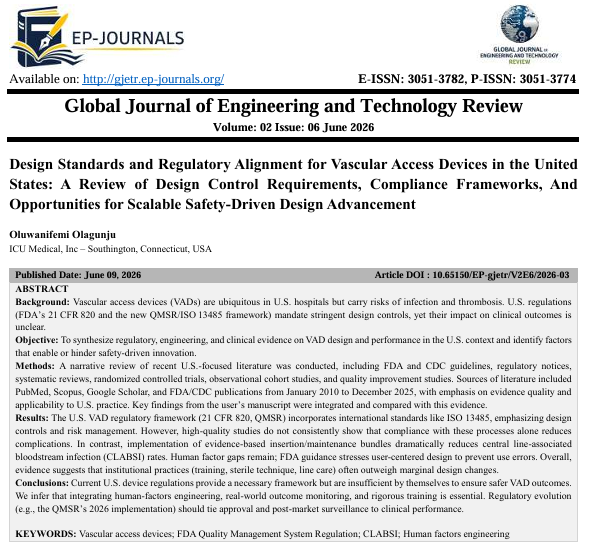
Design Standards and Regulatory Alignment for Vascular Access Devices in the United States: A Review of Design Control Requirements, Compliance Frameworks, And Opportunities for Scalable Safety-Driven Design Advancement
DOI:
https://doi.org/10.65150/EP-gjetr/V2E6/2026-03Keywords:
Vascular access devices, FDA Quality Management System Regulation, CLABSI, Human factors engineeringAbstract
Background: Vascular access devices (VADs) are ubiquitous in U.S. hospitals but carry risks of infection and thrombosis. U.S. regulations (FDA’s 21 CFR 820 and the new QMSR/ISO 13485 framework) mandate stringent design controls, yet their impact on clinical outcomes is unclear.
Objective: To synthesize regulatory, engineering, and clinical evidence on VAD design and performance in the U.S. context and identify factors that enable or hinder safety-driven innovation.
Methods: A narrative review of recent U.S.-focused literature was conducted, including FDA and CDC guidelines, regulatory notices, systematic reviews, randomized controlled trials, observational cohort studies, and quality improvement studies. Sources of literature included PubMed, Scopus, Google Scholar, and FDA/CDC publications from January 2010 to December 2025, with emphasis on evidence quality and applicability to U.S. practice. Key findings from the user’s manuscript were integrated and compared with this evidence.
Results: The U.S. VAD regulatory framework (21 CFR 820, QMSR) incorporates international standards like ISO 13485, emphasizing design controls and risk management. However, high-quality studies do not consistently show that compliance with these processes alone reduces complications. In contrast, implementation of evidence-based insertion/maintenance bundles dramatically reduces central line-associated bloodstream infection (CLABSI) rates. Human factor gaps remain; FDA guidance stresses user-centered design to prevent use errors. Overall, evidence suggests that institutional practices (training, sterile technique, line care) often outweigh marginal design changes.
Conclusions: Current U.S. device regulations provide a necessary framework but are insufficient by themselves to ensure safer VAD outcomes. We infer that integrating human-factors engineering, real-world outcome monitoring, and rigorous training is essential. Regulatory evolution (e.g., the QMSR’s 2026 implementation) should tie approval and post-market surveillance to clinical performance.
References
1) Air Force Medical Service. (2026, February 4). Combat casualty care technology receives FDA breakthrough designation for the “AI-GUIDE.” Air Force Medical Service. https://www.airforcemedicine.af.mil/News/Display/Article/4396861/combat-casualty-care-technology-receives-fda-breakthrough-designation-for-the-a/
2) Balsorano, P., Virgili, G., Villa, G., Pittiruti, M., Romagnoli, S., De Gaudio, A. R., & Pinelli, F. (2020). Peripherally inserted central catheter-related thrombosis rate in modern vascular access era-when insertion technique matters: A systematic review and meta-analysis. The Journal of Vascular Access, 21(1), 45–54. https://doi.org/10.1177/1129729819852203
3) Baskin, J. L., Pui, C.-H., Reiss, U., Wilimas, J. A., Metzger, M. L., Ribeiro, R. C., & Howard, S. C. (2009). Management of occlusion and thrombosis associated with long-term indwelling central venous catheters. Lancet, 374(9684), 159–169. https://doi.org/10.1016/S0140-6736(09)60220-8
4) Bills, E., & Tartal, J. (2008). Integrating risk management into the CAPA process. Biomedical Instrumentation & Technology, 42(6), 466–468. https://doi.org/10.2345/0899-8205-42.6.466
5) Brash, J. L., Horbett, T. A., Latour, R. A., & Tengvall, P. (2019). The blood compatibility challenge. Part 2: Protein adsorption phenomena governing blood reactivity. Acta Biomaterialia, 94, 11–24. https://doi.org/10.1016/j.actbio.2019.06.022
6) Bunch, J., Hanley, B., & Donahue, D. (2023). A retrospective, comparative, clinical study of occlusion rate of peripherally inserted central catheters fabricated of poly(vinyl alcohol)-based hydrogel composite. Journal of Materials Science. Materials in Medicine, 34(7), 34. https://doi.org/10.1007/s10856-023-06736-0
7) Burns, L., Le Roux, N., Kalesnik-Orszulak, R., Christian, J., Dudinak, J., Rockhold, F., Khozin, S., & O’Donnell, J. (2023). Real-world evidence for regulatory decision-making: Updated guidance from around the world. Frontiers in Medicine, 10, 1236462. https://doi.org/10.3389/fmed.2023.1236462
8) Centers for Disease Control and Prevention [CDC]. (2024a, April 3). Background Information: Strategies for Prevention of Catheter-Related Infections in Adult and Pediatric Patients. Infection Control. https://www.cdc.gov/infection-control/hcp/intravascular-catheter-related-infection/prevention-strategies.html
9) Centers for Disease Control and Prevention [CDC]. (2024b, May 10). Summary of Recommendations. Infection Control. https://www.cdc.gov/infection-control/hcp/intravascular-catheter-related-infections/summary-recommendations.html
10) Choi, Y. J., Lim, J. K., Park, J. J., Huh, H., Kim, D.-J., Gong, C.-H., & Yoon, S. Z. (2017). Chlorhexidine and silver sulfadiazine coating on central venous catheters is not sufficient for protection against catheter-related infection: Simulation-based laboratory research with clinical validation. The Journal of International Medical Research, 45(3), 1042–1053. https://doi.org/10.1177/0300060517708944
11) Chopra, V., Ratz, D., Kuhn, L., Lopus, T., Lee, A., & Krein, S. (2014). Peripherally inserted central catheter-related deep vein thrombosis: Contemporary patterns and predictors. Journal of Thrombosis and Haemostasis: JTH, 12(6), 847–854. https://doi.org/10.1111/jth.12549
12) Cohen, A. B., Dagli, M., Stavropoulos, S. W., Mondschein, J. I., Soulen, M. C., Shlansky-Goldberg, R. D., Solomon, J. A., Chittams, J. L., & Trerotola, S. O. (2011). Silicone and polyurethane tunneled infusion catheters: A comparison of durability and breakage rates. Journal of Vascular and Interventional Radiology: JVIR, 22(5), 638–641. https://doi.org/10.1016/j.jvir.2011.01.433
13) Coventry, L. L., Hosking, J. M., Chan, D. T., Coral, E., Lim, W. H., Towell-Barnard, A., Twigg, D. E., & Rickard, C. M. (2019). Variables associated with successful vascular access cannulation in hemodialysis patients: A prospective cohort study. BMC Nephrology, 20(1), 197. https://doi.org/10.1186/s12882-019-1373-3
14) Damkjær, M., Elkjær, M., Hróbjartsson, A., & Schroll, J. B. (2025). Scoping review on regulation, implementation and postmarket surveillance of medical devices. PLOS ONE, 20(5), e0325250. https://doi.org/10.1371/journal.pone.0325250
15) DeVries, M., & Sleweon, T. (2021). Bridging the gap: Introduction of an antimicrobial peripherally inserted central catheter (PICC) in response to high PICC central line-associated bloodstream infection incidence*. British Journal of Nursing, 30(19), S16–S22. https://doi.org/10.12968/bjon.2021.30.19.S16
16) Donabedian, A. (1988). The quality of care. How can it be assessed? JAMA, 260(12), 1743–1748. https://doi.org/10.1001/jama.260.12.1743
17) Donlan, R. M., & Costerton, J. W. (2002). Biofilms: Survival mechanisms of clinically relevant microorganisms. Clinical Microbiology Reviews, 15(2), 167–193. https://doi.org/10.1128/CMR.15.2.167-193.2002
18) Drews, F. A., Martinello, R. A., Hebden, J. N., St John, K. H., & Pegues, D. A. (2024). Disinfection of central venous access device needleless connectors: A human factors analysis. Infection Control and Hospital Epidemiology, 45(8), 959–964. https://doi.org/10.1017/ice.2024.22
19) Elangovan, S., Lo, J. J., Xie, Y., Mitchell, B., Graves, N., & Cai, Y. (2024). Impact of central-line-associated bloodstream infections and catheter-related bloodstream infections: A systematic review and meta-analysis. The Journal of Hospital Infection, 152, 126–137. https://doi.org/10.1016/j.jhin.2024.08.002
20) Esposito, S., Purrello, S. M., Bonnet, E., Novelli, A., Tripodi, F., Pascale, R., Unal, S., & Milkovich, G. (2013). Central venous catheter-related biofilm infections: An up-to-date focus on meticillin-resistant Staphylococcus aureus. Journal of Global Antimicrobial Resistance, 1(2), 71–78. https://doi.org/10.1016/j.jgar.2013.03.002
21) Everhart, A. O., Karaca-Mandic, P., Redberg, R. F., Ross, J. S., & Dhruva, S. S. (2025). Late adverse event reporting from medical device manufacturers to the US Food and Drug Administration: Cross sectional study. BMJ, 388, e081518. https://doi.org/10.1136/bmj-2024-081518
22) Fallouh, N., McGuirk, H. M., Flanders, S. A., & Chopra, V. (2015). Peripherally Inserted Central Catheter-associated Deep Vein Thrombosis: A Narrative Review. The American Journal of Medicine, 128(7), 722–738. https://doi.org/10.1016/j.amjmed.2015.01.027
23) Fauver, C., Colburn, N., Smyer, J., & Day, S. (2025). Bundle-Up to Prevent CLABSIs: Analysis of CLABSIs Pre and Post Toolkit Implementation. Antimicrobial Stewardship & Healthcare Epidemiology : ASHE, 5(Suppl 2), s78–s79. https://doi.org/10.1017/ash.2025.296
24) Fernández‐Fernández, I., Castro‐Sánchez, E., & Blanco‐Mavillard, I. (2025). Determinants of the optimal selection of vascular access devices: A systematic review underpinned by the COM‐B behavioural model. Journal of Advanced Nursing, 81(11), 6990–7006. https://doi.org/10.1111/jan.16202
25) Frykholm, P., Pikwer, A., Hammarskjöld, F., Larsson, A. T., Lindgren, S., Lindwall, R., Taxbro, K., Oberg, F., Acosta, S., & Akeson, J. (2014). Clinical guidelines on central venous catheterisation. Swedish Society of Anaesthesiology and Intensive Care Medicine. Acta Anaesthesiologica Scandinavica, 58(5), 508–524. https://doi.org/10.1111/aas.12295
26) Girardi, L., Di Nisio, M., Candeloro, M., Valeriani, E., & Ageno, W. (2025). Catheter-related deep vein thrombosis: Where are we at and where are we going? Updates and ongoing unmet clinical needs. European Journal of Clinical Investigation, 55(1), e14311. https://doi.org/10.1111/eci.14311
27) Gorbet, M. B., & Sefton, M. V. (2004). Biomaterial-associated thrombosis: Roles of coagulation factors, complement, platelets and leukocytes. Biomaterials, 25(26), 5681–5703. https://doi.org/10.1016/j.biomaterials.2004.01.023
28) Grau, D., Clarivet, B., Lotthé, A., Bommart, S., & Parer, S. (2017). Complications with peripherally inserted central catheters (PICCs) used in hospitalized patients and outpatients: A prospective cohort study. Antimicrobial Resistance and Infection Control, 6, 18. https://doi.org/10.1186/s13756-016-0161-0
29) Haddadin, Y., Annamaraju, P., & Regunath, H. (2026). Central Line–Associated Blood Stream Infections. In StatPearls. StatPearls Publishing. http://www.ncbi.nlm.nih.gov/books/NBK430891/
30) Hausman, E. D., & Altaie, S. S. (2004). Regulatory aspects of total product life cycle. Diabetes Technology & Therapeutics, 6(6), 761–766. https://doi.org/10.1089/dia.2004.6.761
31) International Organization for Standardization. (2020). ISO/TR 24971:2020 Medical devices—Guidance on the application of ISO 14971 (2nd ed.). ISO. https://www.iso.org/standard/74437.html
32) International Organization for Standardization [ISO]. (2016). ISO 13485:2016(en), Medical devices—Quality management systems—Requirements for regulatory purposes. https://www.iso.org/obp/ui/#iso:std:iso:13485:ed-3:v1:en
33) International Organization for Standardization[ISO]. (2019). ISO 14971:2019(en), Medical devices—Application of risk management to medical devices. https://www.iso.org/obp/ui/#iso:std:iso:14971:ed-3:v1:en
34) Itkin, M., Mondshein, J. I., Stavropoulos, S. W., Shlansky-Goldberg, R. D., Soulen, M. C., & Trerotola, S. O. (2014). Peripherally inserted central catheter thrombosis--reverse tapered versus nontapered catheters: A randomized controlled study. Journal of Vascular and Interventional Radiology: JVIR, 25(1), 85-91.e1. https://doi.org/10.1016/j.jvir.2013.10.009
35) Kinsel, D. (2012). Design control requirements for medical device development. World Journal for Pediatric & Congenital Heart Surgery, 3(1), 77–81. https://doi.org/10.1177/2150135111422720
36) Kleidon, T. M., Horowitz, J., Rickard, C. M., Ullman, A. J., Marsh, N., Schults, J., Ratz, D., & Chopra, V. (2021). Peripherally Inserted Central Catheter Thrombosis After Placement via Electrocardiography vs Traditional Methods. The American Journal of Medicine, 134(2), e79–e88. https://doi.org/10.1016/j.amjmed.2020.06.010
37) Kossoff, E. H., & Poirier, M. P. (1998). Peripherally inserted central venous catheter fracture and embolization to the lung. Pediatric Emergency Care, 14(6), 403–405. https://doi.org/10.1097/00006565-199812000-00006
38) Kramer, D. B., Xu, S., & Kesselheim, A. S. (2012). How Does Medical Device Regulation Perform in the United States and the European Union? A Systematic Review. PLoS Medicine, 9(7), e1001276. https://doi.org/10.1371/journal.pmed.1001276
39) Kramer, R. D., Rogers, M. A. M., Conte, M., Mann, J., Saint, S., & Chopra, V. (2017). Are antimicrobial peripherally inserted central catheters associated with reduction in central line-associated bloodstream infection? A systematic review and meta-analysis. American Journal of Infection Control, 45(2), 108–114. https://doi.org/10.1016/j.ajic.2016.07.021
40) Liem, T. K., Yanit, K. E., Moseley, S. E., Landry, G. J., DeLoughery, T. G., Rumwell, C. A., Mitchell, E. L., & Moneta, G. L. (2012). Peripherally inserted central catheter usage patterns and associated symptomatic upper extremity venous thrombosis. Journal of Vascular Surgery, 55(3), 761–767. https://doi.org/10.1016/j.jvs.2011.10.005
41) Lorente, L. (2016). Antimicrobial-impregnated catheters for the prevention of catheter-related bloodstream infections. World Journal of Critical Care Medicine, 5(2), 137–142. https://doi.org/10.5492/wjccm.v5.i2.137
42) Lowery, A., Strojny, J., & Puleo, J. (1996). Medical Device Quality Systems Manual: A Small Entity Compliance Guide. First Edition. (No. PB97148001). Food and Drug Administration, Rockville, MD. Center for Devices and Radiological Health. https://ntrl.ntis.gov/NTRL/dashboard/searchResults/titleDetail/PB97148001.xhtml
43) Maki, D. G., Stolz, S. M., Wheeler, S., & Mermel, L. A. (1997). Prevention of central venous catheter-related bloodstream infection by use of an antiseptic-impregnated catheter. A randomized, controlled trial. Annals of Internal Medicine, 127(4), 257–266. https://doi.org/10.7326/0003-4819-127-4-199708150-00001
44) Manimuthukumar, O., M., M., & T., A. (2025). Global trends in post-market surveillance of high-risk medical devices: An empirical analysis based on regulatory data. The Indian Journal of Medical Research, 162(2), 163–168. https://doi.org/10.25259/IJMR_86_2025
45) Marsh, N., Larsen, E. N., Ullman, A. J., Mihala, G., Cooke, M., Chopra, V., Ray-Barruel, G., & Rickard, C. M. (2024). Peripheral intravenous catheter infection and failure: A systematic review and meta-analysis. International Journal of Nursing Studies, 151, 104673. https://doi.org/10.1016/j.ijnurstu.2023.104673
46) Mishali, M., Sheffer, N., Mishali, O., & Negev, M. (2025). Understanding Variation Among Medical Device Reporting Sources: A Study of the MAUDE Database. Clinical Therapeutics, 47(1), 76–81. https://doi.org/10.1016/j.clinthera.2024.10.004
47) Morrison, T. M., Dreher, M. L., Nagaraja, S., Angelone, L. M., & Kainz, W. (2017). The Role of Computational Modeling and Simulation in the Total Product Life Cycle of Peripheral Vascular Devices. Journal of Medical Devices, 11(2), 024503. https://doi.org/10.1115/1.4035866
48) Moureau, N. L., & Flynn, J. (2015). Disinfection of Needleless Connector Hubs: Clinical Evidence Systematic Review. Nursing Research and Practice, 2015, 796762. https://doi.org/10.1155/2015/796762
49) Nifong, T. P., & McDevitt, T. J. (2011). The effect of catheter to vein ratio on blood flow rates in a simulated model of peripherally inserted central venous catheters. Chest, 140(1), 48–53. https://doi.org/10.1378/chest.10-2637
50) Nolan, N., & McDermott, O. (2025). Failure mode effect analysis use and limitations in medical device risk management. Journal of Open Innovation: Technology, Market, and Complexity, 11(1), 100439. https://doi.org/10.1016/j.joitmc.2024.100439
51) O’Grady, N. P., Alexander, M., Burns, L. A., Dellinger, E. P., Garland, J., Heard, S. O., Lipsett, P. A., Masur, H., Mermel, L. A., Pearson, M. L., Raad, I. I., Randolph, A. G., Rupp, M. E., Saint, S., & Healthcare Infection Control Practices Advisory Committee (HICPAC). (2011). Guidelines for the prevention of intravascular catheter-related infections. Clinical Infectious Diseases: An Official Publication of the Infectious Diseases Society of America, 52(9), e162-193. https://doi.org/10.1093/cid/cir257
52) Patel, P. A., Boehm, S., Zhou, Y., Zhu, C., Peterson, K. E., Grayes, A., & Peterson, L. R. (2017). Prospective observational study on central line-associated bloodstream infections and central venous catheter occlusions using a negative displacement connector with an alcohol disinfecting cap. American Journal of Infection Control, 45(2), 115–120. https://doi.org/10.1016/j.ajic.2016.06.013
53) PatenSee. (2025). PatenSee Receives FDA Breakthrough Device Designation for Non-Contact Vascular Access Management for Patients Undergoing Hemodialysis. https://www.prnewswire.com/news-releases/patensee-receives-fda-breakthrough-device-designation-for-non-contact-vascular-access-management--for-patients-undergoing-hemodialysis-302557716.html
54) Pronovost, P., Needham, D., Berenholtz, S., Sinopoli, D., Chu, H., Cosgrove, S., Sexton, B., Hyzy, R., Welsh, R., Roth, G., Bander, J., Kepros, J., & Goeschel, C. (2006). An intervention to decrease catheter-related bloodstream infections in the ICU. The New England Journal of Medicine, 355(26), 2725–2732. https://doi.org/10.1056/NEJMoa061115
55) Raad, I., Darouiche, R., Dupuis, J., Abi-Said, D., Gabrielli, A., Hachem, R., Wall, M., Harris, R., Jones, J., Buzaid, A., Robertson, C., Shenaq, S., Curling, P., Burke, T., & Ericsson, C. (1997). Central venous catheters coated with minocycline and rifampin for the prevention of catheter-related colonization and bloodstream infections. A randomized, double-blind trial. The Texas Medical Center Catheter Study Group. Annals of Internal Medicine, 127(4), 267–274. https://doi.org/10.7326/0003-4819-127-4-199708150-00002
56) Raad, I. I., & Hanna, H. A. (2002). Intravascular catheter-related infections: New horizons and recent advances. Archives of Internal Medicine, 162(8), 871–878. https://doi.org/10.1001/archinte.162.8.871
57) Resnic, F. S., & Normand, S.-L. T. (2012). Postmarketing Surveillance of Medical Devices—Filling in the Gaps. New England Journal of Medicine, 366(10), 875–877. https://doi.org/10.1056/NEJMp1114865
58) Saber, W., Moua, T., Williams, E. C., Verso, M., Agnelli, G., Couban, S., Young, A., De Cicco, M., Biffi, R., van Rooden, C. J., Huisman, M. V., Fagnani, D., Cimminiello, C., Moia, M., Magagnoli, M., Povoski, S. P., Malak, S. F., & Lee, A. Y. (2011). Risk factors for catheter-related thrombosis (CRT) in cancer patients: A patient-level data (IPD) meta-analysis of clinical trials and prospective studies. Journal of Thrombosis and Haemostasis: JTH, 9(2), 312–319. https://doi.org/10.1111/j.1538-7836.2010.04126.x
59) Seckold, T., Walker, S., & Dwyer, T. (2015). A comparison of silicone and polyurethane PICC lines and postinsertion complication rates: A systematic review. The Journal of Vascular Access, 16(3), 167–177. https://doi.org/10.5301/jva.5000330
60) Sharp, R., Carr, P., Childs, J., Scullion, A., Young, M., Flynn, T., Kirker, C., Jackson, G., & Esterman, A. (2021). Catheter to vein ratio and risk of peripherally inserted central catheter (PICC)-associated thrombosis according to diagnostic group: A retrospective cohort study. BMJ Open, 11(7), e045895. https://doi.org/10.1136/bmjopen-2020-045895
61) Sharp, R., Cummings, M., Fielder, A., Mikocka-Walus, A., Grech, C., & Esterman, A. (2015). The catheter to vein ratio and rates of symptomatic venous thromboembolism in patients with a peripherally inserted central catheter (PICC): A prospective cohort study. International Journal of Nursing Studies, 52(3), 677–685. https://doi.org/10.1016/j.ijnurstu.2014.12.002
62) Slaughter, E., Kynoch, K., Brodribb, M., & Keogh, S. J. (2020a). Evaluating the Impact of Central Venous Catheter Materials and Design on Thrombosis: A Systematic Review and Meta-Analysis. Worldviews on Evidence-Based Nursing, 17(5), 376–384. https://doi.org/10.1111/wvn.12472
63) Swayze, S. C., & James, A. (2006). The Unfamiliar Catheter. The Unfamiliar Catheter. https://psnet.ahrq.gov/web-mm/unfamiliar-catheter
64) Takashima, M., Ray-Barruel, G., Ullman, A., Keogh, S., & Rickard, C. M. (2017). Randomized controlled trials in central vascular access devices: A scoping review. PLOS ONE, 12(3), e0174164. https://doi.org/10.1371/journal.pone.0174164
65) Teja, B., Bosch, N. A., Diep, C., Pereira, T. V., Mauricio, P., Sklar, M. C., Sankar, A., Wijeysundera, H. C., Saskin, R., Walkey, A., Wijeysundera, D. N., & Wunsch, H. (2024). Complication Rates of Central Venous Catheters: A Systematic Review and Meta-Analysis. JAMA Internal Medicine, 184(5), 474–482. https://doi.org/10.1001/jamainternmed.2023.8232
66) Timbie, J. W., Kim, A. Y., Baker, L., Li, R., & W Concannon, T. (2024). Lessons on the use of real-world data in medical device research: Findings from the National Evaluation System for Health Technology Test-Cases. Journal of Comparative Effectiveness Research, 13(9), e240078. https://doi.org/10.57264/cer-2024-0078
67) Toor, H., Farr, S., Savla, P., Kashyap, S., Wang, S., & Miulli, D. E. (2022). Prevalence of Central Line-Associated Bloodstream Infections (CLABSI) in Intensive Care and Medical-Surgical Units. Cureus, 14(3), e22809. https://doi.org/10.7759/cureus.22809
68) U. S. Government Accountability Office. (2024). Medical Devices: FDA Has Begun Building an Active Postmarket Surveillance System | U.S. GAO. https://www.gao.gov/products/gao-24-106699
69) U. S. Government Accountability Office. (2025). Medical Device Recalls: HHS and FDA Should Address Limitations in Oversight of Recall Process | U.S. GAO. https://www.gao.gov/products/gao-26-107619
70) Ullman, A. J., August, D., Kleidon, T. M., Walker, R. M., Marsh, N., Bulmer, A. C., Pearch, B., Runnegar, N., Leema, J., Lee-Archer, P., Biles, C., Gibson, V., Royle, R., Southam, K., Byrnes, J., Chopra, V., Coulthard, A., Mollee, P., Rickard, C. M., … Ware, R. S. (2025). A Comparison of Peripherally Inserted Central Catheter Materials. The New England Journal of Medicine, 392(2), 161–172.
https://doi.org/10.1056/NEJMoa2406815
71) Ullman, A. J., Marsh, N., Mihala, G., Cooke, M., & Rickard, C. M. (2015). Complications of Central Venous Access Devices: A Systematic Review. Pediatrics, 136(5), e1331-1344. https://doi.org/10.1542/peds.2015-1507
72) Ullman, A. J., Paterson, R. S., Schults, J. A., Kleidon, T. M., August, D., O’Malley, M., Horowitz, J., Rickard, C. M., Paje, D., & Chopra, V. (2022). Do antimicrobial and antithrombogenic peripherally inserted central catheter (PICC) materials prevent catheter complications? An analysis of 42,562 hospitalized medical patients. Infection Control and Hospital Epidemiology, 43(4), 427–434.
https://doi.org/10.1017/ice.2021.141
73) U.S. Food and Drug Administration. (2018a). Appropriate Use of Voluntary Consensus Standards.
74) U.S. Food and Drug Administration. (2018b). Premarket Notification [510(K)] Submissions for Short-Term and Long-Term Intravascular Catheters—Guidance. FDA. https://www.fda.gov/medical-devices/guidance-documents-medical-devices-and-radiation-emitting-products/premarket-notification-510k-submissions-short-term-and-long-term-intravascular-catheters-guidance
75) U.S. Food and Drug Administration. (2019, February 9). Applying Human Factors and Usability Engineering to Medical Devices. FDA. https://www.fda.gov/regulatory-information/search-fda-guidance-documents/applying-human-factors-and-usability-engineering-medical-devices
76) U.S. Food and Drug Administration. (2021). Examples of Real-World Evidence (RWE) Used in Medical Device Regulatory Decisions. FDA Center for Devices and Radiological Health (CDRH).
77) U.S Food and Drug Administration. (2022). Design Control Guidance for Medical Device Manufacturers.
78) U.S. Food and Drug Administration. (2022). Use of Production and Post-Production Information in Risk Management.
79) U.S. Food and Drug Administration. (2023a). Assessing the Credibility of Computational Modeling and Simulation in Medical Device Submissions. FDA. https://www.fda.gov/regulatory-information/search-fda-guidance-documents/assessing-credibility-computational-modeling-and-simulation-medical-device-submissions
80) U.S. Food and Drug Administration. (2023b). Total Product Life Cycle for Medical Devices. FDA.
https://www.fda.gov/about-fda/cdrh-transparency/total-product-life-cycle-medical-devices
81) U.S. Food and Drug Administration. (2023c, September 7). Use of International Standard ISO 10993-1, “Biological evaluation of medical devices - Part 1: Evaluation and testing within a risk management process.” FDA. https://www.fda.gov/regulatory-information/search-fda-guidance-documents/use-international-standard-iso-10993-1-biological-evaluation-medical-devices-part-1-evaluation-and
82) U.S. Food and Drug Administration. (2024a). 21 CFR Part 820—Quality System Regulation. https://www.ecfr.gov/current/title-21/part-820
83) U.S. Food and Drug Administration. (2024b). Certain Percutaneous Transluminal Coronary Angioplasty (PTCA) Catheters—Class II Special Controls Guidance for Industry and FDA. FDA. https://www.fda.gov/medical-devices/guidance-documents-medical-devices-and-radiation-emitting-products/certain-percutaneous-transluminal-coronary-angioplasty-ptca-catheters-class-ii-special-controls
84) U.S. Food and Drug Administration. (2024c). Medical Device Safety Action Plan: Protecting Patients, Promoting Public Health. FDA. https://www.fda.gov/about-fda/cdrh-reports/medical-device-safety-action-plan-protecting-patients-promoting-public-health
85) U.S. Food and Drug Administration. (2024d, January 31). Quality System (QS) Regulation/Medical Device Current Good Manufacturing Practices (CGMP). FDA. https://www.fda.gov/medical-devices/postmarket-requirements-devices/quality-system-qs-regulationmedical-device-current-good-manufacturing-practices-cgmp
86) U.S. Food and Drug Administration. (2024e, February 2). Medical Devices; Quality System Regulation Amendments.
87) U.S. Food and Drug Administration. (2024f, August 9). Examples of Medical Device Misconnections. FDA.
https://www.fda.gov/medical-devices/medical-device-connectors/examples-medical-device-misconnections
88) U.S. Food and Drug Administration. (2025a). About Manufacturer and User Facility Device Experience (MAUDE) Database. FDA. https://www.fda.gov/medical-devices/mandatory-reporting-requirements-manufacturers-importers-and-device-user-facilities/about-manufacturer-and-user-facility-device-experience-maude-database
89) U.S. Food and Drug Administration. (2025b). Medical Device Single Audit Program (MDSAP). FDA. https://www.fda.gov/medical-devices/cdrh-international-affairs/medical-device-single-audit-program-mdsap
90) U.S. Food and Drug Administration. (2025c). Use of Real-World Evidence to Support Regulatory Decision-Making for Medical Devices. FDA.https://www.fda.gov/regulatory-information/search-fda-guidance-documents/use-real-world-evidence-support-regulatory-decision-making-medical-devices
91) U.S. Food and Drug Administration. (2026). Quality Management System Regulation (QMSR). FDA. https://www.fda.gov/medical-devices/postmarket-requirements-devices/quality-management-system-regulation-qmsr
92) Wall, C., Moore, J., & Thachil, J. (2016). Catheter-related thrombosis: A practical approach. Journal of the Intensive Care Society, 17(2), 160–167. https://doi.org/10.1177/1751143715618683
93) Wang, H., Tong, H., Liu, H., Wang, Y., Wang, R., Gao, H., Yu, P., Lv, Y., Chen, S., Wang, G., Liu, M., Li, Y., Yu, K., & Wang, C. (2018). Effectiveness of antimicrobial-coated central venous catheters for preventing catheter-related blood-stream infections with the implementation of bundles: A systematic review and network meta-analysis. Annals of Intensive Care, 8(1), 71.
https://doi.org/10.1186/s13613-018-0416-4
94) Wildgruber, M., Lueg, C., Borgmeyer, S., Karimov, I., Braun, U., Kiechle, M., Meier, R., Koehler, M., Ettl, J., & Berger, H. (2016). Polyurethane versus silicone catheters for central venous port devices implanted at the forearm. European Journal of Cancer, 59, 113–124. https://doi.org/10.1016/j.ejca.2016.02.011
95) Wu, Y., Liu, Y., Wang, B., & Feng, B. (2023). Efficacy of antimicrobial peripherally inserted central catheters in line-associated bloodstream infections: A systematic review and meta-analysis. American Journal of Infection Control, 51(12), 1425–1429. https://doi.org/10.1016/j.ajic.2023.04.163
96) Xu, H. G., Keogh, S., Ullman, A. J., Marsh, N., Tobiano, G., Rickard, C. M., Clark, J., & Griffin, B. (2023). Implementation frameworks, strategies and outcomes used in peripheral intravenous catheter studies: A systematic review. Journal of Clinical Nursing, 32(17–18), 6706–6722. https://doi.org/10.1111/jocn.16671
97) Yoon, S., Ng, J. H., Kwan, Y. H., & Low, L. L. (2022). Healthcare Professionals’ Views of Factors Influencing Diabetes Self-Management and the Utility of a mHealth Application and Its Features to Support Self-Care. Frontiers in Endocrinology, 13, 793473. https://doi.org/10.3389/fendo.2022.793473
98) Zimlichman, E., Henderson, D., Tamir, O., Franz, C., Song, P., Yamin, C. K., Keohane, C., Denham, C. R., & Bates, D. W. (2013). Health Care–Associated Infections: A Meta-analysis of Costs and Financial Impact on the US Health Care System. JAMA Internal Medicine, 173(22), 2039–2046. https://doi.org/10.1001/jamainternmed.2013.9763
99) Zuckerman, D. M., Brown, P., & Nissen, S. E. (2011). Medical Device Recalls and the FDA Approval Process. Archives of Internal Medicine,171(11), 1006–1011.https://doi.org/10.1001/archinternmed.2011.30
Downloads
Published
Issue
Section
License
Copyright (c) 2026 Oluwanifemi Olagunju (Author)

This work is licensed under a Creative Commons Attribution 4.0 International License.