Climate-Resilient Foundation Design for Coastal Infrastructure Under Rising Groundwater Conditions: A Review
DOI:
https://doi.org/10.65150/EP-gjetr/V2E9/2026-13Keywords:
rising groundwater, sea-level rise, foundation design, coastal infrastructure, cone penetration test, climate resilienceAbstract
Background: Sea-level rise poses not only a threat to coastal infrastructure through surface inundation, but also through coastal groundwater table rise, which occurs slowly, over a long period of time, and is difficult to see, before it even reaches the surface.
Methods: The methods for this review involve a synthesis of the mechanisms of coastal groundwater rise, the structural and geotechnical implications, and the new strategies in foundation design and site characterisation based on peer-reviewed literature (2021–2025) from journals in Earth and environmental science, geotechnical engineering literature, and civil engineering case studies.
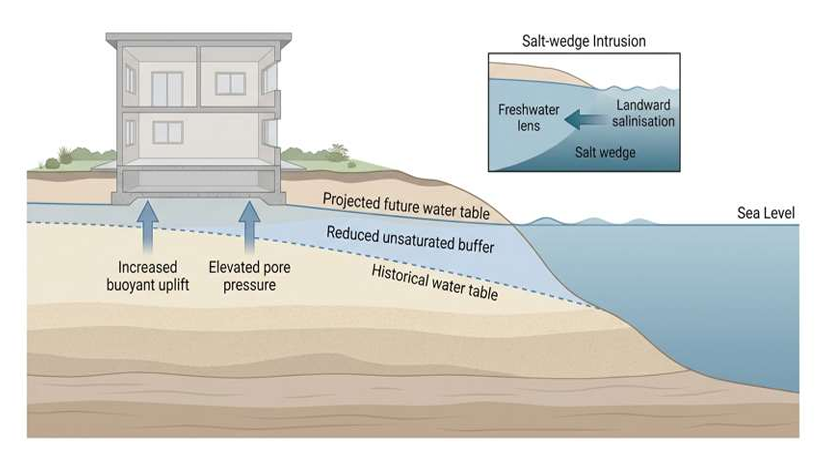
Results: Rising groundwater causes decrease in unsaturated buffer above foundations, enhances buoyant uplift, raises pore pressure, and speeds up chlorides-induced corrosion of substructure concrete and buried steel. Data from the USA, the Netherlands and the city of Lagos, Nigeria, demonstrates that these forces exacerbate low-lying deltaic cities' experience of land subsidence. A climate resilient foundation design framework is built on the foundation of the integrated borehole-cone penetration test (CPT) characterisation, new liquefaction and bearing-capacity correlations, ground improvement, and probabilistic uncertainty-aware design.
Conclusion: Coastal foundation engineering needs to move beyond the precepts of the past, relying on water-table assumptions, to one based on monitoring and knowledge of uncertainty, and prepared to face decades of groundwater rise.
References
1) Bosserelle AL, Morgan LK, Hughes MW. Groundwater rise and associated flooding in coastal settlements due to sea-level rise: a review of processes and methods. Earth's Future. 2022;10(7):e2021EF002580. doi:10.1029/2021EF002580
2) Habel S, Fletcher CH, Barbee MM, Fornace KL. Hidden threat: the influence of sea-level rise on coastal groundwater and the convergence of impacts on municipal infrastructure. Annu Rev Mar Sci. 2024;16:81–103. doi:10.1146/annurev-marine-020923-120737
3) Zamrsky D, Oude Essink GHP, Bierkens MFP. Global impact of sea level rise on coastal fresh groundwater resources. Earth's Future. 2024;12(1):e2023EF003581. doi:10.1029/2023EF003581
4) Richardson CM, Davis KL, Ruiz-González C, et al. The impacts of climate change on coastal groundwater. Nat Rev Earth Environ. 2024;5:100–119. doi:10.1038/s43017-023-00500-2
5) Seibert SL, Greskowiak J, Oude Essink GHP, Massmann G. Understanding climate change and anthropogenic impacts on the salinization of low-lying coastal groundwater systems. Earth's Future. 2024;12(8):e2024EF004737. doi:10.1029/2024EF004737
6) Xu D, Bisht G, Feng D, Tan Z, Li L, Qiu H, Leung LR. Impacts of sea-level rise on coastal groundwater table simulated by an Earth system model with a land-ocean coupling scheme. Earth's Future. 2024;12(8):e2024EF004479. doi:10.1029/2024EF004479
7) Ohenhen LO, Shirzaei M. Land subsidence hazard and building collapse risk in the coastal city of Lagos, West Africa. Earth's Future. 2022;10(9):e2022EF003219. doi:10.1029/2022EF003219
8) Hill K, Hirschfeld D, Lindquist C, Cook F, Warner S. Rising coastal groundwater as a result of sea-level rise will influence contaminated coastal sites and underground infrastructure. Earth's Future. 2023;11(9):e2023EF003825. doi:10.1029/2023EF003825
9) Rotta Loria AF. The silent impact of underground climate change on civil infrastructure. Commun Eng. 2023;2:44. doi:10.1038/s44172-023-00092-1
10) Alsaffar AK, Hamed R, Majeed ZH. A comprehensive analysis of groundwater inundation vulnerability and remediation for infrastructures. E3S Web Conf. 2023;427:04004. doi:10.1051/e3sconf/202342704004
11) Ali M, Shams MA, Bheel N, Almaliki AH, Mahmoud AS, Dodo YA, Benjeddou O. A review on chloride induced corrosion in reinforced concrete structures: lab and in situ investigation. RSC Adv. 2024;14(50):37252–37271. doi:10.1039/d4ra05506c
12) Ishola KS, Amu BD, Adeoti L. Evaluation of near-surface conditions for engineering site characterization using geophysical and geotechnical methods in Lagos, Southwestern Nigeria. NRIAG J Astron Geophys. 2022;11(1):237–256.
doi:10.1080/20909977.2022.2075160
13) Faseki OE. Geotechnical and geophysical evaluation of subsoils in Ikate area, southwestern Nigeria: implications on foundation integrity and corrosivity. Malays J Geosci. 2022;6(2):61–68. doi:10.26480/mjg.02.2022.61.68
14) Yao JC, Wang Y, Guan Z, Senetakis K. Cone penetration test (CPT)-based soil classification and stratification with consideration of data cross-correlation and noises. Acta Geotech. 2025;20(12):6537–6555. doi:10.1007/s11440-025-02732-6
15) Xie J, Zeng C, Huang J, Zhang Y, Lu J. A back analysis scheme for refined soil stratification based on integrating borehole and CPT data. Geosci Front. 2024;15(2):101688. doi:10.1016/j.gsf.2023.101688
16) Sodré DJR. Cone penetration index for soil behaviour type prediction. Sci Rep. 2022;12:12412. doi:10.1038/s41598-022-15994-x
17) Robertson PK. Evaluation of flow liquefaction and liquefied strength using the cone penetration test: an update. Can Geotech J. 2022;59(4):620–631. doi:10.1139/cgj-2021-0698
18) Zwara Ł, Bałachowski L. Prediction of pile shaft capacity in tension based on some direct CPT methods—Vistula Marshland test site. Materials. 2022;15(7):2426. doi:10.3390/ma15072426
19) Ahmed D, bt Taib SNL, Ayadat T, Hasan A. Numerical analysis of the carrying capacity of a piled raft foundation in soft clayey soils. Civil Eng J. 2022;8(4):622–636. doi:10.28991/CEJ-2022-08-04-01
20) Verma H, Ray A, Rai R, Gupta T, Mehta N. Ground improvement using chemical methods: a review. Heliyon. 2021;7(7):e07678. doi:10.1016/j.heliyon.2021.e07678
21) Wersäll C, Massarsch KR, Spross J. Heavy vibratory plate compaction of silty sand: a field study. Soils Found. 2022;62(5):101208. doi:10.1016/j.sandf.2022.101208
22) Baghbani A, Choudhury T, Costa S, Reiner J. Application of artificial intelligence in geotechnical engineering: a state-of-the-art review. Earth Sci Rev. 2022;228:103991. doi:10.1016/j.earscirev.2022.103991
23) Phoon KK, Cao Z, Ji J, Leung YF, Najjar S, Shuku T, Tang C, Yin ZY, Ikumasa Y, Ching J. Geotechnical uncertainty, modeling, and decision making. Soils Found. 2022;62(5):101189. doi:10.1016/j.sandf.2022.101189
24) Shimobe S, Spagnoli G. A general overview on the correlation of compression index of clays with some geotechnical index properties. Geotech Geol Eng. 2022;40:311–324. doi:10.1007/s10706-021-01888-8.
25) Abdelhafez MA, Ellingwood B, Mahmoud H. Hidden costs to building foundations due to sea level rise in a changing climate. Sci Rep. 2022;12(1):14020. doi:10.1038/s41598-022-18467-3
Downloads
Published
Issue
Section
License
Copyright (c) 2026 John Ayomide Olukoju, Micheal Abimbola Oladosu (Author)

This work is licensed under a Creative Commons Attribution 4.0 International License.