A Review of the Geometric Configuration of Urban Arterials and Its Role in Heat Island Intensification: A Thermal Flux Modelling Approach
DOI:
https://doi.org/10.65150/EP-gjetr/V2E6/2026-05Keywords:
Urban heat island, urban arterials, street canyon geometry, thermal flux modelling, CFD,, ENVI-met, urban morphology, thermal comfort.Abstract
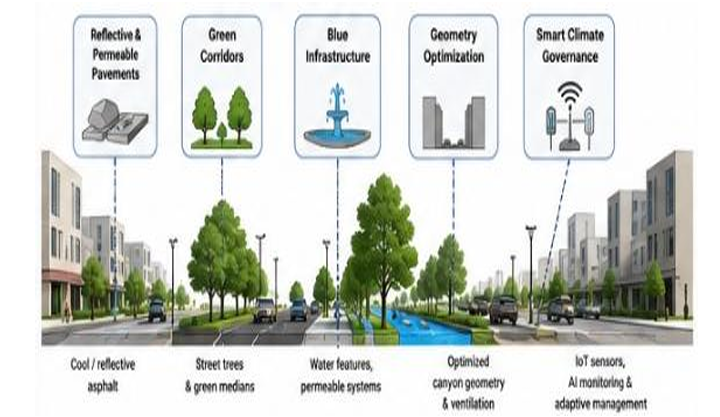
Urban heat island (UHI) intensification is still one of the most critical environmental issues induced by rapid urbanization and climate change. Urban arterial systems (boulevards, grid networks, radial corridors, multilane transportation canyons) can have a large impact on the modification of the urban thermal balance via changes in the surface energy exchange, anthropogenic heat release, flow obstruction and thermal storage. This review summarizes recent research on the geometric configuration of urban arterials and their contribution to UHI amplification using thermal flux modelling approaches published between 2020 and 2026. The paper investigates the effect of street orientation, canyon aspect ratio, sky-view factor, pavement materials, vegetation distribution and aerodynamic roughness on urban thermal regimes. Focus is on computational fluid dynamics (CFD), ENVI-met, mesoscale weather models, remote sensing techniques and machine-learning-assisted thermal simulations. The review summarizes the major mechanisms by which arterial geometry enhances thermal accumulation, including radiative trapping, suppression of turbulent heat exchange and retention of nighttime heat. Results show that compact canyon geometries, low albedo paving systems and poor ventilation corridors greatly enhance sensible heat flux and thermal discomfort. On the contrary, optimized geometries incorporating green infrastructure, reflective surfaces, permeable materials, and ventilation corridors reduce thermal load dramatically. The paper concludes with recommendations for future integrated urban thermal governance and resilient street design.
References
1) Ali-Toudert, F., & Mayer, H. (2020). Thermal comfort in urban street canyons. Theoretical and Applied Climatology, 142, 131-145. https://doi.org/10.1007/s00704-020-03264-4
2) Allegrini, J., Dorer, V., & Carmeliet, J. (2020). Coupled CFD, radiation and building energy model for studying urban microclimate. Building and Environment, 186, 107338. https://doi.org/10.1016/j.buildenv.2020.107338
3) Chatzidimitriou, A., & Yannas, S. (2021). Street canyon geometry and outdoor thermal comfort. Energy and Buildings, 231, 110615. https://doi.org/10.1016/j.enbuild.2020.110615
4) Chen, L., Ng, E., An, X., Ren, C., Lee, M., Wang, U., & He, Z. (2022). Sky view factor analysis of street canyons and thermal comfort. Urban Climate, 41, 101068. https://doi.org/10.1016/j.uclim.2021.101068
5) Duarte, D., Shinzato, P., Gusson, C., & Alves, C. (2020). The impact of vegetation on urban microclimate. Urban Forestry & Urban Greening, 48, 126561. https://doi.org/10.1016/j.ufug.2019.126561
6) Emmanuel, R., & Krüger, E. (2021). Urban heat island and its impact on climate change resilience. Urban Climate, 35, 100726. https://doi.org/10.1016/j.uclim.2020.100726
7) Fonseca, J., & Schlueter, A. (2021). Integrated modeling of urban energy and microclimate. Renewable and Sustainable Energy Reviews, 144, 110988. https://doi.org/10.1016/j.rser.2021.110988
8) Geletič, J., Lehnert, M., Dobrovolný, P., & Žuvela-Aloise, M. (2021). Spatial modeling of summer heat islands. Urban Climate, 37, 100857. https://doi.org/10.1016/j.uclim.2021.100857
9) He, B., Ding, L., & Prasad, D. (2020). Urban ventilation and cooling strategies. Building and Environment, 168, 106559. https://doi.org/10.1016/j.buildenv.2019.106559
10) He, X., Gou, Z., & Zhang, F. (2023). Urban canyon morphology and cooling efficiency of vegetation. Building and Environment, 236, 110261. https://doi.org/10.1016/j.buildenv.2023.110261
11) Huang, Y., & Lu, Y. (2020). The effects of urban form on neighborhood temperatures. Landscape and Urban Planning, 204, 103927. https://doi.org/10.1016/j.landurbplan.2020.103927
12) Kim, Y., Brown, R., & Kim, D. (2024). Integrated effect of aspect ratio and tree spacing on pedestrian thermal comfort. International Journal of Biometeorology, 68, 1023-1041. https://doi.org/10.1007/s00484-024-02735-0
13) Kotharkar, R., Bagade, A., & Ghosh, A. (2020). Urban street geometry and thermal comfort in tropical cities. Urban Climate, 34, 100718. https://doi.org/10.1016/j.uclim.2020.100718
14) Krayenhoff, E., Moustaoui, M., Broadbent, A., Gupta, V., & Georgescu, M. (2021). Diurnal interaction between urban expansion and heat waves. Nature Climate Change, 11, 714-720. https://doi.org/10.1038/s41558-021-01088-1
15) Lai, D., Liu, W., Gan, T., Liu, K., & Chen, Q. (2020). A review of mitigating strategies for urban heat island. Building and Environment, 185, 107239. https://doi.org/10.1016/j.buildenv.2020.107239
16) Lee, H., Mayer, H., & Schindler, D. (2021). Importance of wind corridors in urban climate adaptation. Urban Climate, 39, 100964. https://doi.org/10.1016/j.uclim.2021.100964
17) Li, X., Zhou, Y., Asrar, G., Imhoff, M., & Li, X. (2020). The surface urban heat island response to urban expansion. Science of the Total Environment, 709, 136234. https://doi.org/10.1016/j.scitotenv.2019.136234
18) Lin, B., Cho, Y., & Hsieh, C. (2021). Study of the thermal environment of sidewalks within varied urban road structures. Urban Forestry & Urban Greening, 62, 127137. https://doi.org/10.1016/j.ufug.2021.127137
19) Martilli, A., Krayenhoff, E., & Nazarian, N. (2020). Is the urban heat island intensity relevant for heat mitigation studies? Urban Climate, 31, 100541. https://doi.org/10.1016/j.uclim.2019.100541
20) Mauree, D., Naboni, E., Coccolo, S., Perera, A., Nik, V., & Scartezzini, J. (2020). A review of assessment methods for urban climate. Building and Environment, 177, 106917. https://doi.org/10.1016/j.buildenv.2020.106917
21) Middel, A., Chhetri, N., & Quay, R. (2021). Urban forestry and cooling potential in arid environments. Landscape and Urban Planning, 205, 103938. https://doi.org/10.1016/j.landurbplan.2020.103938
22) Mirzaei, P., & Haghighat, F. (2020). Urban microclimate analysis and thermal comfort. Building and Environment, 183, 107218. https://doi.org/10.1016/j.buildenv.2020.107218
23) Mohajerani, A., Bakaric, J., & Jeffrey-Bailey, T. (2020). The urban heat island effect and mitigation strategies. Journal of Environmental Management, 279, 111624. https://doi.org/10.1016/j.jenvman.2020.111624
24) Morakinyo, T., Dahanayake, K., Ng, E., & Chow, C. (2020). Temperature and cooling demand reduction by green roofs. Energy and Buildings, 210, 109724. https://doi.org/10.1016/j.enbuild.2019.109724
25) Nadeau, D., Brutsaert, W., Parlange, M., Bou-Zeid, E., & Barrenetxea, G. (2020). Aerodynamic roughness and urban heat exchange. Boundary-Layer Meteorology, 176, 307-327. https://doi.org/10.1007/s10546-020-00526-0
26) Nazarian, N., Kleissl, J., & Krayenhoff, E. (2020). Modeling microclimate in dense urban environments. Building and Environment, 171, 106634. https://doi.org/10.1016/j.buildenv.2019.106634
27) Oke, T., Mills, G., Christen, A., & Voogt, J. (2021). Urban Climates. Cambridge University Press. https://doi.org/10.1017/9781139016476
28) Palme, M., Lobato-Cordero, A., & Carrasco, C. (2021). Urban morphology and thermal comfort in arid cities. Sustainable Cities and Society, 68, 102774. https://doi.org/10.1016/j.scs.2021.102774
29) Park, J., Kim, H., & Lee, S. (2024). Urban canyon design with aspect ratio and street tree placement for enhanced thermal comfort. Buildings, 14(8), 2517. https://doi.org/10.3390/buildings14082517
30) Perini, K., & Magliocco, A. (2020). Effects of vegetation on urban thermal comfort. Energy Procedia, 78, 3156-3161. https://doi.org/10.1016/j.egypro.2020.11.675
31) Qaid, A., & Ossen, D. (2020). Effect of asymmetrical street canyons on thermal comfort. Sustainable Cities and Society, 52, 101839. https://doi.org/10.1016/j.scs.2019.101839
32) Reinbigler, M., Rouffet, R., Naylor, P., & Fetita, C. (2026). HeatMat: Simulation of city material impact on urban heat island effect. arXiv. https://arxiv.org/abs/2601.22796
33) Rizwan, A., Dennis, Y., & Liu, C. (2008). A review on the generation, determination and mitigation of urban heat island. Journal of Environmental Sciences, 20(1), 120-128. https://doi.org/10.1016/S1001-0742(08)60019-4
34) Rosenzweig, C., Solecki, W., Parshall, L., Chopping, M., Pope, G., & Goldberg, R. (2020). Characterizing the urban heat island in current and future climates. Environmental Research Letters, 15(3), 034023. https://doi.org/10.1088/1748-9326/ab6d7f
35) Sailor, D., Georgescu, M., Milne, J., & Hart, M. (2021). Development of a national anthropogenic heating database. Urban Climate, 36, 100784. https://doi.org/10.1016/j.uclim.2021.100784
36) Salamanca, F., Georgescu, M., Mahalov, A., Moustaoui, M., & Wang, M. (2020). Anthropogenic heating of urban environments. Nature Climate Change, 10, 992-1000. https://doi.org/10.1038/s41558-020-00900-8
37) Salvati, A., Coch Roura, H., & Cecere, C. (2021). Urban heat island and building energy performance. Energy and Buildings, 224, 110179. https://doi.org/10.1016/j.enbuild.2020.110179
38) Sangkakool, T., Techato, K., Zaman, R., & Brudermann, T. (2021). Thermal comfort and urban heat island. Heliyon, 7(1), e05981. https://doi.org/10.1016/j.heliyon.2021.e05981
39) Santamouris, M. (2020). Recent progress on urban overheating and heat island research. Energy and Buildings, 207, 109482. https://doi.org/10.1016/j.enbuild.2019.109482
40) Schneider, F., Ortiz, J., Vanos, J., & Sailor, D. (2023). Reflective pavement for urban heat mitigation in Arizona. Environmental Research Letters, 18(4), 044018. https://doi.org/10.1088/1748-9326/acc8fd
41) Sharifi, A., & Khavarian-Garmsir, A. (2020). The COVID-19 pandemic and urban resilience. Sustainable Cities and Society, 64, 102504. https://doi.org/10.1016/j.scs.2020.102504
42) Sharma, R., Ghosh, S., & Joshi, P. (2022). Urban street morphology and heat stress. Urban Climate, 43, 101157. https://doi.org/10.1016/j.uclim.2022.101157
43) Taleghani, M. (2021). Outdoor thermal comfort by urban geometry reshaping. Building and Environment, 187, 107394. https://doi.org/10.1016/j.buildenv.2020.107394
44) Tsoka, S., Tsikaloudaki, K., & Theodosiou, T. (2021). Urban green infrastructure and cooling performance. Sustainable Cities and Society, 74, 103208. https://doi.org/10.1016/j.scs.2021.103208
45) Wang, C., Middel, A., Myint, S., Kaplan, S., Brazel, A., & Lukasczyk, J. (2021). Assessing street-level heat exposure. Landscape and Urban Planning, 215, 104217. https://doi.org/10.1016/j.landurbplan.2021.104217
46) Wang, Y., Berardi, U., & Akbari, H. (2020). Comparing the effects of urban heat mitigation strategies. Solar Energy, 195, 1-9. https://doi.org/10.1016/j.solener.2019.11.020
47) Xue, Y., Zhao, Y., Mei, S., Chao, Y., & Carmeliet, J. (2023). Impact of street canyon morphology on heat and fluid flow. Building and Environment, 244, 110682. https://doi.org/10.1016/j.buildenv.2023.110682
48) Yang, J., Wong, M., Menenti, M., & Nichol, J. (2020). Modeling the effective thermal environment in urban canyons. Remote Sensing of Environment, 247, 111931. https://doi.org/10.1016/j.rse.2020.111931
49) Yang, X., Zhao, L., Bruse, M., & Meng, Q. (2021). Evaluation of ENVI-met for urban thermal studies. Building and Environment, 193, 107628. https://doi.org/10.1016/j.buildenv.2021.107628
50) Yao, R., Wang, L., Huang, X., Niu, Z., Liu, F., & Wang, Q. (2022). Remote sensing of urban heat islands. Remote Sensing of Environment, 270, 112855. https://doi.org/10.1016/j.rse.2021.112855
51) Yuan, C., Ng, E., & Norford, L. (2020). Improving air ventilation in high-density cities. Building and Environment, 181, 107093. https://doi.org/10.1016/j.buildenv.2020.107093
52) Zhang, Y., Murray, A., & Turner, B. (2021). Optimizing green space locations to reduce urban heat. Computers, Environment and Urban Systems, 86, 101584. https://doi.org/10.1016/j.compenvurbsys.2020.101584
53) Zhao, L., Oppenheimer, M., Zhu, Q., Baldwin, J., Ebi, K., Bou-Zeid, E., & Liu, X. (2021). Interactions between urban heat islands and heat waves. Nature Climate Change, 11, 109-117. https://doi.org/10.1038/s41558-020-00924-0
54) Zhou, B., Rybski, D., & Kropp, J. (2020). On the statistics of urban heat island intensity. Geophysical Research Letters, 47(7), e2019GL086420. https://doi.org/10.1029/2019GL086420
55) Zhu, R., Wong, N., Jusuf, S., & Ignatius, M. (2021). Influence of street canyon geometry on outdoor thermal comfort. Building Simulation, 14, 873-888. https://doi.org/10.1007/s12273-021-0762-5.
Downloads
Published
Issue
Section
License
Copyright (c) 2026 Emad H. Salih, Baydaa Hamdi Salih (Author)

This work is licensed under a Creative Commons Attribution 4.0 International License.