Experimental Investigation on Short Term Effect of Calcined Clay on Concrete Strength
DOI:
https://doi.org/10.65150/EP-gjetr/V2E7/2026-06Keywords:
Carbon dioxide emission, mix design, oxide composition, compressive strengthAbstract
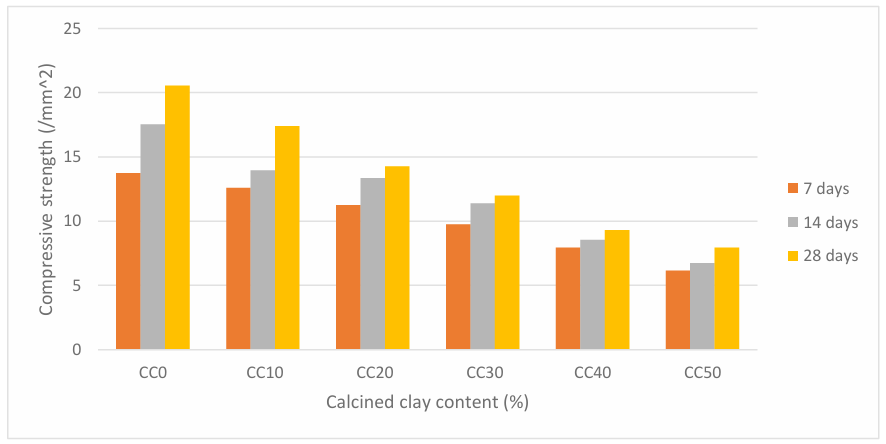
The cement and concrete industry faces amassed pressure to cut carbon dioxide emissions associated with cement production. One viable strategy is inclusion of supplemental resources to replace fractions of cement clinker. Calcined Clay (CC) has the potential to partially supplement cement and significantly reduce carbon dioxide emission. Therefore, the short term effect of CC on the strength of concrete incorporating CC is being examined. Natural clay was collected in Ekiti State, Nigeria and calcined at 750℃. Concrete was prepared by mixing sand, granite, cement, CC (varying proportions) and water manually using a developed mix design at 0.5 water binder ratio. The CC0 served as control, while other mixes were labelled CC10, CC20, CC30, CC40 and CC50. Laboratory tests conducted were determination of: oxide compositions of the CC, slump and density of wet concrete, and compressive strength of matured concrete at varying curing durations. Outcome on oxide composition shows that CC contains about 93.7 % of combined silica, alumina and ferrite. The slump ranges between 35-95 mm and decrease with increase in CC content. Wet density for all the mixes were comparable with control. Compressive strength at 28 days was comparable with control at medium replacement levels 10-20% while mixes with 40-50 % replacement recorded 54.8% and 61.3% reduction respectively compared to the control. Conclusively, CC can safely be included in concrete without compromising the strength capability of the concrete. Strides should be made towards the necessary standardization, validation that will encourage the market acceptance of CC as cement replacement.
References
1) Ahmed, A., Hyndman, F., Kamau, J., & Fitriani, H. (2020). Rice husk ash as a cement replacement in high strength sustainable concrete. Materials Science Forum, 1007 MSF, 90–98. https://doi.org/10.4028/www.scientific.net/MSF.1007.90
2) Ajagbe, W. O., Tijani, M. A., & Olulope, O. R. (2023). Strength and Abrasion Properties of Mortar Incorporating Groundnut Husk Ash as Partial Cement Replacement. Journal of Science and Engineering Production, 5(1), 570–584.
3) Amin, M. N., Ahmad, W., & Khan, K. (2022). Mapping Research Knowledge on Rice Husk Ash Application in Concrete : A Scientometric Review. 1–21.
4) ASTM C143 (2015). Standard test method for slump of hydraulic-cement concrete. America Standard of Testing Material International. 1916 Race Street, Philadelphia, 19103, USA
5) ASTM C618. (2008). Specification for Pozzolanas. America Standard of Testing Material International. 1916 Race Street, Philadelphia, 19103, USA
6) Avet, F., Li, X., Scrivener, K. L., and Müller, C. (2025). Calcined clay as a low-carbon cementitious material: Properties, performance and sustainability. Cement and Concrete Composites, 146, 105128. https://doi.org/10.1016/j.cemconcomp.2025.105128.
7) Benjeddou, O., Smaoui, N., and Bouaziz, J. (2025). Performance of calcined clay-based sustainable mortars. Scientific Reports, 15, 4342. https://doi.org/10.1038/s41598-025 04342-4
8) BS EN 12350-6 (2019). Methods for measuring compacted fresh concrete density. British Standard Institution. London.
9) Cheah, C. B., Liew, J. J., Khaw, K. L., Akil, H. and Alengaram, U. J. (2025). Calcined clay as a low-carbon cementitious material: Comprehensive review of treatment method, properties, and performance in concrete. Cleaner Waste Systems, 11, 100323. https://doi.org/10.1016/j.clwas.2025.100323
10) Kaminskas, R., Barauskas, I., Kubiliute, R., & Monstvilaite, D. (2020). The effect of the pozzolanic activity of different micro-fillers on portland cement hydration. 64(2), 145–154. https://doi.org/10.13168/cs.2020.0003
11) Martinez-Molina, W., Chavez-Garcia, H. L., Perez-Lopez, T., Alonso-Guzman, E. M., Arreola-Sanchez, M., Navarrete-Seras, M. A., Borrego-Perez, J. A., Sanchez-Calvillo, A., Guzman-Torres, J. A., & Perez-Quiroz, J. T. (2021). Effect of the addition of agribusiness and industrial wastes as a partial substitution of portland cement for the carbonation of mortars. Materials, 14(23). https://doi.org/10.3390/MA14237276
12) Mehta, A., & Siddique, R. (2018). Sustainable geopolymer concrete using ground granulated blast furnace slag and rice husk ash: Strength and permeability properties. Journal of Cleaner Production, 205, 49–57. https://doi.org/10.1016/j.jclepro.2018.08.313
13) Musbau, K. D., Kolawole, J. T., Babafemi, A. J., & Olalusi, O. B. (2021). Comparative performance of limestone calcined clay and limestone calcined laterite blended cement concrete. Cleaner Engineering and Technology, 4. https://doi.org/10.1016/j.clet.2021.100264
14) Olonade, K. A., Shamass, R., McCann, F., Abiodun, Y. O., Jin, R., Rossi, & Federico. (2023). Comparative Analyses of Circularity Practices in Civil. Nano World Journal, 9, 485–491. https://doi.org/https://doi.org/10.17756/nwj.2023-s2-082
15) Olulope, O. R. and Ajagbe, W. O. (2025). Engineering Properties of Agro Waste Ash-Cement Mortar Incorporating 0.5% Nano Silica. Iconic Research and Engineering Journals IRE Journals, 9 (1), pp. 368-372. ISSN: 2456-8880
16) Pillai, R. G., Gettu, R., & Santhanam, M. (2020). Use of supplementary cementitious materials (SCMs) in reinforced concrete systems – Benefits and limitations. Revista ALCONPAT, 10(2), 147–164. https://doi.org/10.21041/ra.v10i2.477
17) RILEM TC 282-CCL. (2021). Calcined clays for sustainable concrete: Production, properties and applications. Materials and Structures, 54, 207. https://doi.org/10.1617/s11527-021 01807-6
18) Schmidt, W., Commeh, M., Olonade, K., Schiewer, G. L., Dodoo-Arhin, D., Dauda, R., Fataei, S., Tawiah, A. T., Mohamed, F., Thiedeitz, M., Radebe, N. W., & Rogge, A. (2021). Sustainable circular value chains: From rural waste to feasible urban construction materials solutions. Developments in the Built Environment, 6, 100047. https://doi.org/10.1016/J.DIBE.2021.100047
19) Scrivener, K. L., Avet, F., Maraghechi, H., Zunino, F., Ston, J., Hanpongpun, W., and Favier, A. (2023). Limestone calcined clay cement (LC³): A review. Cement and Concrete Research, 164, 107018. https://doi.org/10.1016/j.cemconres.2023.107018
20) Tangchirapat, W., Jaturapitakkul, C., & Chindaprasirt, P. (2009). Use of palm oil fuel ash as a supplementary cementitious material for producing high-strength concrete. Construction and Building Materials, 23(7), 2641–2646. https://doi.org/10.1016/j.conbuildmat.2009.01.008
21) Thiedeitz, M., Schmidt, W., Härder, M., & Kränkel, T. (2020). Performance of rice husk ash as supplementary cementitious material after production in the field and in the lab. Materials, 13(19), 1–17. https://doi.org/10.3390/ma13194319
22) Zhang, Y., Li, Q., Wang, P., and Shi, C. (2024). Chloride transport and durability performance of calcined clay concrete: A review. Construction and Building Materials, 391, 131802. https://doi.org/10.1016/j.conbuildmat.2024.131802
23) Zhou, Y., Li, X., and Wang, Q. (2021). Pozzolanic performance of calcined clay in blended cement: Strength and durability study. Materials, 14(3), 654. https://doi.org/10.3390/ma14030654
24) Zunino, F., & Scrivener, K. L. (2023). Recent advances in understanding the hydration of limestone calcined clay cements ( LC 3). 2023.
Downloads
Published
Issue
Section
License
Copyright (c) 2026 Olulope, O. R., Ayeni, I. S., Popoola, O.O. (Author)

This work is licensed under a Creative Commons Attribution 4.0 International License.