Innovation in the Production of Tactile Paving (Guiding Block) from A Biochar Mixture as a Direction Indicator for Visually Impaired Individuals
DOI:
https://doi.org/10.65150/EP-gjetr/V2E6/2026-02Keywords:
Tactile Paving (Guiding Block), Biochar, Directional Indicators, Blind DisabilityAbstract
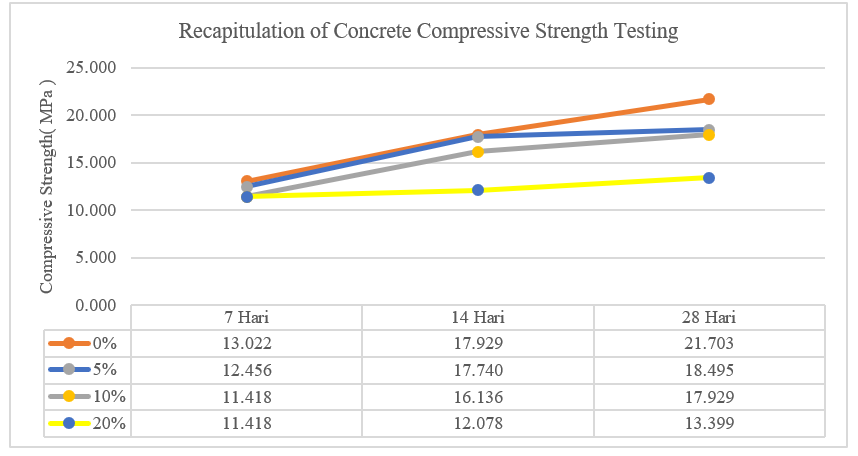
This research examines the innovation of creating tactile paving (guiding block) based on a biochar mixture as a directional aid for visually impaired individuals. Biochar is used as an additive to replace a portion of the sand volume with variations of 0%, 5%, 10%, and 20% relative to the concrete volume. The aim of the research is to evaluate the effect of adding biochar on the physical and mechanical properties of concrete, specifically compressive strength, water absorption, slump, and its suitability for non-structural tactile paving applications. The methods used include testing the characteristics of aggregates and biochar according to SNI, planning a concrete mix with a target strength of 25 MPa using the SNI 7656:2012 method, creating cylindrical test specimens of 15×30 cm, and testing slump, compressive strength at 7, 14, and 28 days, and water absorption at 28 days. The results show that the addition of biochar reduces the average compressive strength compared to normal concrete; at 28 days, the compressive strength of normal concrete is 21.703 MPa, while the variations of 5%, 10%, and 20% are 18.495 MPa, 17.929 MPa, and 13.399 MPa, respectively. Water absorption increased from 1.04% (0%) to 1.79% (20%), while the slump value decreased but remained within the planned range of 75–100 mm. Overall, biochar-based tactile paving with 5–10% variation still meets the compressive strength requirements for non-structural elements, while offering potential weight reduction and the use of environmentally friendly materials for accessible infrastructure for the visually impaired.
References
1) Abbas, A. A., & Thapa, S. J. (2025). Experimental Investigation of Low-Carbon Concrete Using Biochar as Partial Cement Replacement. Sustainability, 17(23), 10744. https://doi.org/10.3390/su172310744
2) Akhtar, A., & Sarmah, A. K. (2018). Novel biochar-concrete composites: Manufacturing, characterization and evaluation of the mechanical properties. Science of The Total Environment, 616–617, 408–416. https://doi.org/10.1016/j.scitotenv.2017.10.319
3) Aman, A. M. N., Selvarajoo, A., Lau, T. L., & Chen, W.-H. (2022). Biochar as Cement Replacement to Enhance Concrete Composite Properties: A Review. Energies, 15(20), 7662. https://doi.org/10.3390/en15207662
4) Aneja, A., Sharma, R. L., & Singh, H. (2022). Mechanical and durability properties of biochar concrete. Materials Today: Proceedings, 65, 3724–3730. https://doi.org/10.1016/j.matpr.2022.06.371
5) Barbhuiya, S., Bhusan Das, B., & Kanavaris, F. (2024). Biochar-concrete: A comprehensive review of properties, production and sustainability. Case Studies in Construction Materials, 20, e02859. https://doi.org/10.1016/j.cscm.2024.e02859
6) Chen, L., Zhang, Y., Wang, L., Ruan, S., Chen, J., Li, H., Yang, J., Mechtcherine, V., & Tsang, D. C. W. (2022). Biochar-augmented carbon-negative concrete. Chemical Engineering Journal, 431, 133946. https://doi.org/10.1016/j.cej.2021.133946
7) Diny Sujannah, W., Swastikawara, S., & Ningsih, Z. (2025). Advancing inclusive practices in higher education: insights from Indonesia’s approach to disability support. Cogent Social Sciences, 11(1). https://doi.org/10.1080/23311886.2025.2593559
8) Fernández González, J., & Gongal, A. (2022). Unidirectional Tactile Paving: Circulation for the Visually Impaired. In Studies in Health Technology and Informatics (Vol. 297, pp. 375–382). https://doi.org/10.3233/SHTI220863
9) Gupta, S., Kua, H. W., & Pang, S. D. (2020). Effect of biochar on mechanical and permeability properties of concrete exposed to elevated temperature. Construction and Building Materials, 234, 117338. https://doi.org/10.1016/j.conbuildmat.2019.117338
10) Haris Javed, M., Ali Sikandar, M., Ahmad, W., Tariq Bashir, M., Alrowais, R., & Bilal Wadud, M. (2022). Effect of various biochars on physical, mechanical, and microstructural characteristics of cement pastes and mortars. Journal of Building Engineering, 57, 104850. https://doi.org/https://doi.org/10.1016/j.jobe.2022.104850
11) Lin, X., Li, W., Guo, Y., Dong, W., Castel, A., & Wang, K. (2023). Biochar-cement concrete toward decarbonisation and sustainability for construction: Characteristic, performance and perspective. Journal of Cleaner Production, 419, 138219. https://doi.org/10.1016/j.jclepro.2023.138219
12) Ling, Y., Wu, X., Tan, K., & Zou, Z. (2023). Effect of Biochar Dosage and Fineness on the Mechanical Properties and Durability of Concrete. Materials, 16(7), 2809. https://doi.org/10.3390/ma16072809
13) Ma, W., Wang, Y., Huang, L., Yan, L., & Kasal, B. (2023). Natural and recycled aggregate concrete containing rice husk ash as replacement of cement: Mechanical properties, microstructure, strength model and statistical analysis. Journal of Building Engineering, 66, 105917. https://doi.org/https://doi.org/10.1016/j.jobe.2023.105917
14) Ma, Y., Gu, X., Zhang, W., Hu, S., Liu, H., Zhao, J., & Chen, S. (2021). Evaluating the effectiveness of crosswalk tactile paving on street-crossing behavior: A field trial study for people with visual impairment. Accident Analysis & Prevention, 163, 106420. https://doi.org/10.1016/j.aap.2021.106420
15) Ma, Y., Mo, S., Chen, S., Xing, G., Tang, K., Zhao, J., & Guo, Z. (2023). Evaluating the effectiveness of accessibility features for roadway users with visual impairment: A case study for Nanjing, China. Transportation Research Part F: Traffic Psychology and Behaviour, 97, 301–313. https://doi.org/10.1016/j.trf.2023.07.021
16) Maljaee, H., Madadi, R., Paiva, H., Tarelho, L., & Ferreira, V. M. (2021). Incorporation of biochar in cementitious materials: A roadmap of biochar selection. Construction and Building Materials, 283, 122757. https://doi.org/10.1016/j.conbuildmat.2021.122757
17) Murali, G., & Wong, L. S. (2024). A comprehensive review of biochar-modified concrete: Mechanical performance and microstructural insights. Construction and Building Materials, 425, 135986. https://doi.org/10.1016/j.conbuildmat.2024.135986
18) Paoleng, P., Kongsomsaksakul, S., Meepon, I., & Maneekaew, S. (2025). APPLICATION OF BIOCHAR AS PARTIAL CEMENT REPLACEMENT WITH POLYPROPYLENE PLASTIC WASTE FOR SUSTAINABLE CONCRETE PAVING BLOCKS. Cuestiones de Fisioterapia, 54(5), 4978–4991. https://doi.org/10.48047/vmsxaq82
19) Patel, R., Stobbs, J., & Acharya, B. (2025). Study of biochar in cementitious materials for developing green concrete composites. Scientific Reports,15(1), 22192.https://doi.org/10.1038/s41598-025-07210-3
20) Qin, Y., Pang, X., Tan, K., & Bao, T. (2021). Evaluation of pervious concrete performance with pulverized biochar as cement replacement. Cement and Concrete Composites, 119, 104022. https://doi.org/10.1016/j.cemconcomp.2021.104022
21) Raflis, Irfan Amrullah, & Syarif Hidayatullah. (2025). Kinerja Infrastruktur Pendukung Disabilitas di DKI Jakarta. Jurnal TESLINK : Teknik Sipil Dan Lingkungan, 7(1), 1–12. https://doi.org/10.52005/teslink.v7i1.561
22) Room, S., & Bahadori-Jahromi, A. (2024). Biochar-Enhanced Carbon-Negative and Sustainable Cement Composites: A Scientometric Review. Sustainability, 16(23), 10162. https://doi.org/10.3390/su162310162
23) Tan, K., Qin, Y., & Wang, J. (2022). Evaluation of the properties and carbon sequestration potential of biochar-modified pervious concrete. Construction and Building Materials, 314, 125648. https://doi.org/10.1016/j.conbuildmat.2021.125648
24) Xu, S., Yang, C., Ge, W., Yu, C., & Shi, Y. (2020). Virtual Paving. Proceedings of the ACM on Interactive, Mobile, Wearable and Ubiquitous Technologies, 4(3), 1–25. https://doi.org/10.1145/3411814
25) Zaid, O., Alsharari, F., & Ahmed, M. (2024). Utilization of engineered biochar as a binder in carbon negative cement-based composites: A review. Construction and Building Materials, 417, 135246. https://doi.org/10.1016/j.conbuildmat.2024.135246
26) Zhang, Y., Maierdan, Y., Guo, T., Chen, B., Fang, S., & Zhao, L. (2022). Biochar as carbon sequestration material combines with sewage sludge incineration ash to prepare lightweight concrete. Construction and Building Materials, 343, 128116. https://doi.org/10.1016/j.conbuildmat.2022.128116
27) Zhao, Z., El-Naggar, A., Kau, J., Olson, C., Tomlinson, D., & Chang, S. X. (2024). Biochar affects compressive strength of Portland cement composites: a meta-analysis. Biochar, 6(1), 21. https://doi.org/10.1007/s42773-024-00309-2
Downloads
Published
Issue
Section
License
Copyright (c) 2026 Muh. Jabir M, Ahmad Selao, Andry T, Gina, Muh. Alfi (Author)

This work is licensed under a Creative Commons Attribution 4.0 International License.