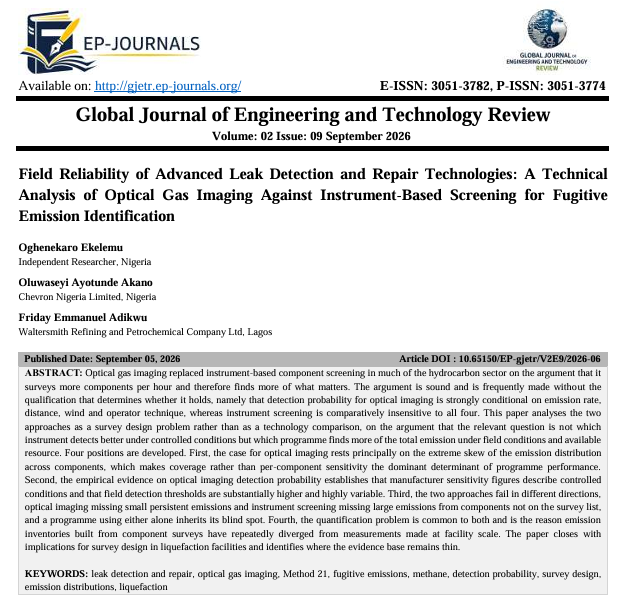
Field Reliability of Advanced Leak Detection and Repair Technologies: A Technical Analysis of Optical Gas Imaging Against Instrument-Based Screening for Fugitive Emission Identification
DOI:
https://doi.org/10.65150/EP-gjetr/V2E9/2026-06Keywords:
leak detection and repair, optical gas imaging, Method 21, fugitive emissions, methane, detection probability, survey design, emission distributions, liquefactionAbstract
Optical gas imaging replaced instrument-based component screening in much of the hydrocarbon sector on the argument that it surveys more components per hour and therefore finds more of what matters. The argument is sound and is frequently made without the qualification that determines whether it holds, namely that detection probability for optical imaging is strongly conditional on emission rate, distance, wind and operator technique, whereas instrument screening is comparatively insensitive to all four. This paper analyses the two approaches as a survey design problem rather than as a technology comparison, on the argument that the relevant question is not which instrument detects better under controlled conditions but which programme finds more of the total emission under field conditions and available resource. Four positions are developed. First, the case for optical imaging rests principally on the extreme skew of the emission distribution across components, which makes coverage rather than per-component sensitivity the dominant determinant of programme performance. Second, the empirical evidence on optical imaging detection probability establishes that manufacturer sensitivity figures describe controlled conditions and that field detection thresholds are substantially higher and highly variable. Third, the two approaches fail in different directions, optical imaging missing small persistent emissions and instrument screening missing large emissions from components not on the survey list, and a programme using either alone inherits its blind spot. Fourth, the quantification problem is common to both and is the reason emission inventories built from component surveys have repeatedly diverged from measurements made at facility scale. The paper closes with implications for survey design in liquefaction facilities and identifies where the evidence base remains thin.
References
1) Abdulhadi, B. M., & Hamdan, A. M. (2026a). Carbon-driven decision gates: Integrating embodied carbon accounting into construction project lifecycle governance. Research Journal of Pure Science and Technology, 9(5), 48-82.
2) Abdulhadi, B. M., & Hamdan, A. M. (2026b). Net-zero project delivery: A maturity model for carbon management capability in construction organizations. International Journal of Engineering and Modern Technology, 12(6), 199-233.
3) Abdulhadi, B. M., & Hamdan, A. M. (2026c). Sustainability-linked contracting and incentive alignment in integrated project delivery: A conceptual framework. International Journal of Social Sciences and Management Research, 12(6), 466-501.
4) Abioye, R. F., Okojie, J. S., Filani, O. M., Ike, P. N., Idu, J. O. O., Nnabueze, S. B., Okojokwu-Idu, J. O., & Ihwughwavwe, S. I. (2023). Automated ESG reporting in energy projects using blockchain-driven smart compliance management systems. International Journal of Multidisciplinary Evolutionary Research, 4(2), 120-129.
5) Abrahams, L. S., Samaras, C., Griffin, W. M., & Matthews, H. S. (2015). Life cycle greenhouse gas emissions from U.S. liquefied natural gas exports: Implications for end uses. Environmental Science and Technology, 49(5), 3237-3245.
6) Adebayo, A., Adegbite, M. P., & Ahmed, M. O. (2022). Adversarial machine learning in critical infrastructure: A conceptual framework for threat modeling AI enabled OT systems. World Journal of Innovation and Modern Technology, 6(1), 184-234.
7) Adebayo, A., Adegbite, M. P., & Ahmed, M. O. (2023). AI augmented threat detection in industrial control systems: A systematic review of machine learning approaches for ICS anomaly detection. International Journal of Engineering and Modern Technology, 9(3), 287-340.
8) Adegbite, M. P., Adebayo, A., & Ahmed, M. O. (2020). Securing operational technology networks in electric utilities: A systematic review of NERC CIP compliance and architectural threat mitigation. International Journal of Engineering and Modern Technology, 6(3), 103-146.
9) Adegbite, M. P., Adebayo, A., & Ahmed, M. O. (2022). A security architecture model for IT and OT convergence in regulated energy networks: Design principles and governance alignment. International Journal of Computer Science and Mathematical Theory, 8(2), 81-132.
10) Adegbite, M. P., Adebayo, A., & Ahmed, M. O. (2023). ICS and SCADA threat detection architectures in energy sector networks: A systematic review of SIEM, NDR, and anomaly detection approaches. World Journal of Innovation and Modern Technology, 7(2), 121-182.
11) Adegbite, M. P., Adebayo, A., & Ahmed, M. O. (2024a). A vulnerability governance architecture for power and utilities corporations: From exposure mapping to remediation verification. World Journal of Innovation and Modern Technology, 8(6), 185-246.
12) Adegbite, M. P., Adebayo, A., & Ahmed, M. O. (2024b). An AI driven security operations architecture for utility sector SOCs: Integrating threat intelligence, behavioral analytics, and automated response. International Journal of Engineering and Modern Technology, 10(11), 197-256.
13) Adegbite, M. P., Adebayo, A., & Ahmed, M. O. (2025). A cyber risk quantification and governance architecture for critical infrastructure: From posture measurement to executive reporting. International Journal of Computer Science and Mathematical Theory, 11(12), 232-293.
14) Adekoya, O. O., Adefemi, A., Tula, O. A., Umoh, A. A., & Gidiagba, J. O. (2024). A comprehensive review of liquefied natural gas (LNG) market dynamics. World Journal of Advanced Research and Reviews, 21(1), 58-74.
15) Adelanwa, A., Basnet, A., & Anene, U. N. (2023a). Data driven digital transformation models for lifecycle performance management in infrastructure delivery. International Journal of Advanced Multidisciplinary Research and Studies, 3(6), 2646-2662.
16) Adelanwa, A., Basnet, A., & Anene, U. N. (2023b). Predictive analytics models for financial risk detection and fraud prevention in public systems. International Journal of Advanced Multidisciplinary Research and Studies, 3(6).
17) Adelanwa, A., Basnet, A., & Anene, U. N. (2024). Performance intelligence models for optimization and outcome measurement in large scale public services. Shodhshauryam, International Scientific Refereed Research Journal, 6(1).
18) Adenuga, O. M. (2022). Smart grid architectures and energy distribution for high renewable penetration: A comprehensive review of technologies, operations, and deployment pathways. International Journal of Engineering and Modern Technology, 8(5), 125-155.
19) Adeyelu, O. O. (2018). A predictive compliance monitoring framework for detecting systemic safety risks through aviation consumer complaint data. Iconic Research and Engineering Journals, 1(8), 250-276.
20) Adeyelu, O. O. (2019). An adaptive safety management system implementation model for aerodromes in developing economy contexts. Iconic Research and Engineering Journals, 3(4), 628-654.
21) Adeyelu, O. O. (2022). A regulatory evidence framework for assessing unauthorized structure violations within protected airport obstacle limitation surfaces. International Journal of Scientific Research in Civil Engineering, 6(6), 248-283.
22) Adeyelu, O. O. (2026). A root-cause investigation framework for recurring runway wildlife hazards and standardized corrective action protocols at Nigerian international airports. International Journal of Social Sciences and Management Research, 12(5), 842-880.
23) Adeyelu, O. O., & Dagodzo, D. (2022). A comparative benchmarking model for aerodrome certification compliance across developing economy civil aviation authorities. International Journal of Multidisciplinary Research and Growth Evaluation, 3(6), 1016-1035.
24) Adeyelu, O. O., & Dagodzo, D. (2024a). A maturity model for predicting airport safety audit outcomes in resource-constrained regulatory environments. International Journal of Scientific Research in Civil Engineering, 8(4), 132-170.
25) Adeyelu, O. O., & Dagodzo, D. (2024b). Advances in artificial intelligence and data-driven wildlife hazard monitoring and incident reduction at international airports in West Africa. International Journal of Scientific Research in Science and Technology, 11(5), 872-910.
26) Adikwu, F. E., Ozobu, C. O., Odujobi, O., Onyekwe, F. O., & Nwulu, E. O. (2023). Advances in EHS compliance: A conceptual model for standardizing health, safety, and hygiene programs across multinational corporations. IRE Journals, 7(5), 360-372.
27) Agbabiaka, J., Okonkwo, C. S., Ogunwole, O., Mayo, W., & Okeke, O. T. (2019). Supply chain risk management model for EPC and gas processing projects. Iconic Research and Engineering Journals, 3(2), 968-980.
28) Ahmed, M. O., Adegbite, M. P., & Adebayo, A. (2021). Zero trust architecture for operational technology in North American critical infrastructure: A framework for implementation and resilience optimization. International Journal of Engineering and Modern Technology, 7(1), 66-113.
29) Aifuwa, S. E., Oshoba, T. O., Ogbuefi, E., Ike, P. N., Nnabueze, S. B., & Olatunde-Thorpe, J. (2020). Predictive analytics models enhancing supply chain demand forecasting accuracy and reducing inventory management inefficiencies. International Journal of Multidisciplinary Research and Growth Evaluation, 1(3), 171-181.
30) Akin-Oluyomi, O. T., Atima, M. E., & Akinleye, O. K. (2023a). Green procurement strategies for balancing cost efficiency with long-term environmental responsibility. International Journal of Advanced Multidisciplinary Research and Studies, 3(6), 2183-2193.
31) Akin-Oluyomi, O. T., Okoruwa, P. O., Babatope, O. M., & Akokodaripon, D. A. (2023). Evaluating supplier sustainability metrics through data-driven procurement and supply chain frameworks. International Journal of Advanced Multidisciplinary Research and Studies, 3(6), 2213-2223.
32) Aliliele, C., Mbonu, I. S., & Iwuanyanwu, U. (2023a). A conceptual framework for continuous cloud misconfiguration monitoring and enterprise risk mitigation strategies. International Journal of Scientific Research in Computer Science, Engineering and Information Technology, 9(10), 373-394.
33) Aliliele, C., Mbonu, I. S., & Iwuanyanwu, U. (2024a). A conceptual framework for enterprise data sensitivity classification and regulatory traceability mechanisms. International Journal of Advanced Multidisciplinary Research and Studies, 4(6), 3103-3124.
34) Allen, D. T. (2014). Atmospheric emissions and air quality impacts from natural gas production and use. Annual Review of Chemical and Biomolecular Engineering, 5, 55-75.
35) Allen, D. T., Pacsi, A. P., Sullivan, D. W., Zavala-Araiza, D., Harrison, M., Keen, K., Fraser, M. P., Hill, A. D., Sawyer, R. F., & Seinfeld, J. H. (2015a). Methane emissions from process equipment at natural gas production sites in the United States: Pneumatic controllers. Environmental Science and Technology, 49(1), 633-640.
36) Allen, D. T., Sullivan, D. W., Zavala-Araiza, D., Pacsi, A. P., Harrison, M., Keen, K., Fraser, M. P., Hill, A. D., Lamb, B. K., Sawyer, R. F., & Seinfeld, J. H. (2015b). Methane emissions from process equipment at natural gas production sites in the United States: Liquid unloadings. Environmental Science and Technology, 49(1), 641-648.
37) Allen, D. T., Torres, V. M., Thomas, J., Sullivan, D. W., Harrison, M., Hendler, A., Herndon, S. C., Kolb, C. E., Fraser, M. P., Hill, A. D., Lamb, B. K., Miskimins, J., Sawyer, R. F., & Seinfeld, J. H. (2013). Measurements of methane emissions at natural gas production sites in the United States. Proceedings of the National Academy of Sciences, 110(44), 17768-17773.
38) Allen, M. R., Fuglestvedt, J. S., Shine, K. P., Reisinger, A., Pierrehumbert, R. T., & Forster, P. M. (2016). New use of global warming potentials to compare cumulative and short-lived climate pollutants. Nature Climate Change, 6(8), 773-776.
39) Alvarez, R. A., Pacala, S. W., Winebrake, J. J., Chameides, W. L., & Hamburg, S. P. (2012). Greater focus needed on methane leakage from natural gas infrastructure. Proceedings of the National Academy of Sciences, 109(17), 6435-6440.
40) Alvarez, R. A., Zavala-Araiza, D., Lyon, D. R., Allen, D. T., Barkley, Z. R., Brandt, A. R., Davis, K. J., Herndon, S. C., Jacob, D. J., Karion, A., Kort, E. A., Lamb, B. K., Lauvaux, T., Maasakkers, J. D., Marchese, A. J., Omara, M., Pacala, S. W., Peischl, J., Robinson, A. L., Shepson, P. B., Sweeney, C., Townsend-Small, A., Wofsy, S. C., & Hamburg, S. P. (2018). Assessment of methane emissions from the U.S. oil and gas supply chain. Science, 361(6398), 186-188.
41) Amayo, E. B., Owulade, O. A., & Isi, L. R. (2023a). Optimizing project governance in multinational infrastructure projects: Insights from General Electric's global operations. International Journal of Multidisciplinary Research and Growth Evaluation, 4(1), 975-983.
42) Amayo, E. B., Owulade, O. A., & Isi, L. R. (2023b). Risk management strategies and compliance frameworks in healthcare infrastructure projects: Case studies from West Africa. International Journal of Management and Organizational Research, 2(1), 161-168.
43) Amayo, E. B., Owulade, O. A., & Isi, L. R. (2024a). Best practices for managing data center lifecycle projects: Ensuring security, efficiency, and compliance in U.S. enterprises. Iconic Research and Engineering Journals, 7(7), 598-617.
44) Amayo, E. B., Owulade, O. A., & Isi, L. R. (2024b). Effective project governance in multinational infrastructure projects: A case study from General Electric. Iconic Research and Engineering Journals, 8(5), 1305-1324.
45) Ambali, K. B., Eyetsemitan, R. A., Oyeleye, A. O., & Fadayomi, O. (2021). Lean Six Sigma for small enterprises: A systematic review and Lite-DMAIC adaptation framework for resource-constrained organizations. Iconic Research and Engineering Journals, 5(5), 562-583.
46) American Petroleum Institute. (2014). Pressure-relieving and depressuring systems (API Standard 521, 6th ed.). API Publishing Services.
47) American Petroleum Institute. (2016). Process safety performance indicators for the refining and petrochemical industries (API Recommended Practice 754, 2nd ed.). API Publishing Services.
48) American Petroleum Institute. (2020). Flare details for general refinery and petrochemical service (API Standard 537, 4th ed.). API Publishing Services.
49) Anene, U. N., & Clement, T. (2022). A resilient logistics framework for humanitarian supply chains: Integrating predictive analytics, IoT, and localized distribution to strengthen emergency response systems. International Journal of Scientific Research in Computer Science, Engineering and Information Technology, 8(5), 398-424.
50) Arumosoye, O. M., & Obriki, O. D. (2018). Development of an integrated heat stress risk conceptual model for industrial operations in extreme environments. Iconic Research and Engineering Journals, 1(12), 141-160.
51) Arumosoye, O. M., & Obriki, O. D. (2019). Systematic review of near-miss and hazard observation data utilization in industrial safety management. Iconic Research and Engineering Journals, 3(2), 981-999.
52) Arumosoye, O. M., & Obriki, O. D. (2020). A governance-oriented conceptual model for contractor safety performance in multi-contract industrial projects. International Journal of Multidisciplinary Research and Growth Evaluation, 1(5), 728-740.
53) Arumosoye, O. M., & Obriki, O. D. (2021). Organizational learning-based conceptual maturity model for continuous safety performance improvement. International Journal of Multidisciplinary Research and Growth Evaluation, 2(1), 970-980.
54) Arumosoye, O. M., & Obriki, O. D. (2022). Conceptual risk pathway model for lifting and rigging operations in heavy industrial construction. Gyanshauryam, International Scientific Refereed Research Journal, 5(5), 346-369.
55) Arumosoye, O. M., & Obriki, O. D. (2023). Conceptual model for emergency response readiness and capability in energy and process facilities. International Journal of Scientific Research in Computer Science, Engineering and Information Technology, 9(3), 897-917.
56) Arumosoye, O. M., & Obriki, O. D. (2024). Conceptual model of safety leadership influence in large temporary project organizations. International Journal of Advanced Multidisciplinary Research and Studies, 4(6), 3034-3047.
57) Arumosoye, O. M., Obriki, O. D., & Ozobu, C. O. (2025). Conceptual framework for environmental risk control and ESG performance through waste handling and operational discipline. Gyanshauryam, International Scientific Refereed Research Journal, 8(4), 177-198.
58) Arumosoye, O. M., Obriki, O. D., & Ozobu, C. O. (2026). Systematic review of predictive safety analytics applications in LNG projects with ESG implications. Global Journal of Engineering and Technology Review, 2(2), 61-73.
59) Asiedu, W., & Quainoo, R. (2023a). How far can energy harvesting take us? A systematic review of radio frequency strategies for energy autonomous sensing. Shodhshauryam, International Scientific Refereed Research Journal, 6(1), 448-466.
60) Asiedu, W., & Quainoo, R. (2023b). Toward maintenance free wireless infrastructure: Simulating performance and reliability in large scale intermittently powered IoT networks. Gyanshauryam, International Scientific Refereed Research Journal, 6(1), 489-510.
61) Asiedu, W., & Quainoo, R. (2024). Rethinking energy, reliability, and latency trade-offs in green communication for next generation IoT. International Journal of Multidisciplinary Research and Growth Evaluation, 5(6), 1987-1994.
62) Asiedu, W., & Quainoo, R. (2025). GleanCast: Epoch-aligned reliable broadcast in batteryless intermittent sensor networks. International Journal of Engineering and Modern Technology, 11(12), 205-218.
63) Asiedu, W., Quainoo, R., & Asiedu, A. (2025). A conceptual framework for characterizing fundamental energy, reliability, and latency trade-offs in green communication paradigms for next-generation IoT. International Journal of Advanced Multidisciplinary Research and Studies, 5(6), 2447-2453.
64) Asiedu, W., Quainoo, R., & Asiedu, A. (2026). Predictive power management for intermittent IoT devices using lightweight machine learning under uncertain energy harvest. Gulf Journal of Engineering and Technology, 2(4), 108-118.
65) Atakpa, M. I., Abolaji, T. O., & Abetoh, N. F. (2024). Statistical time-series models for long-range public health trend forecasting: A review and conceptual framework. International Journal of Scientific Research in Computer Science, Engineering and Information Technology, 10(6), 2748-2780.
66) Atakpa, M. I., & Fobellah, A. N. (2023). Anomaly detection in financial time-series data: A conceptual model for healthcare and banking applications. International Journal of Scientific Research in Computer Science, Engineering and Information Technology, 9(2), 967-997.
67) Atta, S. (2026a). Instability patterns in optoelectronic heterojunctions in GeS nanowires. MRS Bulletin, 51, 643.
68) Atta, S. (2026b). Unraveling spray pyrolysis mechanisms: Droplet dynamics and film formation in CdTe thin-film photocathodes. Manuscript in preparation.
69) Atta, S., Adjaklo, E., Asomani, E., & Adenuga, O. M. (2022). Advances in welding inspection standards and quality assurance practices in large-scale power generation projects. International Journal of Engineering and Modern Technology, 8(5), 101-124.
70) Atta, S., Asomani, E., & Adenuga, O. M. (2018). A systematic review of green corrosion inhibitors from agricultural extracts for mild steel protection in acidic and alkaline media. International Journal of Engineering and Modern Technology, 4(1), 64-97.
71) Atta, S., Kerubo, M. L., Sabisa, N. E., Adu-Gyamfi, D., Appiah, S., & Onyishi, E. (2025). Environmental corrosion and long-term degradation of crystalline silicon solar cells: Mechanisms, climate effects and mitigation strategies. Current Journal of Applied Science and Technology, 44(10), 9-18.
72) Atta, S., Onyishi, E. E., Appiah, S. A., & Adenuga, O. M. (2024). Theoretical analysis of charge transport and recombination losses in thin film solar cell architectures. International Journal of Engineering and Modern Technology, 10(10), 147-170.
73) Atta, S., Tofah, P., & Adenuga, O. M. (2021). Advances in non-destructive testing methods for weld integrity evaluation in high-capacity power infrastructure. International Journal of Engineering and Modern Technology, 7(1), 20-47.
74) Atta, S., Tofah, P., Kankam, M. A., & Adenuga, O. M. (2020). A critical review of NDT-based integrity management and corrosion risk assessment strategies for refinery process equipment. International Journal of Engineering and Modern Technology, 6(2), 19-46.
75) Azeez, L. O., & Badmus, O. (2024b). Predictive analytical framework for identifying vapor intrusion risks across urban redevelopment zones. International Journal of Scientific Research in Humanities and Social Sciences, 1(1), 524-555.
76) Badmus, A. L. O. (2025). Integrated predictive and remote-sensing framework for early warning and regulatory compliance in environmentally sensitive urban zones. IIARD International Journal of Geography and Environmental Management, 11(12), 212-239.
77) Bagavathiappan, S., Lahiri, B. B., Saravanan, T., Philip, J., & Jayakumar, T. (2013). Infrared thermography for condition monitoring: A review. Infrared Physics and Technology, 60, 35-55.
78) Balcombe, P., Anderson, K., Speirs, J., Brandon, N., & Hawkes, A. (2017). The natural gas supply chain: The importance of methane and carbon dioxide emissions. ACS Sustainable Chemistry and Engineering, 5(1), 3-20.
79) Balcombe, P., Brandon, N. P., & Hawkes, A. D. (2018). Characterising the distribution of methane and carbon dioxide emissions from the natural gas supply chain. Journal of Cleaner Production, 172, 2019-2032.
80) Bell, C., Vaughn, T., & Zimmerle, D. (2020). Evaluation of next generation emission measurement technologies under repeatable test protocols. Elementa: Science of the Anthropocene, 8, 32.
81) Bourrier, M. (1996). Organizing maintenance work at two American nuclear power plants. Journal of Contingencies and Crisis Management, 4(2), 104-112.
82) Brandt, A. R., Heath, G. A., & Cooley, D. (2016). Methane leaks from natural gas systems follow extreme distributions. Environmental Science and Technology, 50(22), 12512-12520.
83) Brandt, A. R., Heath, G. A., Kort, E. A., O'Sullivan, F., Pétron, G., Jordaan, S. M., Tans, P., Wilcox, J., Gopstein, A. M., Arent, D., Wofsy, S., Brown, N. J., Bradley, R., Stucky, G. D., Eardley, D., & Harriss, R. (2014). Methane leaks from North American natural gas systems. Science, 343(6172), 733-735.
84) Carroll, J. S. (1998). Organizational learning activities in high-hazard industries. Journal of Management Studies, 35(6), 699-717.
85) Caulton, D. R., Shepson, P. B., Cambaliza, M. O. L., McCabe, D., Baum, E., & Stirm, B. H. (2014). Methane destruction efficiency of natural gas flares associated with shale formation wells. Environmental Science and Technology, 48(16), 9548-9554.
86) Center for Chemical Process Safety. (2007). Guidelines for risk based process safety. Wiley.
87) Center for Chemical Process Safety & Energy Institute. (2018). Bow ties in risk management: A concept book for process safety. Wiley.
88) Chen, Y., Sherwin, E. D., Berman, E. S. F., Jones, B. B., Gordon, M. P., Wetherley, E. B., Kort, E. A., & Brandt, A. R. (2022). Quantifying regional methane emissions in the New Mexico Permian Basin with a comprehensive aerial survey. Environmental Science and Technology, 56(7), 4317-4323.
89) Chou, J. (2000). Hazardous gas monitors: A practical guide to selection, operation and applications. McGraw-Hill.
90) Coward, H. F., & Jones, G. W. (1952). Limits of flammability of gases and vapors (Bulletin 503). United States Bureau of Mines.
91) Crowl, D. A., & Louvar, J. F. (2011). Chemical process safety: Fundamentals with applications (3rd ed.). Prentice Hall.
92) Cusworth, D. H., Duren, R. M., Thorpe, A. K., Olson-Duvall, W., Heckler, J., Chapman, J. W., Eastwood, M. L., Helmlinger, M. C., Green, R. O., Asner, G. P., Dennison, P. E., & Miller, C. E. (2021). Intermittency of large methane emitters in the Permian Basin. Environmental Science and Technology Letters, 8(7), 567-573.
93) Dagodzo, D. (2018a). A conceptual framework for UAV integration into national power grid inspection programs. Iconic Research and Engineering Journals, 2(5), 391-412.
94) Dagodzo, D. (2018b). A review of UAV applications in electrical transmission line inspection: Methods, technologies, and challenges. Iconic Research and Engineering Journals, 2(6), 234-254.
95) Dagodzo, D., & Ahiaeke Patrick, M. C. (2020). UAV-based pipeline and corridor monitoring: A review of current practices and emerging technologies. IRE Journals, 3(10), 574-597.
96) Dagodzo, D., & Ahiaeke Patrick, M. C. (2021a). A review of GIS applications in utility asset management and infrastructure planning. Iconic Research and Engineering Journals, 5(3), 468-492.
97) Dagodzo, D., & Ahiaeke Patrick, M. C. (2021b). An integrated framework for UAV, LiDAR, and GIS in infrastructure corridor management. International Journal of Scientific Research in Computer Science, Engineering and Information Technology, 7(5), 497-524.
98) Dagodzo, D., & Ahiaeke Patrick, M. C. (2022). A review of right-of-way encroachment detection methods using geospatial technologies. International Journal of Scientific Research in Computer Science, Engineering and Information Technology, 8(1), 638-667.
99) Dagodzo, D., & Ahiaeke Patrick, M. C. (2023a). A framework for integrating drone operations into enterprise GIS systems for utility companies. International Journal of Scientific Research in Computer Science, Engineering and Information Technology, 9(4), 924-957.
100) Dagodzo, D., & Ahiaeke Patrick, M. C. (2023b). A review of UAV regulatory frameworks in developing economies: Progress, gaps, and recommendations. International Journal of Scientific Research in Computer Science, Engineering and Information Technology, 9(4), 958-994.
101) Dagodzo, D., & Ahiaeke Patrick, M. C. (2025). A framework for national-scale UAV deployment in power infrastructure: Lessons from developing economies. International Journal of Scientific Research in Computer Science, Engineering and Information Technology, 11(4), 779-824.
102) Dagodzo, D., Ahiaeke Patrick, M. C., & Aliliele, C. (2022). AI and deep learning for vegetation classification in power corridor management: A review. International Journal of Scientific Research in Computer Science, Engineering and Information Technology, 8(1), 668-698.
103) Digitemie, W. N., Onyeke, F. O., Adewoyin, M. A., & Dienagha, I. N. (2025). Implementing circular economy principles in oil and gas: Addressing waste management and resource reuse for sustainable operations. International Journal of Multidisciplinary Research and Growth Evaluation, 6(1), 99-104.
104) Duren, R. M., Thorpe, A. K., Foster, K. T., Rafiq, T., Hopkins, F. M., Yadav, V., Bue, B. D., Thompson, D. R., Conley, S., Colombi, N. K., Frankenberg, C., McCubbin, I. B., Eastwood, M. L., Falk, M., Herner, J. D., Croes, B. E., Green, R. O., & Miller, C. E. (2019). California methane super-emitters. Nature, 575(7781), 180-184.
105) Edivri, J., & Oteri, O. (2022). Predictive capacity planning and resource utilization forecasting models for multi-program and multi-stakeholder IT portfolios. International Journal of Scientific Research in Computer Science, Engineering and Information Technology, 8(4), 826-845.
106) Edivri, J., & Oteri, O. (2024). A conceptual KPI-driven decision and optimization framework for IT service delivery, portfolio performance, and adoption. Gyanshauryam, International Scientific Refereed Research Journal, 7(1), 167-187.
107) Elvidge, C. D., Zhizhin, M., Baugh, K., Hsu, F.-C., & Ghosh, T. (2016). Methods for global survey of natural gas flaring from Visible Infrared Imaging Radiometer Suite data. Energies, 9(1), 14.
108) European Union. (2024). Regulation (EU) 2024/1787 of the European Parliament and of the Council of 13 June 2024 on the reduction of methane emissions in the energy sector and amending Regulation (EU) 2019/942. Official Journal of the European Union, L, 2024/1787.
109) Eyetsemitan, R. A., Oyeleye, A. O., Ambali, K. B., & Fadayomi, O. (2022). Standard operating procedures as strategic assets in small business operations: A systematic review and implementation framework. Gyanshauryam, International Scientific Refereed Research Journal, 5(2), 438-465.
110) Eyetsemitan, R. A., Oyeleye, A. O., Ambali, K. B., & Fadayomi, O. (2024b). Data-driven process optimization in micro-enterprises: A conceptual framework for funnel analysis and bottleneck identification. International Journal of Multidisciplinary Research and Growth Evaluation, 5(6), 1950-1968.
111) Falegan, O. C., & Aniebonam, S. O. (2022). Conceptual framework for lifecycle risk assessment in offshore produced water management. Gyanshauryam, International Scientific Refereed Research Journal, 5(5), 322-345.
112) Falegan, O. C., & Aniebonam, S. O. (2023). Integrated physicochemical and bio-based treatment strategies for produced water in arid environments: A review. Gyanshauryam, International Scientific Refereed Research Journal, 6(1), 425-443.
113) Falegan, O. C., & Aniebonam, S. O. (2024). Decentralized produced water treatment systems for remote energy assets: A conceptual design framework. International Journal of Scientific Research in Computer Science, Engineering and Information Technology, 10(3), 1133-1151.
114) Falegan, O. C., & Aniebonam, S. O. (2025). Resource recovery and beneficial reuse of produced water in energy operations: A review of sustainable pathways. International Journal of Advanced Multidisciplinary Research and Studies, 5(6), 1959-1969.
115) Falegan, O. C., & Aniebonam, S. O. (2026). Data-driven performance optimization of produced water treatment infrastructure: A conceptual modeling approach. Engineering and Technology Journal, 11(1), 8764-8777.
116) Fox, T. A., Barchyn, T. E., Risk, D., Ravikumar, A. P., & Hugenholtz, C. H. (2019). A review of close-range and screening technologies for mitigating fugitive methane emissions in upstream oil and gas. Environmental Research Letters, 14(5), 053002.
117) Frankenberg, C., Thorpe, A. K., Thompson, D. R., Hulley, G., Kort, E. A., Vance, N., Borchardt, J., Krings, T., Gerilowski, K., Sweeney, C., Conley, S., Bue, B. D., Aubrey, A. D., Hook, S., & Green, R. O. (2016). Airborne methane remote measurements reveal heavy-tail flux distribution in Four Corners region. Proceedings of the National Academy of Sciences, 113(35), 9734-9739.
118) Gvakharia, A., Kort, E. A., Brandt, A., Peischl, J., Ryerson, T. B., Schwarz, J. P., Smith, M. L., & Sweeney, C. (2017). Methane, black carbon, and ethane emissions from natural gas flares in the Bakken Shale, North Dakota. Environmental Science and Technology, 51(9), 5317-5325.
119) Hale, A. (2009). Why safety performance indicators? Safety Science, 47(4), 479-480.
120) Hale, A. R., Guldenmund, F. W., van Loenhout, P. L. C. H., & Oh, J. I. H. (2010). Evaluating safety management and culture interventions to improve safety. Safety Science, 48(8), 1026-1035.
121) Health and Safety Executive. (2006). Developing process safety indicators: A step-by-step guide for chemical and major hazard industries (HSG254). HSE Books.
122) Hollnagel, E. (2004). Barriers and accident prevention. Ashgate.
123) Hollnagel, E. (2009). The ETTO principle: Efficiency-thoroughness trade-off. Ashgate.
124) Hu, Z., Tariq, S., & Zayed, T. (2021). A comprehensive review of acoustic based leak localization method in pressurized pipelines. Mechanical Systems and Signal Processing, 161, 107994.
125) Ike, P. N., Aifuwa, S. E., Nnabueze, S. B., Olatunde-Thorpe, J., Ogbuefi, E., Oshoba, T. O., & Akokodaripon, D. (2024a). Quantitative risk architecture for public-private partnerships: A multi-layered model for allocating public and private risk. International Journal of Advanced Multidisciplinary Research and Studies, 4(6), 2669-2682.
126) Ike, P. N., Okojie, J. S., Nnabueze, S. B., Idu, J. O. O., Filani, O. M., & Ihwughwavwe, S. I. (2025). Digital twin-driven environmental compliance models for sustainable procurement in oil, gas, and utilities. International Journal of Advanced Multidisciplinary Research and Studies, 5(5), 562-576.
127) Intergovernmental Panel on Climate Change. (2021). Climate change 2021: The physical science basis. Cambridge University Press.
128) International Electrotechnical Commission. (2016). Functional safety: Safety instrumented systems for the process industry sector (IEC 61511). IEC.
129) Ismail, O. S., & Umukoro, G. E. (2012). Global impact of gas flaring. Energy and Power Engineering, 4(4), 290-302.
130) Jacob, D. J., Turner, A. J., Maasakkers, J. D., Sheng, J., Sun, K., Liu, X., Chance, K., Aben, I., McKeever, J., & Frankenberg, C. (2016). Satellite observations of atmospheric methane and their value for quantifying methane emissions. Atmospheric Chemistry and Physics, 16(22), 14371-14396.
131) Jacob, D. J., Varon, D. J., Cusworth, D. H., Dennison, P. E., Frankenberg, C., Gautam, R., Guanter, L., Kelley, J., McKeever, J., Ott, L. E., Poulter, B., Qu, Z., Thorpe, A. K., Worden, J. R., & Duren, R. M. (2022). Quantifying methane emissions from the global scale down to point sources using satellite observations of atmospheric methane. Atmospheric Chemistry and Physics, 22(14), 9617-9646.
132) Jadin, M. S., & Taib, S. (2012). Recent progress in diagnosing the reliability of electrical equipment by using infrared thermography. Infrared Physics and Technology, 55(4), 236-245.
133) Jardine, A. K. S., Lin, D., & Banjevic, D. (2006). A review on machinery diagnostics and prognostics implementing condition-based maintenance. Mechanical Systems and Signal Processing, 20(7), 1483-1510.
134) Johnson, M. R., Tyner, D. R., & Szekeres, A. J. (2021). Blinded evaluation of airborne methane source detection using Bridger Photonics LiDAR. Remote Sensing of Environment, 259, 112418.
135) Kemp, C. E., & Ravikumar, A. P. (2021). New technologies can cost effectively reduce oil and gas methane emissions, but policies will require careful design to establish mitigation equivalence. Environmental Science and Technology, 55(13), 9251-9261.
136) Kemp, C. E., Ravikumar, A. P., & Brandt, A. R. (2016). Comparing natural gas leakage detection technologies using an open-source virtual gas field simulator. Environmental Science and Technology, 50(8), 4546-4553.
137) Kerr, S. (1975). On the folly of rewarding A, while hoping for B. Academy of Management Journal, 18(4), 769-783.
138) Kidnay, A. J., Parrish, W. R., & McCartney, D. G. (2011). Fundamentals of natural gas processing (2nd ed.). CRC Press.
139) Kletz, T. (2001). Learning from accidents (3rd ed.). Gulf Professional Publishing.
140) Komi, N. M. (2021). Hybrid deep learning for wind power forecasting: From grid stability to market equity for small generators. International Journal of Multidisciplinary Research and Growth Evaluation, 2(6), 989-1014.
141) Komi, N. M., & Adamolekun, A. (2021). Interpretable machine learning for early failure prediction in distributed renewable energy assets. International Journal of Multidisciplinary Research and Growth Evaluation, 2(6), 1015-1038.
142) Komi, N. M., & Adamolekun, A. (2022). Hierarchical, decentralized, or hybrid? A systematic review of control architectures for distributed energy resources. International Journal of Engineering and Modern Technology, 8(5), 141-195.
143) Komi, N. M., & Adeniji, I. O. (2023). A tiered digital twin that brings predictive diagnostics to resource-constrained renewable energy sites. International Journal of Engineering and Modern Technology, 9(3), 287-347.
144) Komi, N. M., & Ganiu, O. S. (2023). Edge intelligence for resilient microgrid control: Advances, energy sovereignty, and open challenges. Gyanshauryam, International Scientific Refereed Research Journal, 6(3), 525-586.
145) Lamb, B. K., Edburg, S. L., Ferrara, T. W., Howard, T., Harrison, M. R., Kolb, C. E., Townsend-Small, A., Dyck, W., Possolo, A., & Whetstone, J. R. (2015). Direct measurements show decreasing methane emissions from natural gas local distribution systems in the United States. Environmental Science and Technology, 49(8), 5161-5169.
146) Lauvaux, T., Giron, C., Mazzolini, M., d'Aspremont, A., Duren, R., Cusworth, D., Shindell, D., & Ciais, P. (2022). Global assessment of oil and gas methane ultra-emitters. Science, 375(6580), 557-561.
147) Lim, W., Choi, K., & Moon, I. (2013). Current status and perspectives of liquefied natural gas (LNG) plant design. Industrial and Engineering Chemistry Research, 52(9), 3065-3088.
148) Lyon, D. R., Alvarez, R. A., Zavala-Araiza, D., Brandt, A. R., Jackson, R. B., & Hamburg, S. P. (2016). Aerial surveys of elevated hydrocarbon emissions from oil and gas production sites. Environmental Science and Technology, 50(9), 4877-4886.
149) Mackworth, N. H. (1948). The breakdown of vigilance during prolonged visual search. Quarterly Journal of Experimental Psychology, 1(1), 6-21.
150) Mannan, S. (Ed.). (2012). Lees' loss prevention in the process industries (4th ed.). Butterworth-Heinemann.
151) Marchese, A. J., Vaughn, T. L., Zimmerle, D. J., Martinez, D. M., Williams, L. L., Robinson, A. L., Mitchell, A. L., Subramanian, R., Tkacik, D. S., Roscioli, J. R., & Herndon, S. C. (2015). Methane emissions from United States natural gas gathering and processing. Environmental Science and Technology, 49(17), 10718-10727.
152) Mba, D., & Rao, R. B. K. N. (2006). Development of acoustic emission technology for condition monitoring and diagnosis of rotating machines. Shock and Vibration Digest, 38(1), 3-16.
153) Mbonu, I. S., Iwuanyanwu, U., Uzoka, E., & Oluoha, O. M. (2019). Advances in enterprise log analytics and automated incident response architectures using Python and SIEM platforms. Iconic Research and Engineering Journals, 3(2), 1000-1019.
154) Mitchell, A. L., Tkacik, D. S., Roscioli, J. R., Herndon, S. C., Yacovitch, T. I., Martinez, D. M., Vaughn, T. L., Williams, L. L., Sullivan, M. R., Floerchinger, C., Omara, M., Subramanian, R., Zimmerle, D., Marchese, A. J., & Robinson, A. L. (2015). Measurements of methane emissions from natural gas gathering facilities and processing plants: Measurement results. Environmental Science and Technology, 49(5), 3219-3227.
155) Mokhatab, S., Mak, J. Y., Valappil, J. V., & Wood, D. A. (2014). Handbook of liquefied natural gas. Gulf Professional Publishing.
156) Monye, S. I., Daniyan, I. A., Monye, N. S., Ikumapayi, O. M., Bello, K. A., Boboye, O., Awogbemi, O., Tawose, O. M., & Adesoji, A. A. (2025). Hydrogen infrastructure for a sustainable future: Challenges, innovations, and global opportunities. NIPES Journal of Science and Technology Research, 7(2), 3302-3308.
157) Myhre, G., Shindell, D., Bréon, F.-M., Collins, W., Fuglestvedt, J., Huang, J., Koch, D., Lamarque, J.-F., Lee, D., Mendoza, B., Nakajima, T., Robock, A., Stephens, G., Takemura, T., & Zhang, H. (2013). Anthropogenic and natural radiative forcing. In Climate change 2013: The physical science basis (pp. 659-740). Cambridge University Press.
158) Nwulu, E. O., Ozobu, C. O., Adikwu, F. E., Odujobi, O., & Onyekwe, F. O. (2024). Advancing inspection techniques for coating durability: Integrating non-destructive testing in asset integrity management. International Journal of Scientific Research Updates, 8(2), 164-174.
159) Obogo, S. F., Arumosoye, O. M., & Obriki, O. D. (2020a). Advances in internal QHSE audit systems for industrial engineering operations. Iconic Research and Engineering Journals, 4(4), 399-417.
160) Obogo, S. F., Arumosoye, O. M., & Obriki, O. D. (2020c). Critical review of occupational safety management systems in oil and gas maintenance projects. Shodhshauryam, International Scientific Refereed Research Journal, 3(4), 145-166.
161) Obogo, S. F., Arumosoye, O. M., & Obriki, O. D. (2021). Advances in proactive hazard recognition and near miss reporting systems. International Journal of Multidisciplinary Research and Growth Evaluation, 2(6), 835-846.
162) Obogo, S. F., Arumosoye, O. M., & Obriki, O. D. (2024). Review of sustainable environmental practices in occupational safety management systems. International Journal of Scientific Research in Civil Engineering, 8(3), 164-196.
163) Obogo, S. F., Nwafor, M. I., & Ozobu, C. O. (2023). Conceptual leadership model for safety culture development in construction and engineering projects. International Journal of Scientific Research in Civil Engineering, 7(6), 121-153.
164) Obogo, S. F., Obriki, O. D., & Arumosoye, O. M. (2021). Conceptual model for incident prevention in industrial maintenance engineering environments. International Journal of Multidisciplinary Research and Growth Evaluation, 2(6), 847-858.
165) Obogo, S. F., Obriki, O. D., & Arumosoye, O. M. (2022). Conceptual safety governance model for large commercial facility operations. Gyanshauryam, International Scientific Refereed Research Journal, 5(6), 383-410.
166) Obogo, S. F., Ozobu, C. O., Garba, B. M. P., & Adio, S. A. (2026). Predictive safety analytics model for early detection of high-risk construction activities. Global Journal of Engineering and Technology Review, 2(3), 92-109.
167) Obogo, S. F., Ozobu, C. O., & Nwafor, M. I. (2024). Conceptual environmental safety compliance framework for construction and infrastructure projects. International Journal of Scientific Research in Civil Engineering, 8(3), 132-163.
168) Obogo, S. F., Ozobu, C. O., Nwafor, M. I., & Adio, S. A. (2025). Advances in hazard identification systems for large scale construction operations. International Journal of Scientific Research in Civil Engineering, 9(6), 37-70.
169) Obogo, S. F., Ozobu, C. O., & Uduokhai, D. O. (2019b). Development of a construction safety risk governance model for multi contractor high rise projects. Iconic Research and Engineering Journals, 2(9), 502-522.
170) Obogo, S. F., Uduokhai, D. O., & Ozobu, C. O. (2019). Systematic review of hazard identification and risk control practices in urban construction projects. Iconic Research and Engineering Journals, 2(12), 666-681.
171) Obogo, S. F., Uduokhai, D. O., & Ozobu, C. O. (2021). Review of contractor safety compliance systems in infrastructure engineering projects. International Journal of Scientific Research in Civil Engineering, 5(4), 76-100.
172) Obriki, O. D., & Arumosoye, O. M. (2018). Conceptual modeling of data-driven occupational safety risk control in large-scale energy infrastructure projects. Iconic Research and Engineering Journals, 1(7), 169-189.
173) Obriki, O. D., & Arumosoye, O. M. (2019). A conceptual framework linking management safety walkthrough frequency and coverage to safety culture outcomes in mega projects. Iconic Research and Engineering Journals, 2(8), 355-374.
174) Obriki, O. D., & Arumosoye, O. M. (2020). Conceptual framework for human error causation in high-risk construction and industrial activities. International Journal of Multidisciplinary Research and Growth Evaluation, 1(5), 715-727.
175) Obriki, O. D., & Arumosoye, O. M. (2021). Conceptual model for institutionalizing life-preserving safety practices across project-based organizations. International Journal of Multidisciplinary Research and Growth Evaluation, 2(1), 961-969.
176) Obriki, O. D., & Arumosoye, O. M. (2022). Conceptual framework explaining recurrence mechanisms of unsafe behaviors in high-hazard worksites. Shodhshauryam, International Scientific Refereed Research Journal, 5(3), 380-402.
177) Obriki, O. D., & Arumosoye, O. M. (2023). Conceptual framework for proactive hazard identification using digital safety data streams. Gyanshauryam, International Scientific Refereed Research Journal, 6(3), 457-481.
178) Obriki, O. D., & Arumosoye, O. M. (2024a). Conceptual governance framework for subcontractor safety performance management. International Journal of Advanced Multidisciplinary Research and Studies, 4(6), 3020-3033.
179) Obriki, O. D., & Arumosoye, O. M. (2024b). Systematic review of incident investigation approaches and prevention-oriented learning in industrial operations. Shodhshauryam, International Scientific Refereed Research Journal, 7(4), 239-263.
180) Obriki, O. D., Arumosoye, O. M., & Obogo, S. F. (2023). Advances in continuous hazard monitoring systems for workplace safety. International Journal of Advanced Multidisciplinary Research and Studies, 3(6), 2742-2759.
181) Obriki, O. D., Arumosoye, O. M., & Ozobu, C. O. (2025). Conceptual model linking leading safety signals to sustained injury-free project performance. International Journal of Scientific Research in Humanities and Social Sciences, 2(3), 233-254.
182) Obriki, O. D., Obogo, S. F., & Arumosoye, O. M. (2022a). Advances in workforce safety training models for operational risk reduction. Gyanshauryam, International Scientific Refereed Research Journal, 5(6), 349-382.
183) Obriki, O. D., Obogo, S. F., & Arumosoye, O. M. (2023). Review of behavioral safety programs for risk reduction in large workforces. International Journal of Advanced Multidisciplinary Research and Studies, 3(6), 2760-2775.
184) Ocko, I. B., Sun, T., Shindell, D., Oppenheimer, M., Hristov, A. N., Pacala, S. W., Mauzerall, D. L., Xu, Y., & Hamburg, S. P. (2021). Acting rapidly to deploy readily available methane mitigation measures by sector can immediately slow global warming. Environmental Research Letters, 16(5), 054042.
185) Odujobi, O., Nwulu, E. O., Adikwu, F. E., Ozobu, C. O., & Onyekwe, F. O. (2024). Advanced corrosion protection frameworks for offshore and onshore oil and gas infrastructure. International Journal of Engineering Research Updates, 7(2), 56-67.
186) Ogunwole, O., Okonkwo, C. S., Agbabiaka, J., Mayo, W., & Okeke, O. T. (2021). Supply chain resilience framework for critical infrastructure and gas processing plants. Shodhshauryam, International Scientific Refereed Research Journal, 4(4), 444-461.
187) Okojie, J., Ike, P., Idu, J., Nnabueze, S. B., Filani, O., & Ihwughwavwe, S. (2023). Predictive analytics models for monitoring smart city emissions and infrastructure risk in urban ESG planning. International Journal of Multidisciplinary Futuristic Development, 4(1), 45-57.
188) Okojie, J. S., & Abioye, R. F. (2020). Reconciling chemical safety with circular-economy targets: A decision framework for post-consumer recycled polymers in consumer-goods packaging balancing REACH compliance, lifecycle GHG footprint, and regulatory risk. International Journal of Multidisciplinary Research and Growth Evaluation, 1(5), 992-1006.
189) Okojie, J. S., Filani, O. M., Ike, P. N., Okojokwu-Idu, J. O., Nnabueze, S. B., & Ihwughwavwe, S. I. (2023). Integrating AI with ESG metrics in smart infrastructure auditing for high-impact urban development projects. International Journal of Multidisciplinary Futuristic Development, 4(1), 32-44.
190) Okonkwo, C. S., Agbabiaka, J., Mayo, W., & Okeke, O. T. (2024b). Framework for secure and scalable supply chain systems supporting national energy reliability. International Journal of Advanced Multidisciplinary Research and Studies, 4(6), 2816-2826.
191) Okonkwo, C. S., Agbabiaka, J., Mayo, W., & Okeke, O. T. (2024c). Model for predictive procurement planning to sustain operational uptime. International Journal of Scientific Research in Humanities and Social Sciences, 1(2), 909-928.
192) Okonkwo, C. S., Agbabiaka, J., Ogunwole, O., Mayo, W., & Okeke, O. T. (2021). Conceptual model for materials readiness and maintenance-driven supply chain performance. International Journal of Multidisciplinary Research and Growth Evaluation, 2(6), 584-594.
193) Okonkwo, C. S., Mayo, W., & Okeke, O. T. (2023). Conceptual model for asset lifecycle management and inventory visibility. International Journal of Scientific Research in Computer Science, Engineering and Information Technology, 10(1), 809-824.
194) Okonkwo, C. S., Ogunwole, O., Mayo, W., & Okeke, O. T. (2021). Framework for regulatory-compliant procurement in high-risk energy environments. International Journal of Multidisciplinary Research and Growth Evaluation, 2(6), 595-605.
195) Okonkwo, C. S., Ogunwole, O., & Okeke, O. T. (2018b). Model for inventory availability and plant uptime improvement in energy facilities. Iconic Research and Engineering Journals, 2(4), 160-172.
196) Oladepo, O. O., & Oyediji, K. (2025a). A conceptual model for enterprise financial transformation, process optimization, and digital control systems. Gyanshauryam, International Scientific Refereed Research Journal, 8(6), 130-157.
197) Oladepo, O. O., & Oyediji, K. (2025b). A systematic review of project finance and public private partnership structures for infrastructure development. International Journal of Advanced Multidisciplinary Research and Studies, 5(6), 1765-1778.
198) Oladepo, O. O., & Oyediji, K. (2025c). A theoretical framework for executive compensation, incentive alignment, and performance management in capital intensive industries. Shodhshauryam, International Scientific Refereed Research Journal, 8(6), 97-127.
199) Omara, M., Sullivan, M. R., Li, X., Subramanian, R., Robinson, A. L., & Presto, A. A. (2016). Methane emissions from conventional and unconventional natural gas production sites in the Marcellus Shale Basin. Environmental Science and Technology, 50(4), 2099-2107.
200) Omara, M., Zimmerman, N., Sullivan, M. R., Li, X., Ellis, A., Cesa, R., Subramanian, R., Presto, A. A., & Robinson, A. L. (2018). Methane emissions from natural gas production sites in the United States: Data synthesis and national estimate. Environmental Science and Technology, 52(21), 12915-12925.
201) Omisola, J. O., Etukudoh, E. A., Okenwa, O. K., Owulade, O. A., & Isi, L. R. (2025). Review of balancing economic growth with environmental sustainability in LNG project development. International Journal of Multidisciplinary Research and Growth Evaluation, 6(3), 247-254.
202) Omoegun, G. O., Sunday, E. A., Essien, M. A., & Oluokun, O. A. (2023). Vibration-based condition monitoring of rotating machinery using LabVIEW. International Journal of Scientific Research in Civil Engineering, 7(6), 82-108.
203) Oteri, O., & Edivri, J. (2026). An operational reliability and service assurance framework for enterprise IT systems supporting large user populations. Gulf Journal of Engineering and Technology, 2(1), 1-19.
204) Oyediji, K., & Oladepo, O. O. (2025). A conceptual model for commodity revenue securitization and capital markets financing in infrastructure projects. Gulf Journal of Advance Business Research, 3(12), 1585-1609.
205) Oyeleke, A. V., Eze, F. C., & Asiedu, W. (2026). Reliability-centered maintenance strategies for minimizing downtime and maximizing performance in high-density GPU cluster environments. International Journal of Engineering Technology Research & Management, 10(7), 18-38.
206) Ozowe, C., Ukato, A., Jambol, D. D., & Daramola, G. O. (2024). Technological innovations in liquefied natural gas operations: Enhancing efficiency and safety. Engineering Science and Technology Journal, 5(6), 1909-1929.
207) Parasuraman, R., & Manzey, D. H. (2010). Complacency and bias in human use of automation: An attentional integration. Human Factors, 52(3), 381-410.
208) Plant, G., Kort, E. A., Brandt, A. R., Chen, Y., Fordice, G., Gorchov Negron, A. M., Schwietzke, S., Smith, M., & Zavala-Araiza, D. (2022). Inefficient and unlit natural gas flares both emit large quantities of methane. Science, 377(6614), 1566-1571.
209) Quainoo, R., & Ogundapo, O. (2026a). A system-level power behavior model for Bluetooth and Wi-Fi coexistence in dual-mode wireless devices. International Journal of Computer Science and Mathematical Theory, 12(2), 298-358.
210) Quainoo, R., & Ogundapo, O. (2026b). Wireless system-on-chip performance in next-generation Internet of Things devices: A systematic review of integrated transceiver testing methodologies. World Journal of Innovation and Modern Technology, 10(5), 76-126.
211) Quainoo, R., Ogundapo, O., & Asiedu, W. A. (2024). Modeling the impact of impedance mismatch on wireless link performance: A framework for prototype development and system optimization. International Journal of Computer Science and Mathematical Theory, 10(2), 62-116.
212) Quainoo, R., Ogundapo, O., & Asiedu, W. A. (2025a). Predicting throughput degradation in Wi-Fi 6 networks under varying channel conditions: A physical layer performance model. International Journal of Engineering and Modern Technology, 11(12), 205-264.
213) Quainoo, R., Ogundapo, O., & Asiedu, W. A. (2025b). Test automation in wireless hardware engineering: A comprehensive review of scripting frameworks and instrument control strategies. International Journal of Engineering and Modern Technology, 11(10), 405-464.
214) Ravikumar, A. P., & Brandt, A. R. (2017). Designing better methane mitigation policies: The challenge of distributed small sources in the natural gas sector. Environmental Research Letters, 12(4), 044023.
215) Ravikumar, A. P., Sreekanth, D., Wang, J., Rutherford, J. S., Bell, C., Zimmerle, D., & Brandt, A. R. (2019). Single-blind inter-comparison of methane detection technologies: Results from the Stanford/EDF Mobile Monitoring Challenge. Elementa: Science of the Anthropocene, 7, 37.
216) Ravikumar, A. P., Wang, J., McGuire, M., Bell, C. S., Zimmerle, D., & Brandt, A. R. (2018). Good versus good enough? Empirical tests of methane leak detection sensitivity of a commercial infrared camera. Environmental Science and Technology, 52(4), 2368-2374.
217) Reason, J. (1997). Managing the risks of organizational accidents. Ashgate.
218) Robertson, A. M., Edie, R., Snare, D., Soltis, J., Field, R. A., Burkhart, M. D., Bell, C. S., Zimmerle, D., & Murphy, S. M. (2017). Variation in methane emission rates from well pads in four oil and gas basins with contrasting production volumes and compositions. Environmental Science and Technology, 51(15), 8832-8840.
219) Robson, L. S., Clarke, J. A., Cullen, K., Bielecky, A., Severin, C., Bigelow, P. L., Irvin, E., Culyer, A., & Mahood, Q. (2007). The effectiveness of occupational health and safety management system interventions: A systematic review. Safety Science, 45(3), 329-353.
220) Rochlin, G. I. (1999). Safe operation as a social construct. Ergonomics, 42(11), 1549-1560.
221) Roman-White, S. A., Littlefield, J. A., Fleury, K. G., Allen, D. T., Balcombe, P., Konschnik, K. E., Ewing, J., Ross, G. B., & George, F. (2021). LNG supply chains: A supplier-specific life-cycle assessment for improved emission accounting. ACS Sustainable Chemistry and Engineering, 9(32), 10857-10867.
222) Rutherford, J. S., Sherwin, E. D., Ravikumar, A. P., Heath, G. A., Englander, J., Cooley, D., Lyon, D., Omara, M., Langfitt, Q., & Brandt, A. R. (2021). Closing the methane gap in US oil and natural gas production emissions inventories. Nature Communications, 12, 4715.
223) Schulman, P. R. (1993). The negotiated order of organizational reliability. Administration and Society, 25(3), 353-372.
224) Sherwin, E. D., Chen, Y., Ravikumar, A. P., & Brandt, A. R. (2021). Single-blind test of airplane-based hyperspectral methane detection via controlled releases. Elementa: Science of the Anthropocene, 9(1), 00063.
225) Sklet, S. (2006). Safety barriers: Definition, classification, and performance. Journal of Loss Prevention in the Process Industries, 19(5), 494-506.
226) Subramanian, R., Williams, L. L., Vaughn, T. L., Zimmerle, D., Roscioli, J. R., Herndon, S. C., Yacovitch, T. I., Floerchinger, C., Tkacik, D. S., Mitchell, A. L., Sullivan, M. R., Dallmann, T. R., & Robinson, A. L. (2015). Methane emissions from natural gas compressor stations in the transmission and storage sector: Measurements and comparisons with the EPA greenhouse gas reporting program protocol. Environmental Science and Technology, 49(5), 3252-3261.
227) Sunday, E. A., & Omoegun, G. O. (2022). Smart fault detection in HVAC systems using sensor-based monitoring. International Journal of Scientific Research in Science, Engineering and Technology, 7(4), 380-403.
228) Sunday, E. A., Omoegun, G. O., Essien, M. A., & Oluokun, O. A. (2019). Thermodynamic efficiency and control strategies in residential air conditioning systems. International Journal of Scientific Research in Civil Engineering, 3(3), 52-76.
229) Sunday, E. A., Omoegun, G. O., Essien, M. A., & Oluokun, O. A. (2020). Transitioning from reactive to predictive maintenance in mechanical systems. International Journal of Scientific Research in Computer Science, Engineering and Information Technology, 6(6), 425-447.
230) United States Environmental Protection Agency. (2016). Standards of performance for crude oil and natural gas facilities (40 CFR Part 60, Subpart OOOOa). US EPA.
231) United States Environmental Protection Agency. (2024). Standards of performance for new, reconstructed, and modified sources and emissions guidelines for existing sources: Oil and natural gas sector climate review (40 CFR Part 60, Subparts OOOOb and OOOOc, and Appendix K). Federal Register, 89(47).
232) Varon, D. J., Jacob, D. J., McKeever, J., Jervis, D., Durak, B. O. A., Xia, Y., & Huang, Y. (2018). Quantifying methane point sources from fine-scale satellite observations of atmospheric methane plumes. Atmospheric Measurement Techniques, 11(10), 5673-5686.
233) Vaughn, T. L., Bell, C. S., Pickering, C. K., Schwietzke, S., Heath, G. A., Pétron, G., Zimmerle, D. J., Schnell, R. C., & Nummedal, D. (2018). Temporal variability largely explains top-down and bottom-up difference in methane emission estimates from a natural gas production region. Proceedings of the National Academy of Sciences, 115(46), 11712-11717.
234) Warm, J. S., Parasuraman, R., & Matthews, G. (2008). Vigilance requires hard mental work and is stressful. Human Factors, 50(3), 433-441.
235) Wickens, C. D., & Hollands, J. G. (2000). Engineering psychology and human performance (3rd ed.). Prentice Hall.
236) Yeboah, B. K., Enow, O. F., Ike, P. N., & Nnabueze, S. B. (2024). Program design for advanced preventive maintenance in renewable energy systems. Shodhshauryam, International Scientific Refereed Research Journal, 7(2), 138-156.
237) Yeboah, B. K., Enow, O. F., Ike, P. N., & Nnabueze, S. B. (2025). Policy and compliance program for safety and environmental standards in renewable energy projects. Global Journal of Engineering and Technology Research, 1(2), 64-74.
238) Zabetakis, M. G. (1965). Flammability characteristics of combustible gases and vapors (Bulletin 627). United States Bureau of Mines.
239) Zavala-Araiza, D., Alvarez, R. A., Lyon, D. R., Allen, D. T., Marchese, A. J., Zimmerle, D. J., & Hamburg, S. P. (2017). Super-emitters in natural gas infrastructure are caused by abnormal process conditions. Nature Communications, 8, 14012.
240) Zavala-Araiza, D., Lyon, D., Alvarez, R. A., Palacios, V., Harriss, R., Lan, X., Talbot, R., & Hamburg, S. P. (2015b). Toward a functional definition of methane super-emitters: Application to natural gas production sites. Environmental Science and Technology, 49(13), 8167-8174.
241) Zavala-Araiza, D., Lyon, D. R., Alvarez, R. A., Davis, K. J., Harriss, R., Herndon, S. C., Karion, A., Kort, E. A., Lamb, B. K., Lan, X., Marchese, A. J., Pacala, S. W., Robinson, A. L., Shepson, P. B., Sweeney, C., Talbot, R., Townsend-Small, A., Yacovitch, T. I., Zimmerle, D. J., & Hamburg, S. P. (2015). Reconciling divergent estimates of oil and gas methane emissions. Proceedings of the National Academy of Sciences, 112(51), 15597-15602.
242) Zimmerle, D. J., Williams, L. L., Vaughn, T. L., Quinn, C., Subramanian, R., Duggan, G. P., Willson, B., Opsomer, J. D., Marchese, A. J., Martinez, D. M., & Robinson, A. L. (2015). Methane emissions from the natural gas transmission and storage system in the United States. Environmental Science and Technology, 49(15), 9374-9383.
243) Zimmerle, D., Vaughn, T., Bell, C., Bennett, K., Deshmukh, P., & Thoma, E. (2020). Detection limits of optical gas imaging for natural gas leak detection in realistic controlled conditions. Environmental Science and Technology, 54(18), 11506-11514.
244) Zimmerle, D., Vaughn, T., Luck, B., Lauderdale, T., Keen, K., Harrison, M., Marchese, A., Williams, L., & Allen, D. (2020). Methane emissions from gathering compressor stations in the U.S. Environmental Science and Technology, 54(12), 7552-7561.
Downloads
Published
Issue
Section
License
Copyright (c) 2026 Oghenekaro Ekelemu, Oluwaseyi Ayotunde Akano, Friday Emmanuel Adikwu (Author)

This work is licensed under a Creative Commons Attribution 4.0 International License.