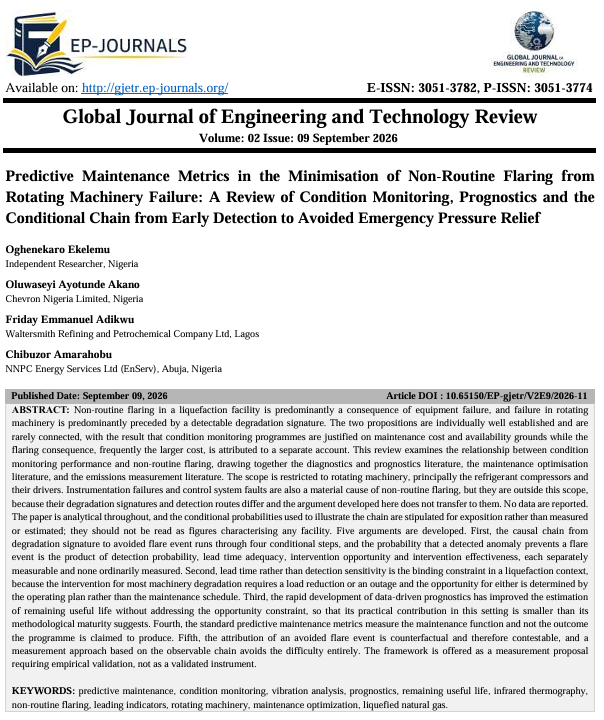
Predictive Maintenance Metrics in the Minimisation of Non-Routine Flaring from Rotating Machinery Failure: A Review of Condition Monitoring, Prognostics and the Conditional Chain from Early Detection to Avoided Emergency Pressure Relief
DOI:
https://doi.org/10.65150/EP-gjetr/V2E9/2026-11Keywords:
predictive maintenance, condition monitoring, vibration analysis, prognostics, remaining useful life, infrared thermography, non-routine flaring, leading indicators, rotating machinery, maintenance optimization, liquefied natural gas.Abstract
Non-routine flaring in a liquefaction facility is predominantly a consequence of equipment failure, and failure in rotating machinery is predominantly preceded by a detectable degradation signature. The two propositions are individually well established and are rarely connected, with the result that condition monitoring programmes are justified on maintenance cost and availability grounds while the flaring consequence, frequently the larger cost, is attributed to a separate account. This review examines the relationship between condition monitoring performance and non-routine flaring, drawing together the diagnostics and prognostics literature, the maintenance optimisation literature, and the emissions measurement literature. The scope is restricted to rotating machinery, principally the refrigerant compressors and their drivers. Instrumentation failures and control system faults are also a material cause of non-routine flaring, but they are outside this scope, because their degradation signatures and detection routes differ and the argument developed here does not transfer to them. No data are reported. The paper is analytical throughout, and the conditional probabilities used to illustrate the chain are stipulated for exposition rather than measured or estimated; they should not be read as figures characterising any facility. Five arguments are developed. First, the causal chain from degradation signature to avoided flare event runs through four conditional steps, and the probability that a detected anomaly prevents a flare event is the product of detection probability, lead time adequacy, intervention opportunity and intervention effectiveness, each separately measurable and none ordinarily measured. Second, lead time rather than detection sensitivity is the binding constraint in a liquefaction context, because the intervention for most machinery degradation requires a load reduction or an outage and the opportunity for either is determined by the operating plan rather than the maintenance schedule. Third, the rapid development of data-driven prognostics has improved the estimation of remaining useful life without addressing the opportunity constraint, so that its practical contribution in this setting is smaller than its methodological maturity suggests. Fourth, the standard predictive maintenance metrics measure the maintenance function and not the outcome the programme is claimed to produce. Fifth, the attribution of an avoided flare event is counterfactual and therefore contestable, and a measurement approach based on the observable chain avoids the difficulty entirely. The framework is offered as a measurement proposal requiring empirical validation, not as a validated instrument.
References
1) Abdulhadi, B. M., & Hamdan, A. M. (2026a). Carbon-driven decision gates: Integrating embodied carbon accounting into construction project lifecycle governance. Research Journal of Pure Science and Technology, 9(5), 48-82.
2) Abdulhadi, B. M., & Hamdan, A. M. (2026b). Net-zero project delivery: A maturity model for carbon management capability in construction organizations. International Journal of Engineering and Modern Technology, 12(6), 199-233.
3) Abdulhadi, B. M., & Hamdan, A. M. (2026c). Sustainability-linked contracting and incentive alignment in integrated project delivery: A conceptual framework. International Journal of Social Sciences and Management Research, 12(6), 466-501.
4) Abioye, R. F., Okojie, J. S., Filani, O. M., Ike, P. N., Idu, J. O. O., Nnabueze, S. B., Okojokwu-Idu, J. O., & Ihwughwavwe, S. I. (2023). Automated ESG reporting in energy projects using blockchain-driven smart compliance management systems. International Journal of Multidisciplinary Evolutionary Research, 4(2), 120-129.
5) Abrahams, L. S., Samaras, C., Griffin, W. M., & Matthews, H. S. (2015). Life cycle greenhouse gas emissions from U.S. liquefied natural gas exports: Implications for end uses. Environmental Science and Technology, 49(5), 3237-3245.
6) Adebayo, A., Adegbite, M. P., & Ahmed, M. O. (2022). Adversarial machine learning in critical infrastructure: A conceptual framework for threat modeling AI enabled OT systems. World Journal of Innovation and Modern Technology, 6(1), 184-234.
7) Adebayo, A., Adegbite, M. P., & Ahmed, M. O. (2023). AI augmented threat detection in industrial control systems: A systematic review of machine learning approaches for ICS anomaly detection. International Journal of Engineering and Modern Technology, 9(3), 287-340.
8) Adegbite, M. P., Adebayo, A., & Ahmed, M. O. (2020). Securing operational technology networks in electric utilities: A systematic review of NERC CIP compliance and architectural threat mitigation. International Journal of Engineering and Modern Technology, 6(3), 103-146.
9) Adegbite, M. P., Adebayo, A., & Ahmed, M. O. (2022). A security architecture model for IT and OT convergence in regulated energy networks: Design principles and governance alignment. International Journal of Computer Science and Mathematical Theory, 8(2), 81-132.
10) Adegbite, M. P., Adebayo, A., & Ahmed, M. O. (2023). ICS and SCADA threat detection architectures in energy sector networks: A systematic review of SIEM, NDR, and anomaly detection approaches. World Journal of Innovation and Modern Technology, 7(2), 121-182.
11) Adegbite, M. P., Adebayo, A., & Ahmed, M. O. (2024a). A vulnerability governance architecture for power and utilities corporations: From exposure mapping to remediation verification. World Journal of Innovation and Modern Technology, 8(6), 185-246.
12) Adegbite, M. P., Adebayo, A., & Ahmed, M. O. (2024b). An AI driven security operations architecture for utility sector SOCs: Integrating threat intelligence, behavioral analytics, and automated response. International Journal of Engineering and Modern Technology, 10(11), 197-256.
13) Adegbite, M. P., Adebayo, A., & Ahmed, M. O. (2025). A cyber risk quantification and governance architecture for critical infrastructure: From posture measurement to executive reporting. International Journal of Computer Science and Mathematical Theory, 11(12), 232-293.
14) Adelanwa, A., Basnet, A., & Anene, U. N. (2023a). Data driven digital transformation models for lifecycle performance management in infrastructure delivery. International Journal of Advanced Multidisciplinary Research and Studies, 3(6), 2646-2662.
15) Adelanwa, A., Basnet, A., & Anene, U. N. (2023b). Predictive analytics models for financial risk detection and fraud prevention in public systems. International Journal of Advanced Multidisciplinary Research and Studies, 3(6).
16) Adelanwa, A., Basnet, A., & Anene, U. N. (2024). Performance intelligence models for optimization and outcome measurement in large scale public services. Shodhshauryam, International Scientific Refereed Research Journal, 6(1).
17) Adenuga, O. M. (2022). Smart grid architectures and energy distribution for high renewable penetration: A comprehensive review of technologies, operations, and deployment pathways. International Journal of Engineering and Modern Technology, 8(5), 125-155.
18) Adenuga, O. M. (2023). Power electronics and energy efficiency in modern power systems: A comprehensive review of devices, converter topologies, and system-level practice. International Journal of Engineering and Modern Technology, 9(3), 287-312.
19) Adeyelu, O. O. (2018). A predictive compliance monitoring framework for detecting systemic safety risks through aviation consumer complaint data. Iconic Research and Engineering Journals, 1(8), 250-276.
20) Adeyelu, O. O. (2019). An adaptive safety management system implementation model for aerodromes in developing economy contexts. Iconic Research and Engineering Journals, 3(4), 628-654.
21) Adeyelu, O. O. (2026). A root-cause investigation framework for recurring runway wildlife hazards and standardized corrective action protocols at Nigerian international airports. International Journal of Social Sciences and Management Research, 12(5), 842-880.
22) Agbabiaka, J., Okonkwo, C. S., Ogunwole, O., Mayo, W., & Okeke, O. T. (2019). Supply chain risk management model for EPC and gas processing projects. Iconic Research and Engineering Journals, 3(2), 968-980.
23) Ahiaeke Patrick, M. C., Okonkwo, C. S., Mayo, W., & Okeke, O. T. (2021). Model for data driven vendor evaluation and bid selection using geospatial intelligence. Shodhshauryam, International Scientific Refereed Research Journal, 4(4), 426-443.
24) Ahmad, R., & Kamaruddin, S. (2012). An overview of time-based and condition-based maintenance in industrial application. Computers and Industrial Engineering, 63(1), 135-149.
25) Ahmed, M. O., Adegbite, M. P., & Adebayo, A. (2021). Zero trust architecture for operational technology in North American critical infrastructure: A framework for implementation and resilience optimization. International Journal of Engineering and Modern Technology, 7(1), 66-113.
26) Aifuwa, S. E., Oshoba, T. O., Ogbuefi, E., Ike, P. N., Nnabueze, S. B., & Olatunde-Thorpe, J. (2020). Predictive analytics models enhancing supply chain demand forecasting accuracy and reducing inventory management inefficiencies. International Journal of Multidisciplinary Research and Growth Evaluation, 1(3), 171-181.
27) Akanbi, O., Ganiu, O. S., & Sunday, E. A. (2023). A review of industrial equipment restoration strategies: Integrating design of experiments (DOE) and root-cause analysis. International Journal of Scientific Research in Computer Science, Engineering and Information Technology, 9(10), 444-462.
28) Akin-Oluyomi, O. T., Atima, M. E., & Akinleye, O. K. (2023). Green procurement strategies for balancing cost efficiency with long-term environmental responsibility. International Journal of Advanced Multidisciplinary Research and Studies, 3(6), 2183-2193.
29) Akin-Oluyomi, O. T., Atima, M. E., & Akinleye, O. K. (2024). Cross-border supplier relationship management frameworks for pharmaceutical and global construction sectors. International Journal of Multidisciplinary Research and Growth Evaluation, 5(6), 1709-1718.
30) Akin-Oluyomi, O. T., Atima, M. E., Akinleye, O. K., & Okoruwa, P. O. (2023). Predictive analytics approaches for improving demand forecasting accuracy in e-commerce procurement systems. International Journal of Advanced Multidisciplinary Research and Studies, 3(6), 2173-2182.
31) Akinleye, O. K., & Adeyoyin, O. (2021). Process automation framework for enhancing procurement efficiency and transparency. Shodhshauryam, International Scientific Refereed Research Journal, 4(4), 356-387.
32) Akinleye, O. K., & Adeyoyin, O. (2022a). A negotiation optimization model for reducing procurement costs in manufacturing firms. Shodhshauryam, International Scientific Refereed Research Journal, 5(5), 398-435.
33) Akinleye, O. K., & Adeyoyin, O. (2022b). Supplier relationship management framework for achieving strategic procurement objectives. Gyanshauryam, International Scientific Refereed Research Journal, 5(4), 565-598.
34) Akomolafe, O., & Agu, M. U. (2018). A conceptual model for enhancing internal audit quality through technology-enabled risk assessment frameworks. Iconic Research and Engineering Journals, 1(9), 458-475.
35) Akomolafe, O., Agu, M. U., & Bello, A. (2023). A conceptual model for implementing risk-based auditing in strategic financial management. International Journal of Advanced Multidisciplinary Research and Studies, 3(6), 2274-2286.
36) Akomolafe, O., Agu, M. U., & Bello, A. (2025). A conceptual model for advancing risk governance through data-driven compliance analytics in financial institutions. Journal of Accounting and Financial Management, 11(11), 211-228.
37) Alaswad, S., & Xiang, Y. (2017). A review on condition-based maintenance optimization models for stochastically deteriorating system. Reliability Engineering and System Safety, 157, 54-63.
38) Aliliele, C., Mbonu, I. S., & Iwuanyanwu, U. (2024). A conceptual framework for enterprise data sensitivity classification and regulatory traceability mechanisms. International Journal of Advanced Multidisciplinary Research and Studies, 4(6), 3103-3124.
39) Aliliele, C., Mbonu, I. S., Uzoka, E., & Iwuanyanwu, U. (2025a). A review of AI assisted continuous auditing systems in technology risk and cybersecurity oversight. Gyanshauryam, International Scientific Refereed Research Journal, 8(4), 210-250.
40) Aliliele, C., Mbonu, I. S., Uzoka, E., & Iwuanyanwu, U. (2025b). Advances in data lakehouse governance architectures for enterprise data loss prevention and compliance assurance. Shodhshauryam, International Scientific Refereed Research Journal, 8(4), 171-213.
41) Allen, D. T. (2014). Atmospheric emissions and air quality impacts from natural gas production and use. Annual Review of Chemical and Biomolecular Engineering, 5, 55-75.
42) Alvarez, R. A., Zavala-Araiza, D., Lyon, D. R., Allen, D. T., Barkley, Z. R., Brandt, A. R., Davis, K. J., Herndon, S. C., Jacob, D. J., Karion, A., Kort, E. A., Lamb, B. K., Lauvaux, T., Maasakkers, J. D., Marchese, A. J., Omara, M., Pacala, S. W., Peischl, J., Robinson, A. L., Shepson, P. B., Sweeney, C., Townsend-Small, A., Wofsy, S. C., & Hamburg, S. P. (2018). Assessment of methane emissions from the U.S. oil and gas supply chain. Science, 361(6398), 186-188.
43) Amayo, E. B., Owulade, O. A., & Isi, L. R. (2023). Optimizing project governance in multinational infrastructure projects: Insights from General Electric's global operations. International Journal of Multidisciplinary Research and Growth Evaluation, 4(1), 975-983.
44) Amayo, E. B., Owulade, O. A., & Isi, L. R. (2024). Effective project governance in multinational infrastructure projects: A case study from General Electric. Iconic Research and Engineering Journals, 8(5), 1305-1324.
45) Ambali, K. B., Eyetsemitan, R. A., Oyeleye, A. O., & Fadayomi, O. (2021). Lean Six Sigma for small enterprises: A systematic review and Lite-DMAIC adaptation framework for resource-constrained organizations. Iconic Research and Engineering Journals, 5(5), 562-583.
46) American Petroleum Institute. (2014a). Machinery protection systems (API Standard 670, 5th ed.). API Publishing Services.
47) American Petroleum Institute. (2014b). Axial and centrifugal compressors and expander-compressors (API Standard 617, 8th ed.). API Publishing Services.
48) American Petroleum Institute. (2014c). Pressure-relieving and depressuring systems (API Standard 521, 6th ed.). API Publishing Services.
49) American Petroleum Institute. (2016). Process safety performance indicators for the refining and petrochemical industries (API Recommended Practice 754, 2nd ed.). API Publishing Services.
50) American Petroleum Institute. (2020). Flare details for general refinery and petrochemical service (API Standard 537, 4th ed.). API Publishing Services.
51) Antoni, J. (2006). The spectral kurtosis: A useful tool for characterising non-stationary signals. Mechanical Systems and Signal Processing, 20(2), 282-307.
52) Antoni, J., & Randall, R. B. (2006). The spectral kurtosis: Application to the vibratory surveillance and diagnostics of rotating machines. Mechanical Systems and Signal Processing, 20(2), 308-331.
53) Arumosoye, O. M., & Obriki, O. D. (2019). Systematic review of near-miss and hazard observation data utilization in industrial safety management. Iconic Research and Engineering Journals, 3(2), 981-999.
54) Arumosoye, O. M., & Obriki, O. D. (2020). A governance-oriented conceptual model for contractor safety performance in multi-contract industrial projects. International Journal of Multidisciplinary Research and Growth Evaluation, 1(5), 728-740.
55) Arumosoye, O. M., & Obriki, O. D. (2021). Organizational learning-based conceptual maturity model for continuous safety performance improvement. International Journal of Multidisciplinary Research and Growth Evaluation, 2(1), 970-980.
56) Arumosoye, O. M., Obriki, O. D., & Ozobu, C. O. (2025). Conceptual framework for environmental risk control and ESG performance through waste handling and operational discipline. Gyanshauryam, International Scientific Refereed Research Journal, 8(4), 177-198.
57) Arumosoye, O. M., Obriki, O. D., & Ozobu, C. O. (2026). Systematic review of predictive safety analytics applications in LNG projects with ESG implications. Global Journal of Engineering and Technology Review, 2(2), 61-73.
58) Asiedu, W., & Quainoo, R. (2023a). How far can energy harvesting take us? A systematic review of radio frequency strategies for energy autonomous sensing. Shodhshauryam, International Scientific Refereed Research Journal, 6(1), 448-466.
59) Asiedu, W., & Quainoo, R. (2023b). Toward maintenance free wireless infrastructure: Simulating performance and reliability in large scale intermittently powered IoT networks. Gyanshauryam, International Scientific Refereed Research Journal, 6(1), 489-510.
60) Asiedu, W., & Quainoo, R. (2024). Rethinking energy, reliability, and latency trade-offs in green communication for next generation IoT. International Journal of Multidisciplinary Research and Growth Evaluation, 5(6), 1987-1994.
61) Asiedu, W., & Quainoo, R. (2025). GleanCast: Epoch-aligned reliable broadcast in batteryless intermittent sensor networks. International Journal of Engineering and Modern Technology, 11(12), 205-218.
62) Asiedu, W., Quainoo, R., & Asiedu, A. (2025). A conceptual framework for characterizing fundamental energy, reliability, and latency trade-offs in green communication paradigms for next-generation IoT. International Journal of Advanced Multidisciplinary Research and Studies, 5(6), 2447-2453.
63) Asiedu, W., Quainoo, R., & Asiedu, A. (2026). Predictive power management for intermittent IoT devices using lightweight machine learning under uncertain energy harvest. Gulf Journal of Engineering and Technology, 2(4), 108-118.
64) Atta, S. (2026a). Instability patterns in optoelectronic heterojunctions in GeS nanowires. MRS Bulletin, 51, 643.
65) Atta, S. (2026b). Unraveling spray pyrolysis mechanisms: Droplet dynamics and film formation in CdTe thin-film photocathodes. Manuscript in publication.
66) Atta, S., Adjaklo, E., Asomani, E., & Adenuga, O. M. (2022). Advances in welding inspection standards and quality assurance practices in large-scale power generation projects. International Journal of Engineering and Modern Technology, 8(5), 101-124.
67) Atta, S., Asomani, E., & Adenuga, O. M. (2018). A systematic review of green corrosion inhibitors from agricultural extracts for mild steel protection in acidic and alkaline media. International Journal of Engineering and Modern Technology, 4(1), 64-97.
68) Atta, S., Kerubo, M. L., Sabisa, N. E., Adu-Gyamfi, D., Appiah, S., & Onyishi, E. (2025). Environmental corrosion and long-term degradation of crystalline silicon solar cells: Mechanisms, climate effects and mitigation strategies. Current Journal of Applied Science and Technology, 44(10), 9-18.
69) Atta, S., Onyishi, E. E., Appiah, S. A., & Adenuga, O. M. (2024). Theoretical analysis of charge transport and recombination losses in thin film solar cell architectures. International Journal of Engineering and Modern Technology, 10(10), 147-170.
70) Atta, S., Tofah, P., & Adenuga, O. M. (2021). Advances in non-destructive testing methods for weld integrity evaluation in high-capacity power infrastructure. International Journal of Engineering and Modern Technology, 7(1), 20-47.
71) Atta, S., Tofah, P., Kankam, M. A., & Adenuga, O. M. (2020). A critical review of NDT-based integrity management and corrosion risk assessment strategies for refinery process equipment. International Journal of Engineering and Modern Technology, 6(2), 19-46.
72) Babatope, O. M., Akokodaripon, D. A., Akinleye, O. K., & Okoruwa, P. O. (2023). The role of data visualization in enhancing strategic procurement decision-making effectiveness. International Journal of Advanced Multidisciplinary Research and Studies, 3(6), 2205-2212.
73) Bagavathiappan, S., Lahiri, B. B., Saravanan, T., Philip, J., & Jayakumar, T. (2013). Infrared thermography for condition monitoring: A review. Infrared Physics and Technology, 60, 35-55.
74) Balcombe, P., Anderson, K., Speirs, J., Brandon, N., & Hawkes, A. (2017). The natural gas supply chain: The importance of methane and carbon dioxide emissions. ACS Sustainable Chemistry and Engineering, 5(1), 3-20.
75) Balcombe, P., Brandon, N. P., & Hawkes, A. D. (2018). Characterising the distribution of methane and carbon dioxide emissions from the natural gas supply chain. Journal of Cleaner Production, 172, 2019-2032.
76) Bloch, H. P., & Geitner, F. K. (2012). Machinery failure analysis and troubleshooting: Practical machinery management for process plants (4th ed.). Butterworth-Heinemann.
77) Brandt, A. R., Heath, G. A., & Cooley, D. (2016). Methane leaks from natural gas systems follow extreme distributions. Environmental Science and Technology, 50(22), 12512-12520.
78) Center for Chemical Process Safety. (2007). Guidelines for risk based process safety. Wiley.
79) Cusworth, D. H., Duren, R. M., Thorpe, A. K., Olson-Duvall, W., Heckler, J., Chapman, J. W., Eastwood, M. L., Helmlinger, M. C., Green, R. O., Asner, G. P., Dennison, P. E., & Miller, C. E. (2021). Intermittency of large methane emitters in the Permian Basin. Environmental Science and Technology Letters, 8(7), 567-573.
80) Dagodzo, D. (2018a). A conceptual framework for UAV integration into national power grid inspection programs. Iconic Research and Engineering Journals, 2(5), 391-412.
81) Dagodzo, D. (2018b). A review of UAV applications in electrical transmission line inspection: Methods, technologies, and challenges. Iconic Research and Engineering Journals, 2(6), 234-254.
82) Dagodzo, D., & Ahiaeke Patrick, M. C. (2020). UAV-based pipeline and corridor monitoring: A review of current practices and emerging technologies. Iconic Research and Engineering Journals, 3(10), 574-597.
83) Dagodzo, D., & Ahiaeke Patrick, M. C. (2021a). A review of GIS applications in utility asset management and infrastructure planning. Iconic Research and Engineering Journals, 5(3), 468-492.
84) Dagodzo, D., & Ahiaeke Patrick, M. C. (2021b). An integrated framework for UAV, LiDAR, and GIS in infrastructure corridor management. International Journal of Scientific Research in Computer Science, Engineering and Information Technology, 7(5), 497-524.
85) Dagodzo, D., & Ahiaeke Patrick, M. C. (2023). A framework for integrating drone operations into enterprise GIS systems for utility companies. International Journal of Scientific Research in Computer Science, Engineering and Information Technology, 9(4), 924-957.
86) Dagodzo, D., Ahiaeke Patrick, M. C., & Aliliele, C. (2022). AI and deep learning for vegetation classification in power corridor management: A review. International Journal of Scientific Research in Computer Science, Engineering and Information Technology, 8(1), 668-698.
87) Dekker, R. (1996). Applications of maintenance optimization models: A review and analysis. Reliability Engineering and System Safety, 51(3), 229-240.
88) Duren, R. M., Thorpe, A. K., Foster, K. T., Rafiq, T., Hopkins, F. M., Yadav, V., Bue, B. D., Thompson, D. R., Conley, S., Colombi, N. K., Frankenberg, C., McCubbin, I. B., Eastwood, M. L., Falk, M., Herner, J. D., Croes, B. E., Green, R. O., & Miller, C. E. (2019). California methane super-emitters. Nature, 575(7781), 180-184.
89) Efobi, O. Z., Akinleye, O. K., & Fasawe, O. (2022). Conceptual model for data-driven lean supply chain optimization in manufacturing and retail operations. International Journal of Scientific Research in Computer Science, Engineering and Information Technology, 8(2), 703-734.
90) Efobi, O. Z., Akinleye, O. K., & Fasawe, O. (2023). Conceptual framework for developing a resilience index for post-pandemic supply chains. Shodhshauryam, International Scientific Refereed Research Journal, 6(2), 421-432.
91) Elattar, H. M., Elminir, H. K., & Riad, A. M. (2016). Prognostics: A literature review. Complex and Intelligent Systems, 2(2), 125-154.
92) Elvidge, C. D., Zhizhin, M., Baugh, K., Hsu, F.-C., & Ghosh, T. (2016). Methods for global survey of natural gas flaring from Visible Infrared Imaging Radiometer Suite data. Energies, 9(1), 14.
93) Eyetsemitan, R. A., Ambali, K. B., Oyeleye, A. O., & Fadayomi, O. (2020). Multi-stakeholder governance alignment in joint venture operations: A conceptual framework for coordinating business processes in highly regulated environments. Iconic Research and Engineering Journals, 4(4), 418-441.
94) Eyetsemitan, R. A., Oyeleye, A. O., Ambali, K. B., & Fadayomi, O. (2022). Standard operating procedures as strategic assets in small business operations: A systematic review and implementation framework. Gyanshauryam, International Scientific Refereed Research Journal, 5(2), 438-465.
95) Falegan, O. C., & Aniebonam, S. O. (2022). Conceptual framework for lifecycle risk assessment in offshore produced water management. Gyanshauryam, International Scientific Refereed Research Journal, 5(5), 322-345.
96) Falegan, O. C., & Aniebonam, S. O. (2024). Decentralized produced water treatment systems for remote energy assets: A conceptual design framework. International Journal of Scientific Research in Computer Science, Engineering and Information Technology, 10(3), 1133-1151.
97) Falegan, O. C., & Aniebonam, S. O. (2025). Resource recovery and beneficial reuse of produced water in energy operations: A review of sustainable pathways. International Journal of Advanced Multidisciplinary Research and Studies, 5(6), 1959-1969.
98) Falegan, O. C., & Aniebonam, S. O. (2026). Data-driven performance optimization of produced water treatment infrastructure: A conceptual modeling approach. Engineering and Technology Journal, 11(1), 8764-8777.
99) Feng, Z., Liang, M., & Chu, F. (2013). Recent advances in time-frequency analysis methods for machinery fault diagnosis: A review with application examples. Mechanical Systems and Signal Processing, 38(1), 165-205.
100) Fink, O., Wang, Q., Svensén, M., Dersin, P., Lee, W.-J., & Ducoffe, M. (2020). Potential, challenges and future directions for deep learning in prognostics and health management applications. Engineering Applications of Artificial Intelligence, 92, 103678.
101) Gebraeel, N. Z., Lawley, M. A., Li, R., & Ryan, J. K. (2005). Residual-life distributions from component degradation signals: A Bayesian approach. IIE Transactions, 37(6), 543-557.
102) Health and Safety Executive. (2006). Developing process safety indicators: A step-by-step guide for chemical and major hazard industries (HSG254). HSE Books.
103) Heng, A., Zhang, S., Tan, A. C. C., & Mathew, J. (2009). Rotating machinery prognostics: State of the art, challenges and opportunities. Mechanical Systems and Signal Processing, 23(3), 724-739.
104) Ho, D., & Randall, R. B. (2000). Optimisation of bearing diagnostic techniques using simulated and actual bearing fault signals. Mechanical Systems and Signal Processing, 14(5), 763-788.
105) Hollnagel, E. (2004). Barriers and accident prevention. Ashgate.
106) Hopkins, A. (2000). Lessons from Longford: The Esso gas plant explosion. CCH Australia.
107) Hopkins, A. (2008). Failure to learn: The BP Texas City refinery disaster. CCH Australia.
108) Hopkins, A. (2009). Thinking about process safety indicators. Safety Science, 47(4), 460-465.
109) Hu, Z., Tariq, S., & Zayed, T. (2021). A comprehensive review of acoustic based leak localization method in pressurized pipelines. Mechanical Systems and Signal Processing, 161, 107994.
110) Ike, P. N., Aifuwa, S. E., Nnabueze, S. B., Olatunde-Thorpe, J., Ogbuefi, E., Oshoba, T. O., & Akokodaripon, D. (2024). Quantitative risk architecture for public-private partnerships: A multi-layered model for allocating public and private risk. International Journal of Advanced Multidisciplinary Research and Studies, 4(6), 2669-2682.
111) Ike, P. N., Ogbuefi, E., Nnabueze, S. B., Olatunde-Thorpe, J., Aifuwa, S. E., Oshoba, T. O., & Akokodaripon, D. (2021). Supplier relationship management strategies fostering innovation, collaboration, and resilience in global supply chain ecosystems. International Journal of Multidisciplinary Evolutionary Research, 2(2), 52-62.
112) Ike, P. N., Ogbuefi, E., Nnabueze, S. B., Olatunde-Thorpe, J., Aifuwa, S. E., Oshoba, T. O., & Akokodaripon, D. (2022). Lean supply chain practices improving operational efficiency, reducing waste, and enhancing organizational competitiveness globally. Journal of Frontiers in Multidisciplinary Research, 3(2), 182-192.
113) Ike, P. N., Okojie, J. S., Nnabueze, S. B., Idu, J. O. O., Filani, O. M., & Ihwughwavwe, S. I. (2025). Digital twin-driven environmental compliance models for sustainable procurement in oil, gas, and utilities. International Journal of Advanced Multidisciplinary Research and Studies, 5(5), 562-576.
114) International Organization for Standardization. (2015). Condition monitoring and diagnostics of machines: Prognostics, Part 1: General guidelines (ISO 13381-1). ISO.
115) International Organization for Standardization. (2016). Mechanical vibration: Measurement and evaluation of machine vibration (ISO 20816). ISO.
116) International Organization for Standardization. (2018). Condition monitoring and diagnostics of machines: General guidelines (ISO 17359). ISO.
117) Jadin, M. S., & Taib, S. (2012). Recent progress in diagnosing the reliability of electrical equipment by using infrared thermography. Infrared Physics and Technology, 55(4), 236-245.
118) Jardine, A. K. S., Lin, D., & Banjevic, D. (2006). A review on machinery diagnostics and prognostics implementing condition-based maintenance. Mechanical Systems and Signal Processing, 20(7), 1483-1510.
119) Jia, F., Lei, Y., Lin, J., Zhou, X., & Lu, N. (2016). Deep neural networks: A promising tool for fault characteristic mining and intelligent diagnosis of rotating machinery with massive data. Mechanical Systems and Signal Processing, 72-73, 303-315.
120) Jimoh, H. O., Abolle-Okoyeagu, C. J., Ahmed, M. O., & Lawal, N. O. (2023). Advancing security in IoT-driven critical infrastructure: A focus on smart transportation system. American Journal of Engineering Research, 12(12), 33-46.
121) Kan, M. S., Tan, A. C. C., & Mathew, J. (2015). A review on prognostic techniques for non-stationary and non-linear rotating systems. Mechanical Systems and Signal Processing, 62-63, 1-20.
122) Kerr, S. (1975). On the folly of rewarding A, while hoping for B. Academy of Management Journal, 18(4), 769-783.
123) Khan, S., & Yairi, T. (2018). A review on the application of deep learning in system health management. Mechanical Systems and Signal Processing, 107, 241-265.
124) Kidnay, A. J., Parrish, W. R., & McCartney, D. G. (2011). Fundamentals of natural gas processing (2nd ed.). CRC Press.
125) Komi, N. M. (2021). Hybrid deep learning for wind power forecasting: From grid stability to market equity for small generators. International Journal of Multidisciplinary Research and Growth Evaluation, 2(6), 989-1014.
126) Komi, N. M. (2023). When accurate forecasts are not fair forecasts: Deep learning load prediction and equity across districts. Shodhshauryam, International Scientific Refereed Research Journal, 6(6), 476-546.
127) Komi, N. M., & Adamolekun, A. (2021). Interpretable machine learning for early failure prediction in distributed renewable energy assets. International Journal of Multidisciplinary Research and Growth Evaluation, 2(6), 1015-1038.
128) Komi, N. M., & Adamolekun, A. (2022). Hierarchical, decentralized, or hybrid? A systematic review of control architectures for distributed energy resources. International Journal of Engineering and Modern Technology, 8(5), 141-195.
129) Komi, N. M., & Adeniji, I. O. (2023). A tiered digital twin that brings predictive diagnostics to resource-constrained renewable energy sites. International Journal of Engineering and Modern Technology, 9(3), 287-347.
130) Komi, N. M., & Adeniji, I. O. (2024b). Why energy projects survive or fail: Modeling the causal link between community trust and infrastructure durability. International Journal of Advanced Multidisciplinary Research and Studies, 4(6), 3263-3296.
131) Komi, N. M., & Ganiu, O. S. (2022). Grid-connected battery storage in hot and weak-grid regions: Advances, degradation challenges, and lifecycle equity. International Journal of Multidisciplinary Research and Growth Evaluation, 3(6), 1072-1095.
132) Komi, N. M., & Ganiu, O. S. (2023). Edge intelligence for resilient microgrid control: Advances, energy sovereignty, and open challenges. Gyanshauryam, International Scientific Refereed Research Journal, 6(3), 525-586.
133) Ladapo, O. O., Dosunmu, A. A., Jooda, D., & Abolaji, T. O. (2022). Human-in-the-loop machine learning: A state of the art. Journal of Frontiers in Multidisciplinary Research, 3(1), 656-669.
134) Ladapo, O. O., Jooda, D., Dosunmu, A. A., & Abolaji, T. O. (2026). On the disagreement problem in human-in-the-loop federated machine learning. International Journal of Multidisciplinary Research and Growth Evaluation, 7(3), 178-192.
135) Lee, J., Wu, F., Zhao, W., Ghaffari, M., Liao, L., & Siegel, D. (2014). Prognostics and health management design for rotary machinery systems: Reviews, methodology and applications. Mechanical Systems and Signal Processing, 42(1-2), 314-334.
136) Lei, Y., Li, N., Guo, L., Li, N., Yan, T., & Lin, J. (2018). Machinery health prognostics: A systematic review from data acquisition to RUL prediction. Mechanical Systems and Signal Processing, 104, 799-834.
137) Lei, Y., Lin, J., He, Z., & Zuo, M. J. (2013). A review on empirical mode decomposition in fault diagnosis of rotating machinery. Mechanical Systems and Signal Processing, 35(1-2), 108-126.
138) Lei, Y., Yang, B., Jiang, X., Jia, F., Li, N., & Nandi, A. K. (2020). Applications of machine learning to machine fault diagnosis: A review and roadmap. Mechanical Systems and Signal Processing, 138, 106587.
139) Li, N., Lei, Y., Lin, J., & Ding, S. X. (2015). An improved exponential model for predicting remaining useful life of rolling element bearings. IEEE Transactions on Industrial Electronics, 62(12), 7762-7773.
140) Li, N., Lei, Y., Yan, T., Li, N., & Han, T. (2019). A Wiener-process-model-based method for remaining useful life prediction considering unit-to-unit variability. IEEE Transactions on Industrial Electronics, 66(3), 2092-2101.
141) Li, X., Ding, Q., & Sun, J.-Q. (2018). Remaining useful life estimation in prognostics using deep convolution neural networks. Reliability Engineering and System Safety, 172, 1-11.
142) Liao, L., & Köttig, F. (2014). Review of hybrid prognostics approaches for remaining useful life prediction of engineered systems, and an application to battery life prediction. IEEE Transactions on Reliability, 63(1), 191-207.
143) Lim, W., Choi, K., & Moon, I. (2013). Current status and perspectives of liquefied natural gas (LNG) plant design. Industrial and Engineering Chemistry Research, 52(9), 3065-3088.
144) Liu, K., Gebraeel, N. Z., & Shi, J. (2013). A data-level fusion model for developing composite health indices for degradation modeling and prognostic analysis. IEEE Transactions on Automation Science and Engineering, 10(3), 652-664.
145) Mba, D., & Rao, R. B. K. N. (2006). Development of acoustic emission technology for condition monitoring and diagnosis of rotating machines. Shock and Vibration Digest, 38(1), 3-16.
146) Mbonu, I. S., Aliliele, C., Iwuanyanwu, U., & Uzoka, E. (2021). A conceptual framework for risk based business intelligence architecture in financial technology platforms. International Journal of Multidisciplinary Research and Growth Evaluation, 2(6), 731-746.
147) Mbonu, I. S., Aliliele, C., Iwuanyanwu, U., & Uzoka, E. (2022). A conceptual framework for AI enabled IT general controls and SOX audit automation processes. Gyanshauryam, International Scientific Refereed Research Journal, 5(5), 384-414.
148) McFadden, P. D., & Smith, J. D. (1984). Model for the vibration produced by a single point defect in a rolling element bearing. Journal of Sound and Vibration, 96(1), 69-82.
149) Medjaher, K., Tobon-Mejia, D. A., & Zerhouni, N. (2012). Remaining useful life estimation of critical components with application to bearings. IEEE Transactions on Reliability, 61(2), 292-302.
150) Mokhatab, S., Mak, J. Y., Valappil, J. V., & Wood, D. A. (2014). Handbook of liquefied natural gas. Gulf Professional Publishing.
151) Moubray, J. (1997). Reliability-centred maintenance (2nd ed.). Butterworth-Heinemann.
152) Nicolai, R. P., & Dekker, R. (2008). Optimal maintenance of multi-component systems: A review. In K. A. H. Kobbacy & D. N. P. Murthy (Eds.), Complex system maintenance handbook (pp. 263-286). Springer.
153) Nnabueze, S. B., Ike, P. N., Olatunde-Thorpe, J., Aifuwa, S. E., Oshoba, T. O., Ogbuefi, E., & Akokodaripon, D. (2021). End-to-end visibility frameworks improving transparency, compliance, and traceability across complex global supply chain operations. International Journal of Multidisciplinary Futuristic Development, 2(2), 50-60.
154) Obogo, S. F., Arumosoye, O. M., & Obriki, O. D. (2020a). Advances in internal QHSE audit systems for industrial engineering operations. Iconic Research and Engineering Journals, 4(4), 399-417.
155) Obogo, S. F., Arumosoye, O. M., & Obriki, O. D. (2020b). Critical review of occupational safety management systems in oil and gas maintenance projects. Shodhshauryam, International Scientific Refereed Research Journal, 3(4), 145-166.
156) Obogo, S. F., Arumosoye, O. M., & Obriki, O. D. (2021). Advances in proactive hazard recognition and near miss reporting systems. International Journal of Multidisciplinary Research and Growth Evaluation, 2(6), 835-846.
157) Obogo, S. F., Obriki, O. D., & Arumosoye, O. M. (2021). Conceptual model for incident prevention in industrial maintenance engineering environments. International Journal of Multidisciplinary Research and Growth Evaluation, 2(6), 847-858.
158) Obogo, S. F., Ozobu, C. O., Garba, B. M. P., & Adio, S. A. (2026). Predictive safety analytics model for early detection of high-risk construction activities. Global Journal of Engineering and Technology Review, 2(3), 92-109.
159) Obogo, S. F., Uduokhai, D. O., & Ozobu, C. O. (2021). Review of contractor safety compliance systems in infrastructure engineering projects. International Journal of Scientific Research in Civil Engineering, 5(4), 76-100.
160) Obriki, O. D., & Arumosoye, O. M. (2018). Conceptual modeling of data-driven occupational safety risk control in large-scale energy infrastructure projects. Iconic Research and Engineering Journals, 1(7), 169-189.
161) Obriki, O. D., & Arumosoye, O. M. (2019). A conceptual framework linking management safety walkthrough frequency and coverage to safety culture outcomes in mega projects. Iconic Research and Engineering Journals, 2(8), 355-374.
162) Obriki, O. D., & Arumosoye, O. M. (2020). Conceptual framework for human error causation in high-risk construction and industrial activities. International Journal of Multidisciplinary Research and Growth Evaluation, 1(5), 715-727.
163) Obriki, O. D., & Arumosoye, O. M. (2022). Conceptual framework explaining recurrence mechanisms of unsafe behaviors in high-hazard worksites. Shodhshauryam, International Scientific Refereed Research Journal, 5(3), 380-402.
164) Obriki, O. D., & Arumosoye, O. M. (2023). Conceptual framework for proactive hazard identification using digital safety data streams. Gyanshauryam, International Scientific Refereed Research Journal, 6(3), 457-481.
165) Obriki, O. D., & Arumosoye, O. M. (2024a). Conceptual governance framework for subcontractor safety performance management. International Journal of Advanced Multidisciplinary Research and Studies, 4(6), 3020-3033.
166) Obriki, O. D., & Arumosoye, O. M. (2024b). Systematic review of incident investigation approaches and prevention-oriented learning in industrial operations. Shodhshauryam, International Scientific Refereed Research Journal, 7(4), 239-263.
167) Obriki, O. D., Arumosoye, O. M., & Obogo, S. F. (2023). Advances in continuous hazard monitoring systems for workplace safety. International Journal of Advanced Multidisciplinary Research and Studies, 3(6), 2742-2759.
168) Obriki, O. D., Arumosoye, O. M., & Ozobu, C. O. (2025). Conceptual model linking leading safety signals to sustained injury-free project performance. International Journal of Scientific Research in Humanities and Social Sciences, 2(3), 233-254.
169) Ogunwole, O., Okonkwo, C. S., Agbabiaka, J., Mayo, W., & Okeke, O. T. (2021). Supply chain resilience framework for critical infrastructure and gas processing plants. Shodhshauryam, International Scientific Refereed Research Journal, 4(4), 444-461.
170) Okojie, J. S., Filani, O. M., Ike, P. N., Okojokwu-Idu, J. O., Nnabueze, S. B., & Ihwughwavwe, S. I. (2023). Integrating AI with ESG metrics in smart infrastructure auditing for high-impact urban development projects. International Journal of Multidisciplinary Futuristic Development, 4(1), 32-44.
171) Okojie, J., Ike, P., Idu, J., Nnabueze, S. B., Filani, O., & Ihwughwavwe, S. (2023). Predictive analytics models for monitoring smart city emissions and infrastructure risk in urban ESG planning. International Journal of Multidisciplinary Futuristic Development, 4(1), 45-57.
172) Okonkwo, C. S., Agbabiaka, J., Mayo, W., & Okeke, O. T. (2024a). Conceptual framework for digital supply chain governance in energy and infrastructure sectors. Gyanshauryam, International Scientific Refereed Research Journal, 7(4), 335-356.
173) Okonkwo, C. S., Agbabiaka, J., Mayo, W., & Okeke, O. T. (2024b). Framework for secure and scalable supply chain systems supporting national energy reliability. International Journal of Advanced Multidisciplinary Research and Studies, 4(6), 2816-2826.
174) Okonkwo, C. S., Agbabiaka, J., Mayo, W., & Okeke, O. T. (2024c). Model for predictive procurement planning to sustain operational uptime. International Journal of Scientific Research in Humanities and Social Sciences, 1(2), 909-928.
175) Okonkwo, C. S., Agbabiaka, J., Mayo, W., & Okeke, O. T. (2024d). Review of advances in procurement strategy, ERP adoption, and logistics performance. International Journal of Advanced Multidisciplinary Research and Studies, 4(6), 2827-2835.
176) Okonkwo, C. S., Agbabiaka, J., Mayo, W., & Okeke, O. T. (2024e). Review of digital supply chain models for cost control and operational continuity. International Journal of Advanced Multidisciplinary Research and Studies, 4(6), 2836-2846.
177) Okonkwo, C. S., Agbabiaka, J., Mayo, W., & Okeke, O. T. (2024f). Supply chain automation framework using service management platforms. Shodhshauryam, International Scientific Refereed Research Journal, 7(2), 157-177.
178) Okonkwo, C. S., Agbabiaka, J., Ogunwole, O., Mayo, W., & Okeke, O. T. (2020). Model for demurrage elimination and port logistics efficiency in emerging economies. International Journal of Multidisciplinary Research and Growth Evaluation, 1(5), 552-562.
179) Okonkwo, C. S., Agbabiaka, J., Ogunwole, O., Mayo, W., & Okeke, O. T. (2021). Conceptual model for materials readiness and maintenance-driven supply chain performance. International Journal of Multidisciplinary Research and Growth Evaluation, 2(6), 584-594.
180) Okonkwo, C. S., Agbabiaka, J., Okeke, O. T., & Mayo, W. (2025). Framework for national-scale supply chain optimization through integrated IT and procurement systems. Gulf Journal of Advance Business Research, 3(12), 1610-1625.
181) Okonkwo, C. S., Ahiaeke Patrick, M. C., Okeke, O. T., & Mayo, W. (2023). Framework for integrating IT systems engineering with supply chain operations. International Journal of Advanced Multidisciplinary Research and Studies, 3(6), 2580-2589.
182) Okonkwo, C. S., Mayo, W., & Okeke, O. T. (2023). Conceptual model for asset lifecycle management and inventory visibility. International Journal of Scientific Research in Computer Science, Engineering and Information Technology, 10(1), 809-824.
183) Okonkwo, C. S., Ogunwole, O., & Okeke, O. T. (2018a). Framework for strategic procurement optimization in oil and gas operations. Iconic Research and Engineering Journals, 1(7), 153-168.
184) Okonkwo, C. S., Ogunwole, O., & Okeke, O. T. (2018b). Model for inventory availability and plant uptime improvement in energy facilities. Iconic Research and Engineering Journals, 2(4), 160-172.
185) Okonkwo, C. S., Ogunwole, O., Mayo, W., & Okeke, O. T. (2021). Framework for regulatory-compliant procurement in high-risk energy environments. International Journal of Multidisciplinary Research and Growth Evaluation, 2(6), 595-605.
186) Okonkwo, C. S., Ogunwole, O., Okeke, O. T., & Mayo, W. (2019). Conceptual framework for cost reduction through contract negotiation and vendor governance. Iconic Research and Engineering Journals, 2(9), 468-482.
187) Okoruwa, P. O., Babatope, O. M., Akokodaripon, D. A., & Akinleye, O. K. (2024). Developing integrated digital platforms for enhancing transparency in procurement and supply chain management. International Journal of Multidisciplinary Research and Growth Evaluation, 5(6), 1719-1729.
188) Okoruwa, P. O., Babatope, O. M., Akokodaripon, D. A., & Akinleye, O. K. (2025). Digital procurement transformation approaches for strengthening efficiency in global supply chain management. International Journal of Multidisciplinary Research and Growth Evaluation, 6(5), 975-985.
189) Omoegun, G. O., Sunday, E. A., Essien, M. A., & Oluokun, O. A. (2023). Vibration-based condition monitoring of rotating machinery using LabVIEW. International Journal of Scientific Research in Civil Engineering, 7(6), 82-108.
190) Onche, V. O., Adegbite, M. P., & Ogbonna, C. S. (2026). Human factors in information security: A capability framework for administrative professionals in the digital workplace. World Journal of Innovation and Modern Technology, 10(5), 154-179.
191) Onche, V. O., Ogbonna, C. S., & Adegbite, M. P. (2024). Effectiveness of cybersecurity awareness training on insider-threat behavior among university administrators: An integrative academic review. International Journal of Computer Science and Mathematical Theory, 10(2), 117-144.
192) Onyeke, F. O., Odujobi, O., Adikwu, F. E., & Elete, T. Y. (2024). The role of data-driven insights in industrial control systems: Advancing predictive maintenance and operational efficiency in refinery processes. Engineering Science and Technology Journal, 5(12), 3266-3277.
193) Oyeleke, A. V., Eze, F. C., & Asiedu, W. (2026). Reliability-centered maintenance strategies for minimizing downtime and maximizing performance in high-density GPU cluster environments. International Journal of Engineering Technology Research and Management, 10(7), 18-38.
194) Ozowe, C., Ukato, A., Jambol, D. D., & Daramola, G. O. (2024). Technological innovations in liquefied natural gas operations: Enhancing efficiency and safety. Engineering Science and Technology Journal, 5(6), 1909-1929.
195) Peng, Y., Dong, M., & Zuo, M. J. (2010). Current status of machine prognostics in condition-based maintenance: A review. International Journal of Advanced Manufacturing Technology, 50(1-4), 297-313.
196) Quainoo, R., & Ogundapo, O. (2026a). A system-level power behavior model for Bluetooth and Wi-Fi coexistence in dual-mode wireless devices. International Journal of Computer Science and Mathematical Theory, 12(2), 298-358.
197) Quainoo, R., & Ogundapo, O. (2026b). Wireless system-on-chip performance in next-generation Internet of Things devices: A systematic review of integrated transceiver testing methodologies. World Journal of Innovation and Modern Technology, 10(5), 76-126.
198) Quainoo, R., Ogundapo, O., & Asiedu, W. A. (2024). Modeling the impact of impedance mismatch on wireless link performance: A framework for prototype development and system optimization. International Journal of Computer Science and Mathematical Theory, 10(2), 62-116.
199) Quainoo, R., Ogundapo, O., & Asiedu, W. A. (2025a). Predicting throughput degradation in Wi-Fi 6 networks under varying channel conditions: A physical layer performance model. International Journal of Engineering and Modern Technology, 11(12), 205-264.
200) Quainoo, R., Ogundapo, O., & Asiedu, W. A. (2025b). Test automation in wireless hardware engineering: A comprehensive review of scripting frameworks and instrument control strategies. International Journal of Engineering and Modern Technology, 11(10), 405-464.
201) Rahimpour, M. R., & Jokar, S. M. (2012). Feasibility of flare gas reformation to practical energy in Farashband gas refinery: No gas flaring. Journal of Hazardous Materials, 209-210, 204-217.
202) Rai, A., & Upadhyay, S. H. (2016). A review on signal processing techniques utilized in the fault diagnosis of rolling element bearings. Tribology International, 96, 289-306.
203) Ramasso, E., & Saxena, A. (2014). Performance benchmarking and analysis of prognostic methods for CMAPSS datasets. International Journal of Prognostics and Health Management, 5(2), 1-15.
204) Randall, R. B. (2011). Vibration-based condition monitoring: Industrial, aerospace and automotive applications. Wiley.
205) Randall, R. B., & Antoni, J. (2011). Rolling element bearing diagnostics: A tutorial. Mechanical Systems and Signal Processing, 25(2), 485-520.
206) Rausand, M. (2011). Risk assessment: Theory, methods, and applications. Wiley.
207) Rausand, M., & Høyland, A. (2004). System reliability theory: Models, statistical methods, and applications (2nd ed.). Wiley.
208) Reason, J. (1997). Managing the risks of organizational accidents. Ashgate.
209) Roman-White, S. A., Littlefield, J. A., Fleury, K. G., Allen, D. T., Balcombe, P., Konschnik, K. E., Ewing, J., Ross, G. B., & George, F. (2021). LNG supply chains: A supplier-specific life-cycle assessment for improved emission accounting. ACS Sustainable Chemistry and Engineering, 9(32), 10857-10867.
210) Saxena, A., Goebel, K., Simon, D., & Eklund, N. (2008). Damage propagation modeling for aircraft engine run-to-failure simulation. Proceedings of the International Conference on Prognostics and Health Management, 1-9.
211) Schwabacher, M. (2005). A survey of data-driven prognostics. Proceedings of the AIAA Infotech@Aerospace Conference, 7002.
212) Si, X.-S., Wang, W., Hu, C.-H., & Zhou, D.-H. (2011). Remaining useful life estimation: A review on the statistical data driven approaches. European Journal of Operational Research, 213(1), 1-14.
213) Si, X.-S., Wang, W., Hu, C.-H., Chen, M.-Y., & Zhou, D.-H. (2013). A Wiener-process-based degradation model with a recursive filter algorithm for remaining useful life estimation. Mechanical Systems and Signal Processing, 35(1-2), 219-237.
214) Sikorska, J. Z., Hodkiewicz, M., & Ma, L. (2011). Prognostic modelling options for remaining useful life estimation by industry. Mechanical Systems and Signal Processing, 25(5), 1803-1836.
215) Smith, W. A., & Randall, R. B. (2015). Rolling element bearing diagnostics using the Case Western Reserve University data: A benchmark study. Mechanical Systems and Signal Processing, 64-65, 100-131.
216) Sunday, E. A., & Omoegun, G. O. (2022). Smart fault detection in HVAC systems using sensor-based monitoring. International Journal of Scientific Research in Science, Engineering and Technology, 7(4), 380-403.
217) Sunday, E. A., Omoegun, G. O., Essien, M. A., & Oluokun, O. A. (2019). Thermodynamic efficiency and control strategies in residential air conditioning systems. International Journal of Scientific Research in Civil Engineering, 3(3), 52-76.
218) Sunday, E. A., Omoegun, G. O., Essien, M. A., & Oluokun, O. A. (2020). Transitioning from reactive to predictive maintenance in mechanical systems. International Journal of Scientific Research in Computer Science, Engineering and Information Technology, 6(6), 425-447.
219) Tonoyan, A., Dada, O., & Ayivi-Donkor, S. S. (2021). Advances in demand forecasting: Machine learning algorithms for revenue projection and financial planning accuracy. Gyanshauryam, International Scientific Refereed Research Journal, 4(1), 282-317.
220) Tonoyan, A., Dada, O., & Ayivi-Donkor, S. S. (2022). Algorithmic process optimization and cost reduction: A review of simulation modeling and financial impact assessment. Journal of Accounting and Financial Management, 8(8), 139-169.
221) Tonoyan, A., Dada, O., & Ayivi-Donkor, S. S. (2024a). Advances in supply chain resilience: Predictive models for vendor risk assessment and procurement cost optimization. International Journal of Social Sciences and Management Research, 10(11), 525-551.
222) Tonoyan, A., Dada, O., & Ayivi-Donkor, S. S. (2024b). Real-time KPI tracking systems: A review of automated performance monitoring and data-driven decision making. World Journal of Innovation and Modern Technology, 8(6), 247-281.
223) Tsui, K. L., Chen, N., Zhou, Q., Hai, Y., & Wang, W. (2015). Prognostics and health management: A review on data driven approaches. Mathematical Problems in Engineering, 2015, 793161.
224) Uduokhai, D. O., Nwafor, M. I., Sanusi, A. N., & Garba, B. M. P. (2025). Predictive framework for optimizing maintenance schedules in aging public infrastructure systems. Global Journal of Engineering and Technology Review, 1(3), 142-152.
225) Vachtsevanos, G., Lewis, F. L., Roemer, M., Hess, A., & Wu, B. (2006). Intelligent fault diagnosis and prognosis for engineering systems. Wiley.
226) Wang, H. (2002b). A survey of maintenance policies of deteriorating systems. European Journal of Operational Research, 139(3), 469-489.
227) Wang, T., Yu, J., Siegel, D., & Lee, J. (2008). A similarity-based prognostics approach for remaining useful life estimation of engineered systems. Proceedings of the International Conference on Prognostics and Health Management, 1-6.
228) Wang, W. (2002a). A model to predict the residual life of rolling element bearings given monitored condition information to date. IMA Journal of Management Mathematics, 13(1), 3-16.
229) Wu, F., Wu, Q., Tan, Y., & Xu, X. (2024). Remaining useful life prediction based on deep learning: A survey. Sensors, 24(11), 3454.
230) Yan, R., Gao, R. X., & Chen, X. (2014). Wavelets for fault diagnosis of rotary machines: A review with applications. Signal Processing, 96, 1-15.
231) Yeboah, B. K., & Ike, P. N. (2020). Programmatic strategy for renewable energy integration: Lessons from large-scale solar projects. International Journal of Multidisciplinary Research and Growth Evaluation, 1(3), 306-315.
232) Yeboah, B. K., Enow, O. F., Ike, P. N., & Nnabueze, S. B. (2024). Program design for advanced preventive maintenance in renewable energy systems. Shodhshauryam International Scientific Refereed Research Journal, 7(2), 138-156.
233) Yeboah, B. K., Enow, O. F., Ike, P. N., & Nnabueze, S. B. (2025). Policy and compliance program for safety and environmental standards in renewable energy projects. Global Journal of Engineering and Technology Research, 1(2), 64-74.
234) Zavala-Araiza, D., Alvarez, R. A., Lyon, D. R., Allen, D. T., Marchese, A. J., Zimmerle, D. J., & Hamburg, S. P. (2017). Super-emitters in natural gas infrastructure are caused by abnormal process conditions. Nature Communications, 8, 14012.
235) Zavala-Araiza, D., Lyon, D. R., Alvarez, R. A., Davis, K. J., Harriss, R., Herndon, S. C., Karion, A., Kort, E. A., Lamb, B. K., Lan, X., Marchese, A. J., Pacala, S. W., Robinson, A. L., Shepson, P. B., Sweeney, C., Talbot, R., Townsend-Small, A., Yacovitch, T. I., Zimmerle, D. J., & Hamburg, S. P. (2015). Reconciling divergent estimates of oil and gas methane emissions. Proceedings of the National Academy of Sciences, 112(51), 15597-15602.
236) Zavala-Araiza, D., Lyon, D., Alvarez, R. A., Palacios, V., Harriss, R., Lan, X., Talbot, R., & Hamburg, S. P. (2015b). Toward a functional definition of methane super-emitters: Application to natural gas production sites. Environmental Science and Technology, 49(13), 8167-8174.
237) Zhao, R., Yan, R., Chen, Z., Mao, K., Wang, P., & Gao, R. X. (2019). Deep learning and its applications to machine health monitoring. Mechanical Systems and Signal Processing, 115, 213-237.
238) Zhu, X., Zhong, C., & Zhe, J. (2017). Lubricating oil conditioning sensors for online machine health monitoring: A review. Tribology International, 109, 473-484.
239) Zio, E. (2016). Some challenges and opportunities in reliability engineering. IEEE Transactions on Reliability, 65(4), 1769-1782.
Downloads
Published
Issue
Section
License
Copyright (c) 2026 Oghenekaro Ekelemu, Oluwaseyi Ayotunde Akano, Friday Emmanuel Adikwu, Chibuzor Amarahobu (Author)

This work is licensed under a Creative Commons Attribution 4.0 International License.