Performance of Stabilised Lateritic Soil with Citric Acid Cross Linked Cassava Starch Biopolymer for Rural Highway Infrastructure
DOI:
https://doi.org/10.65150/EP-gjetr/V2E9/2026-14Keywords:
Lateritic soil, Citric acid cross-linked cassava starch (CLSS), Biopolymer, rural highway, Laboratory test.Abstract
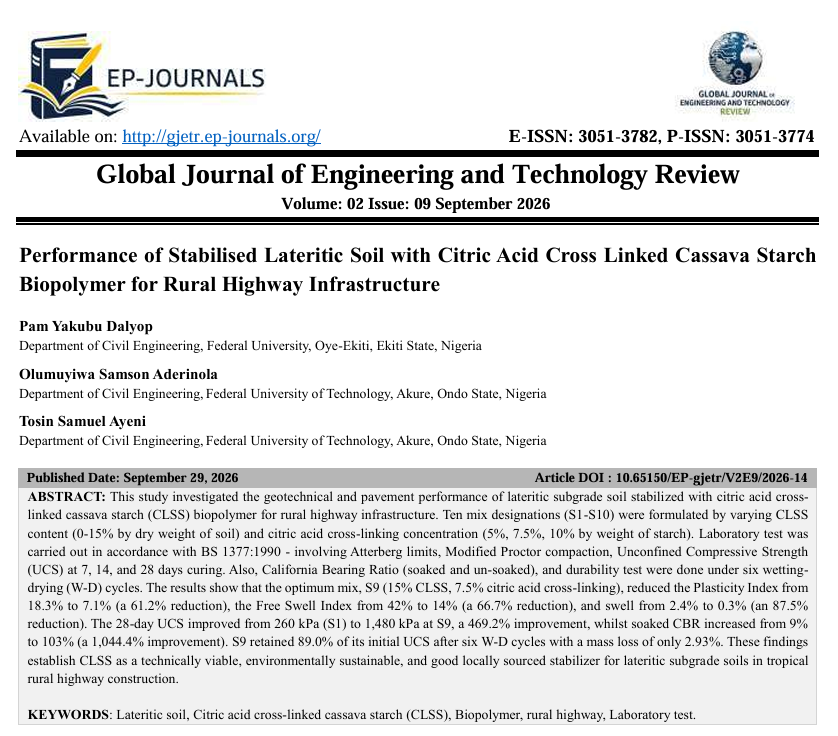
This study investigated the geotechnical and pavement performance of lateritic subgrade soil stabilized with citric acid cross-linked cassava starch (CLSS) biopolymer for rural highway infrastructure. Ten mix designations (S1-S10) were formulated by varying CLSS content (0-15% by dry weight of soil) and citric acid cross-linking concentration (5%, 7.5%, 10% by weight of starch). Laboratory test was carried out in accordance with BS 1377:1990 - involving Atterberg limits, Modified Proctor compaction, Unconfined Compressive Strength (UCS) at 7, 14, and 28 days curing. Also, California Bearing Ratio (soaked and un-soaked), and durability test were done under six wetting-drying (W-D) cycles. The results show that the optimum mix, S9 (15% CLSS, 7.5% citric acid cross-linking), reduced the Plasticity Index from 18.3% to 7.1% (a 61.2% reduction), the Free Swell Index from 42% to 14% (a 66.7% reduction), and swell from 2.4% to 0.3% (an 87.5% reduction). The 28-day UCS improved from 260 kPa (S1) to 1,480 kPa at S9, a 469.2% improvement, whilst soaked CBR increased from 9% to 103% (a 1,044.4% improvement). S9 retained 89.0% of its initial UCS after six W-D cycles with a mass loss of only 2.93%. These findings establish CLSS as a technically viable, environmentally sustainable, and good locally sourced stabilizer for lateritic subgrade soils in tropical rural highway construction.
References
1) Amadi, A. A., and Oke, O. (2018). Strength characteristics of lateritic soils stabilised with biopolymers. Geotechnical and Geological Engineering, 36(4), 2301–2314.
2) Ashok Kumar, M., Moghal, A. A. B., Bommisetty, J., and Mohammad, N. (2022). Efficacy of cross-linking of biopolymers in soil stabilization. In Indian Geotechnical Conference (pp. 163–175). Singapore: Springer Nature Singapore.
3) ASTM D559. (2003). Standard test methods for wetting and drying compacted soil-cement mixtures. West Conshohocken, PA: ASTM International.
4) Ayeldeen, M., Negm, A., El Sawwaf, M., and Kitazume, M. (2017). Enhancing mechanical behaviors of collapsible soil using biopolymers. Journal of Geotechnical and Geoenvironmental Engineering, 143(9), 04017076.
5) Banne, S. P., Ingle, G. S., Dhawale, A., Gaikwad, S., and Bobade, S. (2025). Experimental study on the stabilization of laterite soil with chitosan biopolymer for subgrade applications. Engineering and Applied Science Research, 52(3), 270–281.
6) Bhattacharyya, R., Lal, R., Mandal, B., and Das, T. (2021). Effects of biochar on soil properties and crop productivity in degraded soils: A meta-analysis. Soil and Tillage Research, 204, 104731.
7) BS 1377-1:1990. (1990). Methods of test for soils for civil engineering purposes—Part 1: General requirements and sample preparation. London, England: British Standards Institution.
8) BS 1377-2:1990. (1990). Methods of test for soils for civil engineering purposes—Part 2: Classification tests. London, England: British Standards Institution.
9) BS 1377-4:1990. (1990). Methods of test for soils for civil engineering purposes—Part 4: Compaction-related tests. London, England: British Standards Institution.
10) BS 1377-7:1990. (1990). Methods of test for soils for civil engineering purposes—Part 7: Shear strength tests (total stress). London, England: British Standards Institution.
11) Chang, I., Im, J., and Cho, G. C. (2016). Introduction of microbial biopolymers in soil treatment for future environmentally-friendly and sustainable geotechnical engineering. Sustainability, 8(3), 251.
12) Fenglai, Z., Hongxing, Y., and Jinghua, Y. (2018). Study on the energy consumption and carbon emissions of cement production in China. Journal of Cleaner Production, 172, 526–534.
13) Food and Agriculture Organization. (2023). FAOSTAT: Cassava production statistics. Rome, Italy: FAO.
14) Gidigasu, M. D. (1976). Laterite soil engineering: Pedogenesis and engineering principles. Amsterdam, Netherlands: Elsevier.
15) Im, J., Chang, I., and Cho, G. C. (2021). Effects of malonic acid crosslinked starch for soil strength improvement. Transportation Geotechnics, 31, 100653.
16) Kahraman, K., Koksel, H., and Ng, P. K. (2015). Optimisation of the reaction conditions for the production of cross-linked starch with high resistant starch content. Food Chemistry, 174, 173–179.
17) Latifi, N., Horpibulsuk, S., Meehan, C. L., Abd Majid, M. Z., Tahir, M. M., and Mohamad, E. T. (2017). Improvement of problematic soils with biopolymer—An environmentally friendly soil stabilizer. Journal of Materials in Civil Engineering, 29(2), 04016204.
18) Oluwatuyi, O. E., Adeola, A. A., and Osinubi, K. J. (2020). Stabilisation of lateritic soil with biopolymers for road construction. Construction and Building Materials, 247, 118572.
19) Osinubi, K. J., Eberemu, A. O., and Amadi, A. A. (2016). Lateritic soils in highway engineering: A review. Journal of Engineering Research, 21(1), 1–15.
20) Rashid, A. S. A., Tabatabaei, S., Horpibulsuk, S., Yunus, N. Z. M., and Hassan, W. H. W. (2019). Shear strength improvement of lateritic soil stabilized by biopolymer-based stabilizer. Geotechnical and Geological Engineering, 37, 5533–5541.
21) Razanajatovo, H. O., Ravelomanantsoa, S., Rasoazanany, E. O., Matondo, A., Ashande, C. M., Ridwan, M., Ngbolu, K. N., & Rahelivololoniaina, B. R. (2020). Effect of cassava (Manihot esculenta Crantz: Euphorbiaceae) starch on the stabilization of Malagasy lateritic soil. Budapest International Research in Exact Sciences (BirEx) Journal, 2(4), 467–481.
22) Reddy, N., Zhang, Y., and Yang, Y. (2015). Citric acid cross-linking of starch for soil stabilisation. Industrial Crops and Products, 72, 88–95.
23) Walter, L., Estevez, Y., Medjigbodo, G., Aubert, J.-E., Linguet, L., and Nait-Rabah, O. (2023). Exploring the potential of locally sourced biopolymers to stabilize lateritic earthen construction. In Proceedings of the 5th International Conference on Bio-Based Building Materials (ICBBM) (pp. 1–12).
Downloads
Published
Issue
Section
License
Copyright (c) 2026 Pam Yakubu Dalyop , Olumuyiwa Samson Aderinola, Tosin Samuel Ayeni (Author)

This work is licensed under a Creative Commons Attribution 4.0 International License.