Experimental Evaluation of a Photovoltaic Powered DC Heating System with Closed-Loop Temperature Control for a Hybrid Dryer
DOI:
https://doi.org/10.65150/EP-gjetr/V2E11/2026-05Keywords:
Photovoltaic Heating, Temperature Regulation, Hybrid Dryer, DC heater, DC– DC Converter, Closed-loop Control.Abstract
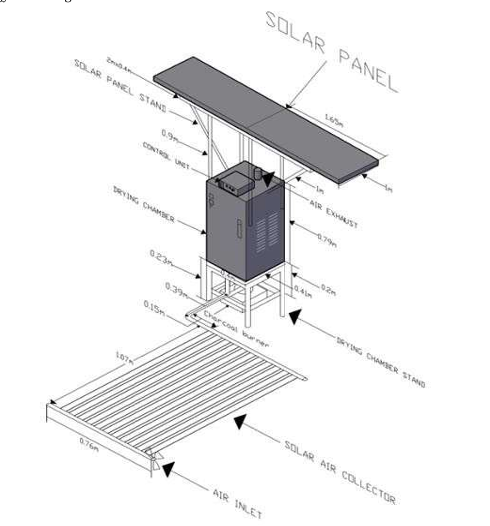
Photovoltaic (PV)-powered electrical heating can provide a fast and controllable auxiliary heat source for hybrid agricultural dryers, but its effectiveness depends on stable DC power conversion and accurate thermal feedback. This study experimentally evaluates a PV-powered direct-current heating subsystem integrated into a modular hybrid dryer. The electrical subsystem used two 350 W PV modules in parallel, an adjustable 800 W DC–DC converter, and a 600 W, 35 V resistive heater. Chamber temperature was regulated by thermistor feedback through an SG3524 PWM controller, C1815 driver transistor and IRFP4468 MOSFET switching stage. The high-power heater was supplied directly from the PV array through the regulated converter, while the auxiliary battery served the low-power fan and control circuits. Measurements were recorded at 15-min intervals during a five-hour electrical control test and an eight-hour plantain drying experiment. Converter input voltage varied from 28.50 to 33.71 V while output voltage remained within 34.70– 35.00 V. Mean converter efficiency was 91.30% with a standard deviation of 0.29% and coefficient of variation of 0.32%. Mean steady-state heater power was 600.13 W, with a standard deviation of 1.97 W and coefficient of variation of 0.33%. Chamber temperature increased from 30.4 to 59.7 °C within approximately one hour and subsequently remained near the 60 °C set-point, giving a steady-state mean of 60.13 °C, standard deviation of 0.11 °C, coefficient of variation of 0.18%, mean absolute temperature error of 0.13 °C and maximum absolute deviation of 0.30 °C. In the associated drying test, 10 kg of fresh plantain at 65% wet-basis moisture content was reduced to approximately 10% in 8 h, with the maximum interval drying rate of 1.29 kg h−1 occurring at 1.75 h. The results demonstrate that direct PV-to-DC heating, when coupled with regulated power conversion and closed-loop electronic control, can provide a stable and responsive auxiliary heat source for modular hybrid drying.
References
1) Akinyemi, O. F., A. A. Adebayo, and S. A. Oladipo. 2022. “Assessment of Post-harvest Losses of Plantain (Musa paradisiaca) in Selected Markets in South-Western Nigeria.” Journal of Agricultural Extension 26 (1): 56–65. https://doi.org/10.4314/jae.v26i1.7.
2) Amer, B. M. A., M. A. Hossain, and K. Gottschalk. 2010. “Design and Performance Evaluation of a New Hybrid Solar Dryer for Banana.” Energy Conversion and Management 51 (4): 813– 820. https://doi.org/10.1016/j.enconman.2009.11.016.
3) Baddadi, Sara, Safa Skouri, Rabeb Ayed, Laxmikant Jathar, and Salwa Bouadila. 2023. “Performance Investigation of an Innovative Solar Heating Unit for a Powered Self-Sustained Solar Dryer.” Applied Thermal Engineering 233: 121173.https://doi.org/10.1016/j.applthermaleng.2023.121173.
4) Bhange, Saurabh S., and Sanjay S. Deshmukh. 2025. “Design and Testing of a Solar Biomass Hybrid Dryer for Vegetables Drying.” International Journal of Mechanical Engineering 12 (11): 110–120. https://doi.org/10.14445/23488360/IJME-V12I11P110.
5) Duque-Dussán, Eduardo, Juan R. Sanz-Uribe, and Jan Banout. 2023. “Design and Evaluation of a Hybrid Solar Dryer for Postharvesting Processing of Parchment Coffee.” Renewable Energy 215: 118961. https://doi.org/10.1016/j.renene.2023.118961.
6) Elangovan, Elavarasan, and Sendhil Kumar Natarajan. 2022. “Experimental Research of Drying Characteristic of Red Banana in a Single Slope Direct Solar Dryer Based on Natural and Forced Convection.” Food Technology and Biotechnology 59 (2): 215–225. https://doi.org/10.17113/ftb.59.02.21.6876.
7) El-Sebaii, A. A., and S. M. Shalaby. 2012. “Solar Drying of Agricultural Products: A Review.” Renewable and Sustainable Energy Reviews 16 (1): 37–43. https://doi.org/10.1016/j.rser.2011.07.134.
8) Ibrahim, Ayman, Islam Elsebaee, Alia Amer, Galal Aboelasaad, Abdelalim El-Bediwy, and Mohamed El-Kholy. 2023. “Development and Evaluation of a Hybrid Smart Solar Dryer.” Journal of Food Science 88 (9): 3859–3878. https://doi.org/10.1111/1750-3841.16713.
9) Jha, Aprajeeta, and P. Tripathy. 2021. “Recent Advancements in Design, Application, and Simulation Studies of Hybrid Solar Drying Technology.” Food Engineering Reviews 13 (2): 375–410. https://doi.org/10.1007/s12393-020-09223-2.
10) Kiburi, F. G., C. L. Kanali, G. M. Kituu, P. O. Ajwang, and E. K. Ronoh. 2020. “Performance Evaluation and Economic Feasibility of a Solar-Biomass Hybrid Greenhouse Dryer for Drying Banana Slices.” Renewable Energy Focus 34: 60–68.https://doi.org/10.1016/j.ref.2020.06.009.
11) Koli, Chandra Shekhar, M. K. Gaur, and Pushpendra Singh. 2022. “Energy and Exergy Assessment of a Novel Parabolic Hybrid Active Greenhouse Solar Dryer.” Solar Energy 245: 228–242. https://doi.org/10.1016/j.solener.2022.09.021.
12) Kong, Decheng, Yunfeng Wang, Ming Li, and Jingkang Liang. 2024. “A Comprehensive Review of Hybrid Solar Dryers Integrated with Auxiliary Energy and Units for Agricultural Products.” Energy 293: 130640. https://doi.org/10.1016/j.energy.2024.130640.
13) Mahajan, K. M., V. H. Patil, and T. A. Koli. 2024. “Design Analysis of an Innovative Solar Biomass Hybrid Dryer for Drying Turmeric.” Hyperfine Interactions 245: 32. https://doi.org/10.1007/s10751-024-01965-3.
14) Mawire, Ashmore, Masodi Ramokali, Molebogeng Mothupi, and Maarten Vierschot. 2024. “An Experimental Evaluation of Drying Banana Slices Using a Novel Indirect Solar Dryer Under Variable Conditions.” Heliyon 10 (5): e28268.https://doi.org/10.1016/j.heliyon.2024.e28268.
15) Mishra, Laxman, Lalhmingsanga Hauchhum, and Rajat Gupta. 2022. “Development and Performance Investigation of a Novel Solar-Biomass Hybrid Dryer.” Applied Thermal Engineering 211: 118492. https://doi.org/10.1016/j.applthermaleng.2022.118492.
16) Rahman, M. A., S. M. M. Hasnain, P. Paramasivam, R. Zairov, and A. G. Ayanie. 2025. “Solar Drying for Domestic and Industrial Applications: A Comprehensive Review of Innovations and Efficiency Enhancements.” Global Challenges 9 (3): 2400301. https://doi.org/10.1002/gch2.202400301.
17) Rawat, Pratish, and Sourav Kumar. 2022. “Designing and Construction of Low Cost Hybrid Photovoltaic-Thermal (PVT) Solar Dryer.” International Journal of Creative Research Thoughts 10 (5): 231–238.
Downloads
Published
Issue
Section
License
Copyright (c) 2026 DARE, Aderonke Adekemi , BABATUNDE, Steven Emmanuel , ENOCHOGHENE, Samuel Oghenenyerovwo, ADESINA, Olusegun Bola (Author)

This work is licensed under a Creative Commons Attribution 4.0 International License.