Integrating Solar-Powered PV Cells And SCR-Controlled Three-Phase Rectifiers to Design A Two-Level DC Grid Architecture
DOI:
https://doi.org/10.65150/EP-gjetr/V2E10/2026-01Keywords:
Rectifier, Inverter, Solar power, DC grid system, Buck-boost converterAbstract
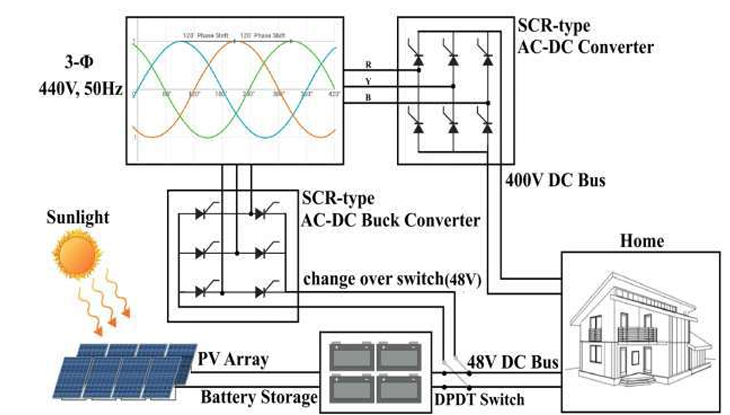
The use of electrical equipment is booming with the growth of the population and the advancement of technology. Acceptance largely depends on cost-benefit considerations during production, distribution, and use. Power electronics, especially inverter and buck-boost converter technology, perfectly serves the purpose nowadays. Equipment embedded with this technology has gained popularity for optimal energy consumption, along with other rational advantages, such as size and cost. However, the dynamics of power conversion within the machinery in such customs are repetitive and sometimes unnecessary. Eliminating recurring processes can remove inadequacies such as complex design, dedicated control schemes, and high maintenance costs that arise from them. The article presents a two-level DC distribution line for consumers who use a wide range of electrical loads. The work integrated the output of a three-phase SCR-controlled, power-efficient AC-to-DC converter and the output of a solar cell to build the dual DC grid. The performance analysis of the novel framework for cataloged loads was conducted using simulations, and the outcomes were observed to be satisfactory.
References
1) Mehedi Hasan Manik. (2024). Demographic and Socio-economic Changes in Bangladesh: Evidence from the Population Census in 2022. Formosa Journal of Sustainable Research, 3(1), 29–38. https://doi.org/10.55927/fjsr.v3i1.5762
2) Uzir, Md. U. H., Hamid, A. B. A., Jerin, I., Latiff, A. S. A., & Thurasamy, R. (2021). Customer satisfaction and brand loyalty to electronic home appliances in Bangladesh: the contingent role of brand trust. SN Business & Economics, 1(6). https://doi.org/10.1007/s43546-021-00088-z
3) Adrián Vidal-Santo, Campos-Domínguez, A., Vázquez-Guzmán, A. G., & Castillo, W. A. (2024). Inverter technology and the role of the user behavior: Towards a more efficient use of energy. Revista de Aplicaciones de La Ingeniería, 20–25.https://doi.org/10.35429/jea.2024.32.11.20.25
4) Cordova-Fajardo, M. A., & Tututi, E. S. (2019). Incorporating home appliances into a DC home nanogrid. Journal of Physics: Conference Series, 1221, 012048. https://doi.org/10.1088/1742-6596/1221/1/012048
5) Sabry, A. H., Shallal, A. H., Hameed, H. S., & Ker, P. J. (2020). Compatibility of household appliances with DC microgrid for PV systems. Heliyon, 6(12), e05699. https://doi.org/10.1016/j.heliyon.2020.e05699
6) Kuhlmann, T., Bianchini, I., & Sauer, A. (2020). Resource and energy efficiency assessment of an industrial DC smart grid. Procedia CIRP, 90, 672–676. https://doi.org/10.1016/j.procir.2020.01.074
7) Memon, D. A., Ali, K. H., Memon, A. A., Ansari, J. A., Badar, J., Alharbi, M., Banatwala, A. Z., & Kumar, M. (2024). Comparative analysis and implementation of DC microgrid systems versus AC microgrid performance. Frontiers in Energy Research, 12.https://doi.org/10.3389/fenrg.2024.1370547
8) Gelani, H., Dastgeer, F., Siraj, K., Nasir, M., Niazi, K., & Yang, Y. (2019). Efficiency Comparison of AC and DC Distribution Networks for Modern Residential Localities. Applied Sciences, 9(3), 582. https://doi.org/10.3390/app9030582
9) Haroon, A., Hasan Erteza Gelani, Tahir, H., & Manzoor, H. U. (2025). DC vs. AC distribution: Revealing the efficiency advantage of DC in today’s energy landscape. PLoS ONE, 20(5), e0318444–e0318444. https://doi.org/10.1371/journal.pone.0318444
10) Kim, S., & Jeon, H. (2022). Comparative Analysis on AC and DC Distribution Systems for Electric Propulsion Ship. Journal of Marine Science and Engineering, 10(5), 559. https://doi.org/10.3390/jmse10050559
11) Memon, D. A., Ali, K. H., Memon, A. A., Ansari, J. A., Badar, J., Alharbi, M., Banatwala, A. Z., & Kumar, M. (2024). Comparative analysis and implementation of DC microgrid systems versus AC microgrid performance. Frontiers in Energy Research, 12.https://doi.org/10.3389/fenrg.2024.1370547
12) Mahmud, D. M., Ahmed, S. M. M., Hasan, S., & Zeyad, M. (2022). Grid-connected microgrid: design and feasibility analysis for a local community in Bangladesh. Clean Energy, 6(3), 447–459. https://doi.org/10.1093/ce/zkac022
13) Talukder, K., Zarin Anjum Ananna, Islam, S., Hasan, M., & Chowdhury, N.-U.-R. (2024). A Model Based Study on the Functionality of DC Microgrids for the Sustainable Rural Electrification in Bangladesh. Zenodo. https://doi.org/10.5281/zenodo.11159326
14) Mahmud, D. M., Ahmed, S. M. M., Hasan, S., & Zeyad, M. (2022). Grid-connected microgrid: design and feasibility analysis for a local community in Bangladesh. Clean Energy, 6(3), 447–459. https://doi.org/10.1093/ce/zkac022
15) Asif, N., Molla, N. S., Tabassum, N. A., & None Md. Shawon. (2025). Design and Comparative Analysis of Single-Phase and Three-Phase Double-Stage Inverters for Photovoltaic Systems. International Journal of Scientific Research in Science, Engineering and Technology, 12(5), 407–417. https://doi.org/10.32628/ijsrset25125046
16) Sarkar, A. A., & Turna, S. S. (2024). A Comparative Study Between Single-Phase Rectifier and Three Phase Rectifier: Running the Inverter Technology Operated Home Appliances. Engineering: Open Access, 2(3), 01–08. https://doi.org/10.33140/eoa.02.03.11
Downloads
Published
Issue
Section
License
Copyright (c) 2026 Sadia Sultana Turna, Amzad Ali Sarkar (Author)

This work is licensed under a Creative Commons Attribution 4.0 International License.