Conceptual Framework for AI Emotional Recognition in Children with Learning Difficulties for Paediatric Screening
DOI:
https://doi.org/10.65150/EP-gjetr/V2E5/2026-05Keywords:
Achievement of Emotion, Affective Computing, CNN, Dyslexia, Facial Emotional Recognition, Machine LearningAbstract
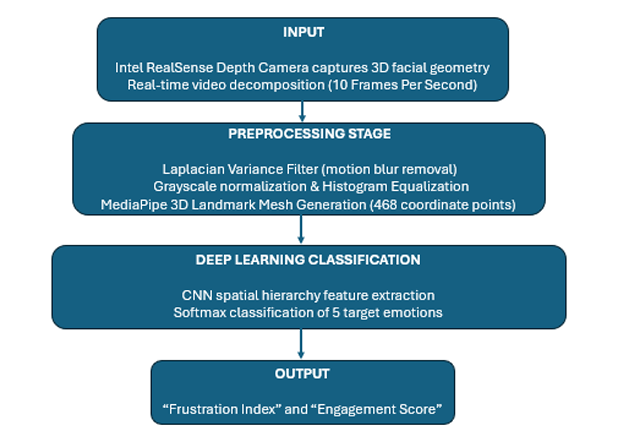
Assessing the emotional states of children with learning difficulties (LD) is critical for effective pedagogical and clinical intervention. However, existing diagnostic methods rely on subjective observations which are prone to human bias and lack a localised Asian-centric perspective. This concept paper proposes an AI-based Facial Emotional Recognition (FER) initiative designed to provide objective, real-time assessment of emotional engagement in children with dyslexia during learning activities. The framework utilises a mixed-methods approach, combining a Convolutional Neural Network (CNN) pipeline for video-to-image emotion classification with clinical field validation at the SPARK Child Development Centre. The system leverages 3D depth-sensing technology via Intel RealSense to extract 468 facial landmarks. Preliminary validation of the initiative’s expert-rated dataset achieved a Cohen’s Kappa of 0.87, indicating excellent inter-rater reliability. By bridging the gap between traditional psychiatric screening and modern affective computing, this digitalisation initiative supports the SDG 4 goals, offering a scalable tool for more precise and timely support for children with learning disabilities.
References
1) Adi, N. S., Kuay, H. S., & Mustafa, Q. M. (2024). A study on the psychological functioning of children with specific learning difficulties and typically developing children. BMC Psychology, 12(1), 1–12. https://doi.org/10.1186/s40359-024-02151-4
2) Banerjee, A., Mutlu, O. C., Kline, A., Surabhi, S., Washington, P., & Wall, D. P. (2023). Training and profiling a paediatric facial expression classifier for children on mobile devices: Machine learning study. JMIR Formative Research, 7, e39917.
3) Romani-Sponchiado, A., Sanvicente-Vieira, B., Mottin, C., Hertzog-Fonini, D., & Arteche, A. (2015). Child Emotions Picture Set (CEPS): Development of a database of children’s emotional expressions. Psychology & Neuroscience, 8(4), 467–478.
https://doi.org/10.1037/h0101430.
4) Choudhary, K., & Prajapati, G. G. L. (2026). Graph-based multimodal affect recognition in children using prototypical networks. Frontiers in Computer Science, 8, 104–118. https://doi.org/10.3389/fcomp.2026.1774796
5) He, K., Zhang, X., Ren, S., & Sun, J. (2016). Deep residual learning for image recognition. In Proceedings of the IEEE Conference on Computer Vision and Pattern Recognition (CVPR) (pp. 770–778). https://doi.org/10.1109/CVPR.2016.90
6) Li, S., & Deng, W. (2020). Deep facial expression recognition: A survey. IEEE Transactions on Affective Computing, 13(3), 1195–1215. https://doi.org/10.1109/TAFFC.2020.2981446
7) Nag, A., Haber, N., Voss, C., Tamura, S., Daniels, J., Ma, J., ... & Wall, D. P. (2020). Toward continuous social phenotyping: Analyzing gaze patterns in an emotion recognition task for children with autism. Journal of Medical Internet Research, 22(4), e13810. https://doi.org/10.2196/13810
8) Pekrun, R., & Goetz, T. (2023). How universal are academic emotions? A control-value theory perspective. In G. Hagenauer, R. Lazarides, & H. Järvenoja (Eds.), Motivation and emotion in learning and teaching across educational contexts: Theoretical and methodological perspectives and empirical insights (pp. 85–99). Taylor & Francis / Routledge.
9) Van Voorhis, W. C., & Morgan, B. L. (2007). Understanding power and rules of thumb for determining sample sizes. Tutorials in Quantitative Methods for Psychology, 3(2), 43–50. https://doi.org/10.20982/tqmp.03.2.p043
10) Wang, Y., Luo, Q., Zhang, Y., & Zhao, K. (2024). Synchrony or asynchrony: development of facial expression recognition from childhood to adolescence based on large-scale evidence. Frontiers in Psychology, 15, 1379652. https://doi.org/10.3389/fpsyg.2024.1379652
11) Xie, J., & Fan, M. (2025). The role of academic emotions in learning: Addressing student motivation, performance, and learning strategies. In Academic Achievement-Perspectives of Students, Teachers, and Institutions. IntechOpen. https://doi.org/10.5772/intechopen.1009197
Downloads
Published
Issue
Section
License
Copyright (c) 2026 Marcella Peter, Jackie Ting Tiew Wei, Khairunnisa Ibrahim (Author)

This work is licensed under a Creative Commons Attribution 4.0 International License.