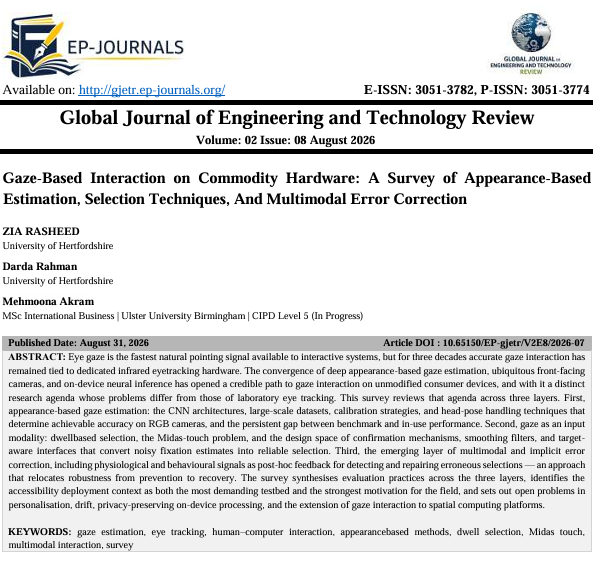
Gaze-Based Interaction on Commodity Hardware: A Survey of Appearance-Based Estimation, Selection Techniques, And Multimodal Error Correction
DOI:
https://doi.org/10.65150/EP-gjetr/V2E8/2026-07Keywords:
gaze estimation,, eye tracking, human–computer interaction, appearance-based methods, dwell selection, Midas touch, multimodal interaction, surveyAbstract
Eye gaze is the fastest natural pointing signal available to interactive systems, but for three decades accurate gaze interaction has remained tied to dedicated infrared eyetracking hardware. The convergence of deep appearance-based gaze estimation, ubiquitous front-facing cameras, and on-device neural inference has opened a credible path to gaze interaction on unmodified consumer devices, and with it a distinct research agenda whose problems differ from those of laboratory eye tracking. This survey reviews that agenda across three layers. First, appearance-based gaze estimation: the CNN architectures, large-scale datasets, calibration strategies, and head-pose handling techniques that determine achievable accuracy on RGB cameras, and the persistent gap between benchmark and in-use performance. Second, gaze as an input modality: dwellbased selection, the Midas-touch problem, and the design space of confirmation mechanisms, smoothing filters, and target-aware interfaces that convert noisy fixation estimates into reliable selection. Third, the emerging layer of multimodal and implicit error correction, including physiological and behavioural signals as post-hoc feedback for detecting and repairing erroneous selections — an approach that relocates robustness from prevention to recovery. The survey synthesises evaluation practices across the three layers, identifies the accessibility deployment context as both the most demanding testbed and the strongest motivation for the field, and sets out open problems in personalisation, drift, privacy-preserving on-device processing, and the extension of gaze interaction to spatial computing platforms.
References
1) K. Krafka, A. Khosla, P. Kellnhofer, H. Kannan, S. Bhandarkar, W. Matusik, and A. Torralba, "Eye tracking for everyone," in Proc. IEEE Conf. Computer Vision and Pattern Recognition (CVPR), 2016, pp. 2176–2184.
2) X. Zhang, Y. Sugano, M. Fritz, and A. Bulling, "Appearance-based gaze estimation in the wild," in Proc. IEEE Conf. Computer Vision and Pattern Recognition (CVPR), 2015, pp. 4511–4520.
3) R. J. K. Jacob, "What you look at is what you get: eye movement-based interaction techniques," in Proc. ACM CHI Conf. Human Factors in Computing Systems, 1990, pp. 11–18.
4) R. S. Sutton and A. G. Barto, Reinforcement Learning: An Introduction, 2nd ed. Cambridge, MA: MIT Press, 2018.
5) X. Zhang, Y. Sugano, M. Fritz, and A. Bulling, "MPIIGaze: Real-world dataset and deep appearance-based gaze estimation," IEEE Trans. Pattern Analysis and Machine Intelligence, vol. 41, no. 1, pp. 162–175, 2019.
6) S. Park, A. Spurr, and O. Hilliges, "Deep pictorial gaze estimation," in Proc. European Conf. Computer Vision (ECCV), 2018, pp. 721–738.
7) Bulling and H. Gellersen, "Toward mobile eye-based human-computer interaction," IEEE Pervasive Computing, vol. 9, no. 4, pp. 8–12, 2010.
8) P. Majaranta and A. Bulling, "Eye tracking and eye-based human–computer interaction," in Advances in Physiological Computing, Springer, 2014, pp. 39–65.
9) D. W. Hansen and Q. Ji, "In the eye of the beholder: A survey of models for eyes and gaze," IEEE Trans. Pattern Analysis and Machine Intelligence, vol. 32, no. 3, pp. 478–500, 2010.
10) W. Picard, Affective Computing. Cambridge, MA: MIT Press, 1997.
11) H. Fairclough, "Fundamentals of physiological computing," Interacting with Computers, vol. 21, no. 1–2, pp. 133–145, 2009.
12) F. Shaffer and J. P. Ginsberg, "An overview of heart rate variability metrics and norms," Frontiers in Public Health, vol. 5, art. 258, 2017.
13) P. M. Fitts, "The information capacity of the human motor system in controlling the amplitude of movement," Journal of Experimental Psychology, vol. 47, no. 6, pp. 381–391, 1954.
14) K. Ruhland et al., "A review of eye gaze in virtual agents, social robotics and HCI," Computer Graphics Forum, vol. 34, no. 6, pp. 299–326, 2015.
15) M. Kumar, A. Paepcke, and T. Winograd, "EyePoint: Practical pointing and selection using gaze and keyboard," in Proc. ACM CHI Conf. Human Factors in Computing Systems, 2007, pp. 421–430.
16) C. H. Morimoto and M. R. M. Mimica, "Eye gaze tracking techniques for interactive applications," Computer Vision and Image Understanding, vol. 98, no. 1, pp. 4–24, 2005.
Downloads
Published
Issue
Section
License
Copyright (c) 2026 ZIA RASHEED, Darda Rahman, Mehmoona Akram (Author)

This work is licensed under a Creative Commons Attribution 4.0 International License.