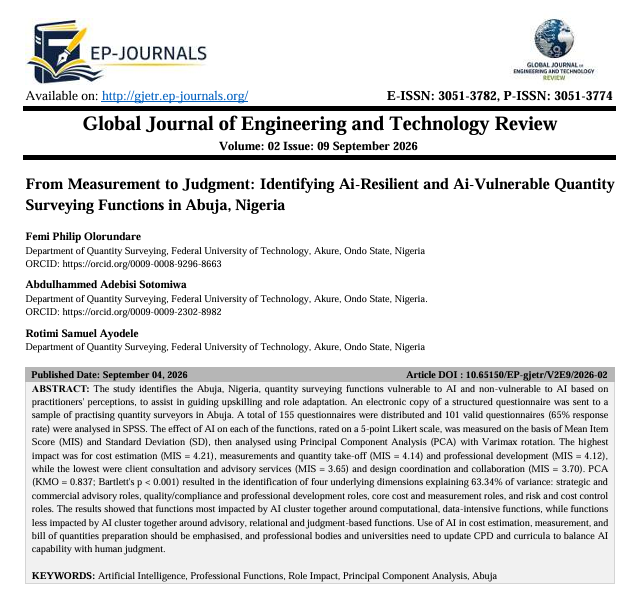
From Measurement to Judgment: Identifying Ai-Resilient and Ai-Vulnerable Quantity Surveying Functions in Abuja, Nigeria
DOI:
https://doi.org/10.65150/EP-gjetr/V2E9/2026-02Keywords:
Artificial Intelligence, Professional Functions, Role Impact, Principal Component Analysis, AbujaAbstract
The study identifies the Abuja, Nigeria, quantity surveying functions vulnerable to AI and non-vulnerable to AI based on practitioners' perceptions, to assist in guiding upskilling and role adaptation. An electronic copy of a structured questionnaire was sent to a sample of practising quantity surveyors in Abuja. A total of 155 questionnaires were distributed and 101 valid questionnaires (65% response rate) were analysed in SPSS. The effect of AI on each of the functions, rated on a 5-point Likert scale, was measured on the basis of Mean Item Score (MIS) and Standard Deviation (SD), then analysed using Principal Component Analysis (PCA) with Varimax rotation. The highest impact was for cost estimation (MIS = 4.21), measurements and quantity take-off (MIS = 4.14) and professional development (MIS = 4.12), while the lowest were client consultation and advisory services (MIS = 3.65) and design coordination and collaboration (MIS = 3.70). PCA (KMO = 0.837; Bartlett's p < 0.001) resulted in the identification of four underlying dimensions explaining 63.34% of variance: strategic and commercial advisory roles, quality/compliance and professional development roles, core cost and measurement roles, and risk and cost control roles. The results showed that functions most impacted by AI cluster together around computational, data-intensive functions, while functions less impacted by AI cluster together around advisory, relational and judgment-based functions. Use of AI in cost estimation, measurement, and bill of quantities preparation should be emphasised, and professional bodies and universities need to update CPD and curricula to balance AI capability with human judgment.
References
1) Abioye, S.O., Oyedele, L.O., Akanbi, L., Ajayi, A., Delgado, J.M.D., Bilal, M., Akinade, O.O. and Ahmed, A. (2021). Artificial intelligence in the construction industry: a review of present status, opportunities and future challenges, Journal of Building Engineering, 44, 103299. https://doi.org/10.1016/j.jobe.2021.103299
2) Aghimien, D.O., Oke, A.E. and Aigbavboa, C.O. (2018). Barriers to the adoption of value management in developing countries, Engineering, Construction and Architectural Management, 25(7), 818-834. https://doi.org/10.1108/ECAM-04-2017-0070
3) Akinosho, T.D., Oyedele, L.O., Bilal, M., Ajayi, A.O., Delgado, M.D., Akinade, O.O. and Ahmed, A.A. (2020). Deep learning in the construction industry: a review of present status and future innovations, Journal of Building Engineering, 32, 101827.https://doi.org/10.1016/j.jobe.2020.101827
4) Akinradewo, O., Aigbavboa, C., Aghimien, D., Oke, A. and Ogunbayo, B. (2023). Modular method of construction in developing countries: the underlying challenges, International Journal of Construction Management, 23(8), 1344-1354.https://doi.org/10.1080/15623599.2021.1970300
5) Babatunde, S.O., Perera, S., Ekundayo, D. and Adeleye, T.E. (2020). An investigation into BIM-based detailed cost estimating and drivers to the adoption of BIM in quantity surveying practices, Journal of Financial Management of Property and Construction, 25(1),61-81. https://doi.org/10.1108/JFMPC-05-2019-0042
6) Bello, S.A., Oyedele, L.O., Akinade, O.O., Bilal, M., Davila Delgado, J.M., Akanbi, L.A., Ajayi, A.O. and Owolabi, H.A. (2021). Cloud computing in construction industry: use cases, benefits and challenges, Automation in Construction, 122, 103441.https://doi.org/10.1016/j.autcon.2020.103441
7) Compeau, D., Higgins, C.A. and Huff, S. (1999). Social cognitive theory and individual reactions to computing technology: a longitudinal study, MIS Quarterly, 23(2), 145-158. https://doi.org/10.2307/249749
8) Davis, F.D. (1989). Perceived usefulness, perceived ease of use, and user acceptance of information technology, MIS Quarterly, 13(3),319-340. https://doi.org/10.2307/249008
9) Egwim, C.N., Alaka, H., Toriola-Coker, L.O., Balogun, H. and Sunmola, F. (2021). Applied artificial intelligence for predicting construction projects delay, Machine Learning with Applications, 6, 100166. https://doi.org/10.1016/j.mlwa.2021.100166
10) Elshafey, A., Saar, C.C., Aminudin, E.B., Gheisari, M. and Usmani, A. (2020). Technology acceptance model for augmented reality and building information modeling integration in the construction industry, Journal of Information Technology in Construction, 25, 161-172. https://doi.org/10.36680/j.itcon.2020.010
11) Faiz, F., Le, V. and Masli, E.K. (2024). Determinants of digital technology adoption in innovative SMEs, Journal of Innovation and Knowledge, 9(4), 100610. https://doi.org/10.1016/j.jik.2024.100610
12) Field, A. (2013). Discovering Statistics Using SPSS, 4th ed. Sage Publications, London.
13) Kabir, K.H., Hassan, F., Mukta, M.Z.N., Roy, D., Darr, D., Leggette, H. and Ullah, S.M.A. (2022). Application of the technology acceptance model to assess the use and preferences of ICTs among field-level extension officers in Bangladesh, Digital Geography and Society, 3, 100027. https://doi.org/10.1016/j.diggeo.2022.100027
14) Kaiser, H.F. (1974). An index of factorial simplicity, Psychometrika, 39(1), 31-36. https://doi.org/10.1007/BF02291575
15) Kothari, C.R. (2004). Research Methodology: Methods and Techniques, 2nd ed. New Age International Publishers, New Delhi.
16) Kusimo, H., Oyedele, L., Akinade, O., Oyedele, A., Abioye, S., Agboola, A. and Mohammed-Yakub, N. (2019). Optimisation of resource management in construction projects: a big data approach, World Journal of Science, Technology and Sustainable Development, 16(2), 82-93. https://doi.org/10.1108/WJSTSD-05-2018-0044
17) Oke, A.E., Kineber, A.F., Al-Bukhari, I., Famakin, I. and Kingsley, C. (2023). Exploring the benefits of cloud computing for sustainable construction in Nigeria, Journal of Engineering, Design and Technology, 21(4), 973-990. https://doi.org/10.1108/JEDT-04-2021-0189
18) Oliveira, T., Thomas, M. and Espadanal, M. (2014). Assessing the determinants of cloud computing adoption: an analysis of the manufacturing and services sectors, Information and Management, 51(5), 497-510. https://doi.org/10.1016/j.im.2014.03.006
19) Osuizugbo, I.C. and Ojelabi, R.A. (2020). Building production management practice in the construction industry in Nigeria, Engineering Management in Production and Services, 12(2), 56-73. https://doi.org/10.2478/emj-2020-0011
20) Rogers, E.M. (2003). Diffusion of Innovations, 5th ed. Free Press, New York, NY.
21) Seidu, R.D., Young, B.E., Clack, J., Adamu, Z. and Robinson, H. (2020). Innovative changes in quantity surveying practice through BIM, big data, artificial intelligence and machine learning, Applied Science University Journal of Natural Science, 4(1), 37-47. https://doi.org/10.18576/asuj/040105
22) Yaseen, Z.M., Ali, Z.H., Salih, S.Q. and Al-Ansari, N. (2020). Prediction of risk delay in construction projects using a hybrid artificial intelligence model, Sustainability, 12(4), 1514. https://doi.org/10.3390/su12041514
Downloads
Published
Issue
Section
License
Copyright (c) 2026 Femi Philip Olorundare , Abdulhammed Adebisi Sotomiwa, Rotimi Samuel Ayodele (Author)

This work is licensed under a Creative Commons Attribution 4.0 International License.