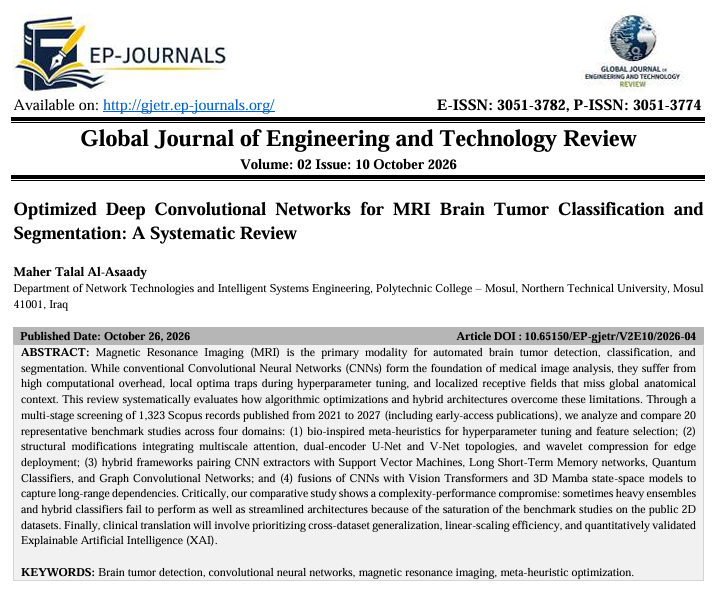
Optimized Deep Convolutional Networks for MRI Brain Tumor Classification and Segmentation: A Systematic Review
DOI:
https://doi.org/10.65150/EP-gjetr/V2E10/2026-04Keywords:
Brain tumor detection, convolutional neural networks, magnetic resonance imaging, meta-heuristic optimizationAbstract
Magnetic Resonance Imaging (MRI) is the primary modality for automated brain tumor detection, classification, and segmentation. While conventional Convolutional Neural Networks (CNNs) form the foundation of medical image analysis, they suffer from high computational overhead, local optima traps during hyperparameter tuning, and localized receptive fields that miss global anatomical context. This review systematically evaluates how algorithmic optimizations and hybrid architectures overcome these limitations. Through a multi-stage screening of 1,323 Scopus records published from 2021 to 2027 (including early-access publications), we analyze and compare 20 representative benchmark studies across four domains: (1) bio-inspired meta-heuristics for hyperparameter tuning and feature selection; (2) structural modifications integrating multiscale attention, dual-encoder U-Net and V-Net topologies, and wavelet compression for edge deployment; (3) hybrid frameworks pairing CNN extractors with Support Vector Machines, Long Short-Term Memory networks, Quantum Classifiers, and Graph Convolutional Networks; and (4) fusions of CNNs with Vision Transformers and 3D Mamba state-space models to capture long-range dependencies. Critically, our comparative study shows a complexity-performance compromise: sometimes heavy ensembles and hybrid classifiers fail to perform as well as streamlined architectures because of the saturation of the benchmark studies on the public 2D datasets. Finally, clinical translation will involve prioritizing cross-dataset generalization, linear-scaling efficiency, and quantitatively validated Explainable Artificial Intelligence (XAI).
References
1) A. Khalaf and M. Al-Asaady, "Developed trends in human identification based on behavioral biometrics," Int. J. Bus. Inf. Commun. Technol., vol. 1, no. 1, Sep. 2026, doi: 10.68092/ijbict.01.01.06.
2) S. Q. Hasan, "Shallow model and deep learning model for features extraction of images," NTU J. Eng. Technol., vol. 2, no. 3, Nov. 2023, doi: 10.56286/ntujet.v2i3. 449.
3) P. Ravali, P. C. S. Reddy, and P. Praveen, "An efficient neuro-framework for brain tumor classification using a CNN-based self-supervised learning approach with genetic optimizations," Curr. Neuropharmacol., vol. 24, no. 10, pp. 1550-1564, 2026, doi: 10.2174/011570159X378103250806214613.
4) K. Mukherjee, A. Babhulkar, M. V. Munot, and R. C. Jaiswal, "Deep learning for glioblastoma segmentation: A survey from CNNs to transformers," in Lect. Notes Netw. Syst., vol. 2127, 2027, pp. 11-22, doi: 10.1007/978-3-032-34772-5_2.
5) M. T. Ghazal, "Robust U-Net-based approach for accurate brain tumor segmentation using multimodal MRI data," NTU J. Eng. Technol., vol. 2, no. 3, Nov. 2023, doi: 10.56286/ntujet.v2i3.692.
6) H. Zou, A. Anil, and M. Qiao, "AE-UVNet: An attention enhanced hybrid architecture using U-Net and V-Net for multimodal brain tumour segmentation," in Lect. Notes Comput. Sci., vol. 16754, 2027, pp. 199-214, doi: 10.1007/978-981-92-2487-6_13.
7) E. Aslan and Y. Özüpak, "A hybrid deep learning framework based on VGG19 and U-Net for accurate brain tumor segmentation in MRI images," Magn. Reson. Lett., vol. 6, no. 4, Art. no. 200275, 2026, doi: 10.1016/j.mrl.2026.200275.
8) M. Kumar, N. Mohd, G. Shivam, A. Goyal, D. Parashar, and R. Khan, "Hybrid Aquila optimizer-Harris Hawks optimization for CNN hyperparameter tuning in brain tumor classification," Sci. Rep., vol. 16, no. 1, Art. no. 12799, 2026, doi: 10.1038/s41598-026-43329-7.
9) Winarno and A. Harjoko, "Enhancing deep learning model using Whale Optimization Algorithm on brain tumor MRI," J. Electron. Electromed. Eng. Med. Inform., vol. 8, no. 1, pp. 136-152, 2026, doi: 10.35882/jeeemi.v8i1.941.
10) R. D. Prayogo, S. A. Karimah, and H. Nambo, "HayabusaNet: Hybrid attention-based multiscale fusion CNN for accurate and efficient brain tumor classification in MRI scans," Expert Syst. Appl., vol. 331, Art. no. 133135, 2026, doi: 10.1016/j.eswa.2026.133135.
11) J. Liu, U. A. Bhatti, J. Zhang, Y. Zhang, and M. Huang, "EF-VPT-Net: Enhanced feature-based vision patch transformer network for accurate brain tumor segmentation in magnetic resonance imaging," IEEE J. Biomed. Health Inform., vol. 30, no. 9, pp. 7938-7951, 2026, doi: 10.1109/JBHI.2025.3526976.
12) L. Brezočnik, I. Fister, and V. Podgorelec, "Swarm intelligence algorithms for feature selection: A review," Appl. Sci., vol. 8, no. 9, p. 1521, Sep. 2018, doi: 10.3390/app8091521.
13) M. T. Al-Asaady, T. N. M. Aris, N. M. Sharef, and H. Hamdan, "COA-MLP: Training neural networks using the Coyote Optimization Algorithm for medical data classification," in Proc. 7th Int. Conf. Interdiscip. Comput. Sci. Eng. (ICICSE), IEEE, Nov. 2025, pp. 29-36, doi: 10.1109/ICICSE67247.2025.11390755.
14) M. Al-Asaady, T. N. M. Aris, N. M. Sharef, and H. Hamdan, "Recent advances on meta-heuristic algorithms for training multilayer perceptron neural network," JOIV: Int. J. Inform. Vis., vol. 9, no. 2, p. 658, 2025,
doi: 10.62527/joiv.9.2.3109.
15) A. Salhi and M. M. Hassan, "Enhanced brain tumor segmentation and classification based on quantum-classical attention-guided hybrid framework with Zebra Optimization Algorithm," J. Signal Process. Syst., vol. 98, no. 1, Art. no. 14, 2026, doi: 10.1007/s11265-025-01973-8.
16) N. B. Vikhe and M. Shrivastava, "White Headed Timber Optimization based deep learning model for brain tumor prediction," Biomed. Mater. Devices, vol. 4, no. 2, pp. 2072-2096, 2026, doi: 10.1007/s44174-025-00293-6.
17) M. T. Al-Asaady, T. N. M. Aris, and A. D. Khalaf, "Multi-scale Inception 1D-CNN for patient-independent congestive heart failure detection from ECG signals," in Int. Conf. Cybersecur., Data Sci., Mach. Learn. (ICCDM-2026), Kuala Lumpur: Springer, 2026.
18) M. Al-Asaady, M. Rashid, and M. Mahmood, “ECA-ECGNet: An Efficient Channel Attention-Enhanced 1D CNN for ECG Arrhythmia Detection”, Journal of Electronics, Electromedical Engineering, and Medical Informatics, vol. 8, no. 4, pp. 1609-1624, Oct. 2026.
19) A. N. K and N. A. K. M, "Haar-initialized parametric wavelet compression with attention-driven lightweight CNN for brain tumor classification on edge devices," Biomed. Phys. Eng. Express, vol. 12, no. 1, 2026, doi: 10.1088/2057-1976/ae3760.
20) R. H. M. Ameen, N. M. Basheer, and A. K. Younis, "A survey: Breast cancer classification by using machine learning techniques," NTU J. Eng. Technol., vol. 2, no. 1, May 2023, doi: 10.56286/ntujet.v2i1.367.
21) M. I. Hussain, S. H. Chowdhury, M. Mamun, and M. M. Hossain, "NeuroBlend-3: Hybrid deep and machine learning framework with explainable AI for multi-class brain tumor detection using MRI scans," Medinformatics, vol. 3, no. 1, pp. 56-66, 2026,doi: 10.47852/bonviewMEDIN52026540.
22) S. Rawas and D. AlSaeed, "Quantum enhanced machine learning for medical image analysis: A hybrid approach," Appl. Comput. Inform., pp. 1-16, 2026, doi: 10.1108/ACI-10-2025-0448.
23) H. M. Omran, K. Ibrahim, G. T. Abdel-Jaber, and A.-N. Sharkawy, "Brain tumor classification from MRI images using hybrid deep learning approaches: VGG19 with SoftMax and SVM classifiers," Int. J. Robot. Control Syst., vol. 6, no. 1, pp. 16-35, 2026,doi: 10.31763/ijrcs.v6i1.2260.
24) M. Bérété, A. Echtioui, L. Sellami, and A. A. Ben Hmida, "Hybrid CNN + LSTM + SVM model for advanced brain tumor classification," Netw. Model. Anal. Health Inform. Bioinform., vol. 15, no. 1, Art. no. 43, 2026,
doi:10.1007/s13721-025-00718-8.
25) W. Elhamzi and R. Mokni, "BrainGraphNet-ViT model: A hybrid model combining vision transformers and graph convolutional networks for brain tumor diagnosis," Sci. Rep., vol. 16, no. 1, Art. no. 16772, 2026, doi: 10.1038/s41598-026-46803-4.
26) S. Tehsin, I. M. Nasir, and R. Damaševičius, "Explainable brain tumor segmentation via attention-guided hybrid CNN-Transformer-Mamba network," Knowl.-Based Syst., vol. 343, Art. no. 116000, 2026, doi: 10.1016/j.knosys.2026.116000.
27) I. Rahim, N. R. Arpa, S. Sarkar, M. M. I. Nibir, and R. Khan, "Bridging transformers and state-space models: An efficient hybrid framework for 3D brain tumor segmentation," Biomed. Signal Process. Control, vol. 122, Art. no. 110406, 2026,doi: 10.1016/j.bspc.2026.110406.
28) K. Kumar Napa, S. Murugan, J. S. Murugan, and A. Jayanthi, "BRAIN-META: A reproducible CNN-vision transformer meta-ensemble pipeline for explainable brain tumor classification," MethodsX, vol. 16, Art. no. 103769, 2026, doi: 10.1016/j.mex.2025.103769.
29) T. B. Nguyen-Tat, L. Q. Truong, K. Q. Truong, and T. H. Ngo, "DoubleBlock-ViT: A MaxViT-based enhancement and dual-path skip connections for brain tumor segmentation in MRI scans," Comput. Methods Programs Biomed., vol. 274, Art. no. 109165, 2026,doi: 10.1016/j.cmpb.2025.109165.
Downloads
Published
Issue
Section
License
Copyright (c) 2026 Maher Talal Al-Asaady (Author)

This work is licensed under a Creative Commons Attribution 4.0 International License.