An Automated Extension and Retraction of a High-Grade Polycarbonate Plastic Modular Roof with Transition Lens Technology
DOI:
https://doi.org/10.65150/EP-gjetr/V2E5/2026-03Keywords:
Automated Extension of Polycarbonate Modular Roof, Retraction of High-Grade Polycarbonate Plastic Modular Roof, and Transition Lens TechnologyAbstract
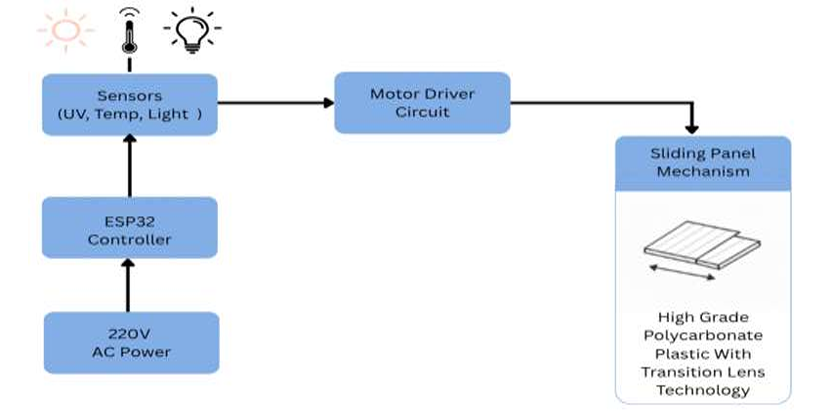
This paper is about the design concept of the automation of a smart roofing system. The designed was based on experimentation by simulation of the circuit, program coding, and actual function through application platforms like Fritzing and Tinker CAD. The materials selected are in actual used in the circuitry which are available in the market for its cheap price and is best used for experimentation to attain the basic concept of the main function of the automated roof system. The roof system was powered by 220 volts and once power on, the automation starts through the sensing of the environmental input of temperature and rain. The roof starts to extend from a 28oC or higher temperature or as rain falls on the sensor of the roof. It will retract as soon as the temperature is less than 28oC and no rain fall on the rain sensor. The roof panels were tinted with chromatic layers that will protect the area from too much light and give shade to the area. The tint automatically gives off shade as the temperature increases. The actual design of the smart roofing was done in CAD with the actual dimension and placement of the roof panels, roof frames, DC motors, sensors, and circuit box. The program codes were based on the circuit design and followed the process we designed for the function of the system. The actual price of the materials was included based on the online pricing in the Philippine market. The price was based on the small-scale design but is also ready for a bigger scale if given with financial funding. With this, adjustment for a better selection of materials is recommended and the price will increase as well. The program codes maybe adjusted based on the re-design of the customer of the roof system. This design was developed to simplify and help chores at home especially nowadays of fast transition of weather condition.
References
1) Bakkali, H. (2025). Design of a roof structure connecting containers (Doctoral dissertation, Magyar Agrár-és Élettudományi Egyetem).
2) Bano, F., & Mohammad, T. (2024). Roofing systems and energy efficiency in low-rise buildings: a comparative study across India’s diverse climates. Science Direct.https://www.sciencedirect.com/science/article/pii/S2949736123000581?via%3Dihub
3) Cha, S. M., Park, J., Han, K. S., Kim, J. D., Lee, J. M., Kwon, S., & Kim, J. (2025). Rooftop-Scale Runoff Reduction Performance of Smart Blue-Green Roofs and Their Potential Role in Urban Flood Mitigation. Water, 17(22), 3328.
4) DC Motors and small DC Gear Motors - The Basics | ISL products. (n.d.). ISL Products International.https://islproducts.com/design-note/dc-motor-dc-small-gear-motor-basics/?srsltid=AfmBOoqVP8WcCKW5Wxqx4_ThjVuCYlg0SXqFvXlWshnbVgZlh9L1Au9j
5) Ginny, Kumar, C., & Naik, K. (2021). Smartphone processor architecture, operations, and functions: current state-of-the-art and future outlook: energy performance trade-off: G. Singh et al. The Journal of Supercomputing, 77(2), 1377-1454.
6) Hill, M. (2013, November 19). CRS Tarps Provide Shelter for Thousands of Filipinos. Relief Web.
https://reliefweb.int/report/philippines/crs-tarps-provide-shelter-thousands-filipinos
7) Hoendarto, G., Muchlis, A., & Suryady, S. (2025). Techno-Economic Analysis of Rooftop Photovoltaic Systems for Smart Buildings in Indonesia. Journal of Multidisciplinary Research and Technology, 1(3), 25-39.
8) Instructables. (2017, October 7). How to use DHT-22 sensor - Arduino tutorial. Instructables.https://www.instructables.com/How-to-use-DHT-22-sensor-Arduino-Tutorial/
9) Isaac. (2024, November 29). How to make a YL-83 rain detector with Arduino. Hardware Libre.https://en.hwlibre.com/How-to-make-a-YL-83-rain-detector-with-Arduino/
10) L298N Motor Driver Module. (2021, April 13). Components101.https://components101.com/modules/l293n-motor-driver-module
11) Lyshuk, V., Tkachuk, A., Moroz, S., Yevsiuk, M., Khvyshchun, M., Prystupa, S., & Zablotskyi, V. (2026). Modelling of dynamic modes in a DC motor for electric vehicle. Informatyka, Automatyka, Pomiary w Gospodarce i Ochronie Środowiska, 16(1), 48-55.
12) Mahmud, M., Al Imran, M., Qader, M. A., & Islam, S. R. (2026). Non-Contact Giant Magnetoresistive Sensors for Monitoring Low-Voltage Distribution Networks: A Review.
13) Mallillin, L. L. D., Carag, E. A., Mallillin, J. B., & Laurel, R. D. (2020). Integration of knowledge through online classes in the learning enhancement of students. European Journal of Open Education and E-learning Studies, 5(1).
14) Mallillin, L. L. D., Mendoza, L. C., Mallillin, J. B., Felix, R. C., & Lipayon, I. C. (2020). Implementation and readiness of online learning pedagogy: a transition to COVID 19 pandemic. European Journal of Open Education and E-learning Studies, 5(2).
15) Matimbwa, H. (2025). Rainwater lead, zinc, aluminum, and copper as influenced by roof type and age: Implications for domestic water use. Next Research, 2(1), 100118.
16) Nannim, F. A., Ibezim, N. E., Agbo, G. C., Mgboji, C., Ngwoke, S. O. R., & Mosia, M. (2025). Development of a project-based arduino learning app: fostering robotics programming competence among preservice teachers of computer and robotics education. ACM Transactions on Computing Education, 25(1), 1-24.
17) Polycarbonate roofing Pros and Cons | A&C Plastics. (n.d.). https://www.acplasticsinc.com/informationcenter/r/polycarbonate-roofing-pros-cons
18) Pozzi, G., & Paris, G. (2025). THE CIRCULAR ECONOMY OF WATER IN SUSTAINABLE CONSTRUCTION. ROOFING AS A RESOURCE. In DESIGN FOR CIRCULARITY. Experimentation and Innovation for the Construction Sector (pp. 97-107). MIMESIS EDIZIONI.
19) Proculustech. (2025, March 14). 1-UART TFT LCD Module. Proculus Technologies Co., Ltd. https://www.proculustech.com/esp32-board
20) Sobhita, R. A., Nugraha, A. T., & Jamaludin, M. (2025). Analysis of capacitor implementation and rectifier circuit impact on the reciprocating load of a single-phase AC generator. Sustainable Energy Control and Optimization, 1(1), 1-9.
21) Sudhakar, T. D., Nitish, R., Aqeel, H., Askar, M. M., Prajesh, R. R., & Boopathy, K. (2025, October). Speed Control of DC Motor with Microcontroller Using Hand Gestures. In 2025 2nd International Conference on Artificial Intelligence and Knowledge Discovery in Concurrent Engineering (ICECONF) (pp. 1-5). IEEE.
22) Talotta, G., Oliva, G., Laganà, F., Manin, L., Fiorillo, A. S., & Pullano, S. A. (2025, October). Development of a Sensor-Based System for Rainwater Monitoring. In 2025 International Workshop on Biomedical Applications, Technologies and Sensors (BATS) (pp. 223-227). IEEE.
23) Ürge-Vorsatz, D., Chatterjee, S., Cabeza, L. F., & Molnár, G. (2025). Global and regional estimation and evaluation of suitable roof area for solar and green roof applications. Developments in the Built Environment, 21, 100607.
24) Wang, S., Zhou, Y., Jiang, T., Yang, R., Tan, G., & Long, Y. (2021). Thermochromic smart windows with highly regulated radiative cooling and solar transmission. Nano Energy, 89, 106440.https://doi.org/10.1016/j.nanoen.2021.106440
25) Wati, T. S. N., Putri, F. A. S., Noviandari, E. D., Suprapto, N., Hariyono, E., & Utami, P. L. (2025, September). Revolutionizing rain sensing: Exploring innovations in STEAM prototype rain sensors. In AIP Conference Proceedings (Vol. 3316, No. 1, p. 130004). AIP Publishing LLC.
26) World Health Organization. (2025). Climate change and workplace heat stress: technical report and guidance. World Health Organization.
27) Zhang, Z., Wang, Y., Zhang, G. J., Xing, C., Xia, W., & Yang, M. (2024). Light rain exacerbates extreme humid heat. Nature Communications, 15(1), 7326.
Downloads
Published
Issue
Section
License
Copyright (c) 2026 Glenda C Morales, Darylle Johne A. Goyal, Jasmine Aquino, Florence Casais, Tohms Hegel Obar, Gean Tabios (Author)

This work is licensed under a Creative Commons Attribution 4.0 International License.