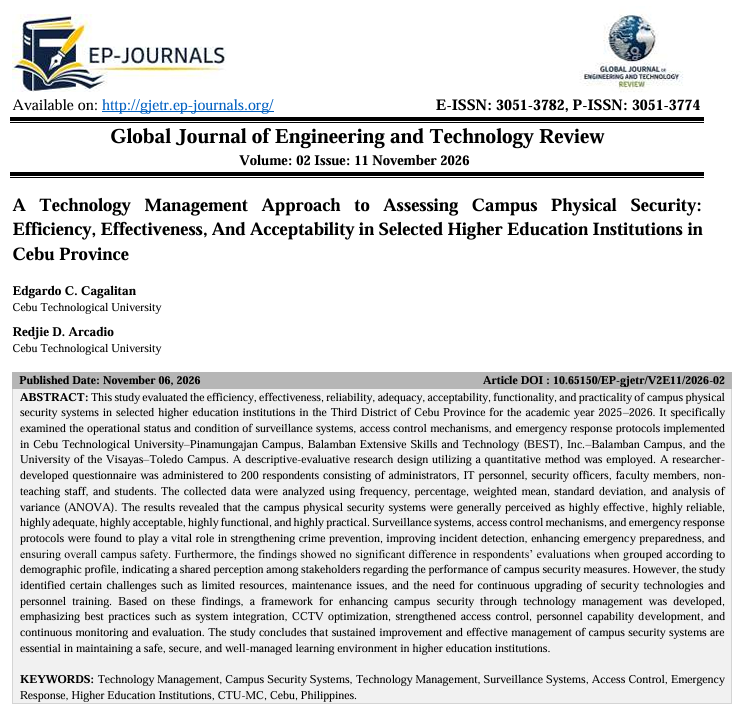
A Technology Management Approach to Assessing Campus Physical Security: Efficiency, Effectiveness, And Acceptability in Selected Higher Education Institutions in Cebu Province
DOI:
https://doi.org/10.65150/EP-gjetr/V2E11/2026-02Keywords:
Technology Management, Campus Security Systems, Surveillance Systems, Access Control, Emergency Response, Higher Education Institutions, CTU-MC, Cebu, Philippines.Abstract
This study evaluated the efficiency, effectiveness, reliability, adequacy, acceptability, functionality, and practicality of campus physical security systems in selected higher education institutions in the Third District of Cebu Province for the academic year 2025–2026. It specifically examined the operational status and condition of surveillance systems, access control mechanisms, and emergency response protocols implemented in Cebu Technological University–Pinamungajan Campus, Balamban Extensive Skills and Technology (BEST), Inc.–Balamban Campus, and the University of the Visayas–Toledo Campus. A descriptive-evaluative research design utilizing a quantitative method was employed. A researcher-developed questionnaire was administered to 200 respondents consisting of administrators, IT personnel, security officers, faculty members, non-teaching staff, and students. The collected data were analyzed using frequency, percentage, weighted mean, standard deviation, and analysis of variance (ANOVA). The results revealed that the campus physical security systems were generally perceived as highly effective, highly reliable, highly adequate, highly acceptable, highly functional, and highly practical. Surveillance systems, access control mechanisms, and emergency response protocols were found to play a vital role in strengthening crime prevention, improving incident detection, enhancing emergency preparedness, and ensuring overall campus safety. Furthermore, the findings showed no significant difference in respondents’ evaluations when grouped according to demographic profile, indicating a shared perception among stakeholders regarding the performance of campus security measures. However, the study identified certain challenges such as limited resources, maintenance issues, and the need for continuous upgrading of security technologies and personnel training. Based on these findings, a framework for enhancing campus security through technology management was developed, emphasizing best practices such as system integration, CCTV optimization, strengthened access control, personnel capability development, and continuous monitoring and evaluation. The study concludes that sustained improvement and effective management of campus security systems are essential in maintaining a safe, secure, and well-managed learning environment in higher education institutions.
References
1) Bougie, R. (2019). Research methods for business: A skill-building approach. Wiley.
2) Smith, J. P. (2019). Modern campus security management systems. Routledge.
3) Journal Articles and Related Studies
4) Aquino, J. R. (2024). Technology management practices in higher education security systems. Philippine Journal of Technology and Education, 16(3), 55–70.
5) Bautista, C. M. (2020). Fragmented security systems in higher education institutions. Asian Educational Technology Journal, 6(1), 25–39.
6) Chen, W. (2022). Digital and physical security integration in educational institutions. International Journal of Technology Management, 18(2), 88–101.
7) Cruz, M. E. (2022). Implementation gaps in campus security systems. Philippine Journal of Educational Management, 13(2), 77–90.
8) Davis, F. D. (1989). Perceived usefulness, perceived ease of use, and user acceptance of information technology. MIS Quarterly, 13(3), 319–340.
9) DeLone, W. H., & McLean, E. R. (2016). Information systems success model. [Journal and publication details to be verified.]
10) Garcia, M. L. (2020). Technology-driven security systems in universities. Journal of Educational Security Management, 12(3), 45–58.
11) Johnson, M. T. (2018). Challenges in campus security system management. Security Operations Review, 9(1), 22–35.
12) Kumar, A. (2023). Diffusion of security innovations in educational institutions. Technology and Society Review, 19(1), 91–106.
13) Lee, S. K. (2023). Sustainability of technological investments in campus security. Asian Journal of Information Security, 14(4), 66–79.
14) Lopez, K. A. (2025). Localized approaches in campus security assessment. Journal of Technology Management Research, 20(1), 82–97.
15) Martinez, L. F. (2020). User acceptability of campus monitoring systems. Journal of Institutional Technology, 8(3), 71–84.
16) Nguyen, T. H. (2022). Artificial intelligence applications in campus surveillance systems. Journal of Smart Security Technologies, 15(1), 50–67.
17) Patel, R. S. (2021). Real-time monitoring and incident response systems. International Journal of Safety Engineering, 11(2), 33–49.
18) Rivera, J. D. (2023). Budget constraints in security technology implementation. Journal of Educational Infrastructure, 17(2), 60–73.
19) Santos, L. R. (2021). Privacy and security compliance in educational institutions. Philippine Journal of Information Management, 9(3), 41–56.
20) Tan, M. G. (2024). User perception and system impact of campus security technologies. International Journal of Campus Safety, 5(1), 30–46.
21) Williams, K. J. (2019). Evaluating physical security systems through technology management. International Journal of Security Studies, 10(2), 40–55.
22) Wilson, E. J. (2020). User acceptance and security technology effectiveness. Journal of Information Systems and Security, 7(4), 55–69.
23) Federal Emergency Management Agency. (n.d.). [Specific publication on emergency preparedness and security resource planning to be identified].
24) International Association of Campus Law Enforcement Administrators. (2022). Campus security and safety best practices manual [Publication details to be verified].
25) National Institute of Standards and Technology. (2021). [Specific publication on security monitoring, risk management, or institutional facilities to be identified].
26) Republic Act No. 7722, Higher Education Act of 1994 (1994) (Philippines).
27) Republic Act No. 8293, Intellectual Property Code of the Philippines (1997) (Philippines).
28) Republic Act No. 10173, Data Privacy Act of 2012 (2012) (Philippines).
Downloads
Published
Issue
Section
License
Copyright (c) 2026 Edgardo C. Cagalitan, Redjie D. Arcadio (Author)

This work is licensed under a Creative Commons Attribution 4.0 International License.