Virtual Reality and Augmented Reality in Aviation Education and Pilot Training: A Systematic Review
DOI:
https://doi.org/10.65150/EP-gjetr/V2E5/2026-04Keywords:
Artificial Intelligence, Augmented Reality, Aviation Education, Immersive Learning, Pilot Training, Virtual RealityAbstract
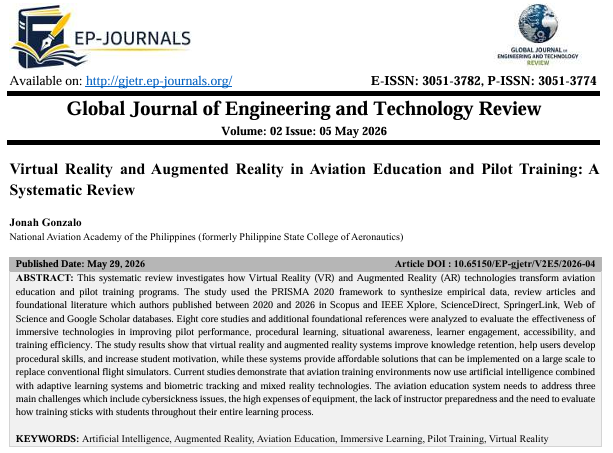
This systematic review investigates how Virtual Reality (VR) and Augmented Reality (AR) technologies transform aviation education and pilot training programs. The study used the PRISMA 2020 framework to synthesize empirical data, review articles and foundational literature which authors published between 2020 and 2026 in Scopus and IEEE Xplore, ScienceDirect, SpringerLink, Web of Science and Google Scholar databases. Eight core studies and additional foundational references were analyzed to evaluate the effectiveness of immersive technologies in improving pilot performance, procedural learning, situational awareness, learner engagement, accessibility, and training efficiency. The study results show that virtual reality and augmented reality systems improve knowledge retention, help users develop procedural skills, and increase student motivation, while these systems provide affordable solutions that can be implemented on a large scale to replace conventional flight simulators. Current studies demonstrate that aviation training environments now use artificial intelligence combined with adaptive learning systems and biometric tracking and mixed reality technologies. The aviation education system needs to address three main challenges which include cybersickness issues, the high expenses of equipment, the lack of instructor preparedness and the need to evaluate how training sticks with students throughout their entire learning process.
References
1) Cross, J., Boag-Hodgson, C., Ryley, T., Mavin, T. J., & Potter, L. E. (2023). Using Extended Reality in Flight Simulators: A Literature Review. IEEE Transactions on Visualization and Computer Graphics, 29(9), 3961–3975. https://doi.org/10.1109/tvcg.2022.3173921
2) Duruaku, F., Nguyen, B., Green, N., Sonnenfeld, N. A., & Jentsch, F. (2023). Suitability of virtual reality for supplemental scenario-based training to facilitate crew resource management outcomes. Proceedings of the Human Factors and Ergonomics Society Annual Meeting, 67(1), 2394–2396. https://doi.org/10.1177/21695067231192656
3) Dymora, P., Kowal, B., Mazurek, M., & Romana, S. (2021). The effects of Virtual Reality technology application in the aircraft pilot training process. IOP Conference Series: Materials Science and Engineering, 1024(1), 012099. https://doi.org/10.1088/1757-899x/1024/1/012099
4) Fussell, S. G., & Truong, D. (2023). Accepting virtual reality for dynamic learning: an extension of the technology acceptance model. Interactive Learning Environments, 31(9), 5442–5459. https://doi.org/10.1080/10494820.2021.2009880
5) Fussell, S.G., Truong, D. Using virtual reality for dynamic learning: an extended technology acceptance model. Virtual Reality 26, 249–267 (2022). https://doi.org/10.1007/s10055-021-00554-x
6) Gorbunov, A. L., & Li, Yu. (2023). Visual coherence in augmented reality training systems considering aerospace specific features. Civil Aviation High Technologies, 26(5), 30–41. https://doi.org/10.26467/2079-0619-2023-26-5-30-41
7) Guevarra, M., Das, S., Wayllace, C., Epp, C. D., Taylor, M., & Tay, A. (2023). Augmenting Flight Training with AI to Efficiently Train Pilots. Proceedings of the AAAI Conference on Artificial Intelligence, 37(13), 16437–16439. https://doi.org/10.1609/aaai.v37i13.27071
8) Guthridge, R., & Clinton-Lisell, V. (2023). Evaluating the Efficacy of Virtual Reality (VR) Training Devices for Pilot Training. Journal of Aviation Technology and Engineering, 12(2). https://doi.org/10.7771/2159-6670.1286
9) Hebbar, A., Vinod, S., Shah, A., Pashilkar, A., & Biswas, P. (2023). Cognitive load estimation in VR flight simulator. Journal of Eye Movement Research, 15(3). https://doi.org/10.16910/jemr.15.3.11
10) Hight, M. P. H., Fussell, S. G., Kurkchubasche, M. A., & Hummell, I. J. (2022). Effectiveness of Virtual Reality Simulations for Civilian, Ab Initio Pilot Training. Journal of Aviation/Aerospace Education & Research. https://doi.org/10.15394/jaaer.2022.1903
11) Ján Jevčák, Kelemen, M., Korniienko, A., & Kristína Ozdincová. (2024). Analyzing Integration of Immersive Technologies in Aviation Education. Acta Avionica Journal, 26(2), 14–22. https://doi.org/10.35116/a.2024.0012
12) Lämsä, J., Mannonen, J., Tuhkala, A., Heilala, V., Helovuo, A., Tynkkynen, I., Lampi, E., Sipiläinen, K., Kärkkäinen, T., & Hämäläinen, R. (2023). Capturing cognitive load management during authentic virtual reality flight training with behavioural and physiological indicators. Journal of Computer Assisted Learning, 39(5), 1553–1563. https://doi.org/10.1111/jcal.12817
13) Li, W., Zhang, J., Court, S., Kearney, P., & Braithwaite, G. (2022). The influence of augmented reality interaction design on pilot’s perceived workload and situation awareness. International Journal of Industrial Ergonomics, 92, 103382.
https://doi.org/10.1016/j.ergon.2022.103382
14) Liedtke, S., Zintl, M., Holzapfel, F., Klinker, G. (2023). A Mixed Reality Setup for Prototyping Holographic Cockpit Instruments. In: Zachmann, G., et al. Virtual Reality and Mixed Reality. EuroXR 2023. Lecture Notes in Computer Science, vol 14410. Springer, Cham. https://doi.org/10.1007/978-3-031-48495-7_5
15) Livatino, S., Morana, G., Iqbal, Y., Mohamed, M., Hwang, S., Gainley, P., Nguyen, T. H., Williams, K., & Zocco, A. (2022). Immersive Visualization in Pilot Training: from Cockpit Panels to Drone Navigation. 2022 IEEE International Conference on Metrology for Extended Reality, Artificial Intelligence and Neural Engineering (MetroXRAINE), 454–458.
https://doi.org/10.1109/metroxraine54828.2022.9967530
16) Mittelstaedt, J., Huelmann, G., Marggraf-Micheel, C., Schiller, A., Seehof, C., & Stelling, D. (2024). Cybersickness with passenger VR in the aircraft: Influence of turbulence and VR content. Virtual Reality, 28(2). https://doi.org/10.1007/s10055-024-01008-w
17) Moesl, B., Schaffernak, H., Vorraber, W., Braunstingl, R., Herrele, T., & Koglbauer, I. V. (2021). A Research Agenda for Implementing Augmented Reality in Ab Initio Pilot Training. Aviation Psychology and Applied Human Factors, 11(2), 118–126.
https://doi.org/10.1027/2192-0923/a000214
18) Myers, P. L., III, Starr, A. W., & Mullins, K. (n.d.). Flight simulator fidelity, training transfer, and the role of instructors in optimizing learning. Scholarly Commons. https://commons.erau.edu/ijaaa/vol5/iss1/6/
19) Page, M. J., McKenzie, J. E., Bossuyt, P. M., Boutron, I., Hoffmann, T. C., Mulrow, C. D., ... & Moher, D. (2021). The PRISMA 2020 statement: an updated guideline for reporting systematic reviews. BMJ, 372, n71. https://doi.org/10.1136/bmj.n71
20) Reyes, C. I. A., Wozniak, D., Ham, A., & Zahabi, M. (2022). An adaptive virtual Reality-Based training system for pilots. Proceedings of the Human Factors and Ergonomics Society Annual Meeting, 66(1), 1962–1966. https://doi.org/10.1177/1071181322661063
21) Ross, G., & Gilbey, A. (2023). Extended reality (xR) flight simulators as an adjunct to traditional flight training methods: A scoping review. CEAS Aeronautical Journal, 14(4), 799–815. https://doi.org/10.1007/s13272-023-00688-5
22) Schaffernak, H., Moesl, B., Vorraber, W., & Koglbauer, I. V. (2020). Potential Augmented Reality Application Areas for Pilot Education: An Exploratory Study. Education Sciences, 10(4), 86. https://doi.org/10.3390/educsci10040086
23) Shaker, M. H., & Al-Alawi, A. I. (2023). Application of Big Data and Artificial Intelligence in Pilot Training: A Systematic Literature Review. International Conference on Cyber Management and Engineering (CyMaEn), 205–209.
https://doi.org/10.1109/cymaen57228.2023.10050972
24) Somerville, A., Joiner, K., & Wild, G. (2026). Virtual Reality in PCATD-Based Instrument Flight Training: A Quasi-Transfer of Training Study. Technologies, 14(2), 94. https://doi.org/10.3390/technologies14020094
25) Thomas, R. L., Albelo, J. L. D., & Wiggins, M. (2023). Enhancing Pilot Training Through Virtual Reality: Recognizing and Mitigating Aviation Visual and Vestibular Illusions. International Journal of Aviation, Aeronautics, and Aerospace, 10(3).
https://doi.org/10.58940/2374-6793.1839
26) Weelden, E. van, Alimardani, M., Wiltshire, T. J., & Louwerse, M. M. (2021, September 1). Advancing the Adoption of Virtual Reality and Neurotechnology to Improve Flight Training. IEEE Xplore. https://doi.org/10.1109/ICHMS53169.2021.9582658
27) Ziakkas, D., Del Cid Flores, A., & Suckow, M. W. (2023). Human Factors in Aviation and Artificial Systems: The Purdue Aviation Virtual Reality Case Study. International Conference on Intelligent Human Systems Integration (IHSI 2023).
Downloads
Published
Issue
Section
License
Copyright (c) 2026 Jonah Gonzalo (Author)

This work is licensed under a Creative Commons Attribution 4.0 International License.