The Role of Visual Literacy in Enhancing Technical Drawing Skills: Implications for Aviation Education from A Systematic Literature Review
DOI:
https://doi.org/10.65150/EP-gjetr/V2E6/2026-06Keywords:
Aviation Education, Engineering Graphics, Spatial Visualization, Technical Drawing, Visual LiteracyAbstract
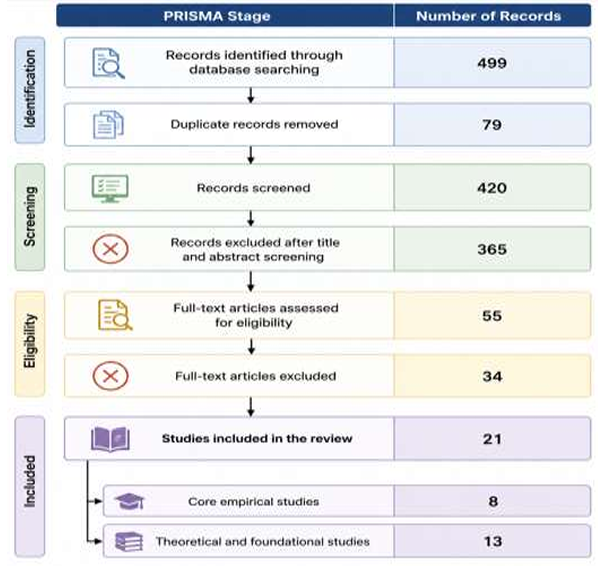
Visual literacy is an important aspect of developing students' skills in interpreting, analyzing and communicating visual information which is crucial to technical drawing and engineering graphics education. This study employed a systematic literature review to explore the impact of visual literacy, improving technical drawing ability and its effect on aviation education in accordance with the PRISMA 2020 framework. A total of 499 records were identified, from which eight core studies and thirteen supporting theoretical studies were included for synthesis. These findings showed that visual literacy is often associated with spatial visualization skills including mental rotation and graphical communication elements. The results highlighted both technology-mediated interventions, for example via augmented reality and virtual learning environments, and traditional interventions such as freehand drawing or situational learning techniques generally improved the spatial reasoning or technical drawing performance of students. Visualization practice was found to be one of the main support mechanisms for expertise acquisition alongside mental representation and cognitive engagement. In general, these results indicate that instructional strategies focused on developing visual literacy should supplement traditional pedagogical techniques that reinforce the knowledge needed for core competencies in technical drawing skills and aviation and engineering learning contexts.
References
1) Ali, D. F., Ahmad, A. R., & Omar, M. (2024a). Enhancing Student’s 3D Development and Mental Rotation Skill using Augmented Reality. International Journal of Academic Research in Progressive Education and Development, 13(3). https://doi.org/10.6007/ijarped/v13-i3/21966
2) Ali, D. F., Ahmad, A. R., Omar, M., Noh@Seth, N. H., Lah, N. H. C., & Sundari, R. S. (2024b). Technology Application in Enhancing Visualization Skills in Learning Engineering Drawing: A Systematic review. Journal of Advanced Research in Applied Sciences and Engineering Technology, 229–245. https://doi.org/10.37934/araset.56.2.229245
3) Ali, D.F., Nasir, A.N., Buntat, Y., Minghat, A.D., Hussin, M.N., Mokhtar, M., & Nordin, M.S. (2013). Virtual environment courseware in engineering drawing to enhance students' visualization skills.
4) Badeleh,, A. and Gholamrezaei, H. R. (2021). Effect of real education model on visual-spatial visualization considering the role of technical self-efficacy of male technical and engineering students in technical drawing. Technology of Education Journal (TEJ), 15(3), 611-622. doi: 10.22061/tej.2021.5610.2245
5) Brumberger, E. (2011). Visual Literacy and the Digital Native: An Examination of the MillennialLearner. Journal of Visual Literacy, 30(1), 19–47. https://doi.org/10.1080/23796529.2011.11674683
6) Chedi, Jamilu Mustapha. (2015). TECHNICAL DRAWING/ GRAPHIC SKILLS ACQUISITION FOR TEACHING AND LEARNING AND CHALLENGES IN TECHNOLOGY EDUCATION. ATBU, Journal of Science, Technology & Education (JOSTE); Vol. 3 (3), August, 2015 ISSN: 2277-0011. 3. 128 - 133.
7) Dong, Y. (2012, June), Lessons Learned in Engaging Engineering Students by Improving Their Spatial Visualization Skills Paper presented at 2012 ASEE Annual Conference & Exposition, San Antonio, Texas. 10.18260/1-2—21651
8) Farzeeha, D., Omar, M., Mokhtar, M. K., Ali, D. F., Suhairom, N., Halim, N. D. A., Shukor, N. A., & Abdullah, Z. (2017). Enhancing Students’ Mental Rotation Skills in Engineering Drawing by Using Virtual Learning Environment. Man in India, 97(17), 161–170. http://eprints.utm.my/id/eprint/81213/
9) Gonzalo, J. O. (2024). Digital Transformation in Aviation Education: A review of ICT Tools and techniques. American Journal of Education and Technology, 3(3), 63–70. https://doi.org/10.54536/ajet.v3i3.2988
10) Katsioloudis, P., Jovanovic, V., & Jones, M. (2014). A Comparative Analysis of Spatial Visualization Ability and Drafting Models for Industrial and Technology Education Students. Journal of Technology Education, 26(1). https://doi.org/10.21061/jte.v26i1.a.6
11) Keller, C. A., & Robinson, L. A., & Ault, H. K. (2018, June), Board 82: Visual Literacy in Mechanical Engineering Design: A Practical Approach to Assessment and Methods to Enhance Instruction Paper presented at 2018 ASEE Annual Conference & Exposition, Salt Lake City, Utah. 10.18260/1-2—30117
12) Martín Erro, A., & Nuere Menéndez-Pidal, S. (2024). How visual literacy is developed through Engineering Graphics subjects. Journal of Visual Literacy, 43(1), 29–45. https://doi.org/10.1080/1051144X.2024.2315835
13) Martín Erro, A., Martínez Muneta, M. L., & Rodríguez Sevillano, Á. A. (2024). Exploring Freehand Drawing Skills of Engineering Students as a Support of Visualization. Education Sciences, 14(6), 641. https://doi.org/10.3390/educsci14060641
14) Matusiak, K., Heinbach, C., Harper, A., & Bovee, M. (2019). Visual Literacy in Practice: Use of Images in Students’ Academic Work. College & Research Libraries, 80(1), 123–139. https://doi.org/10.5860/crl.80.1.123
15) Maughmer, M., & Schmidt, K. (2007, June), Teaching Free Hand Drawing In Aerospace Engineering Paper presented at 2007 Annual Conference & Exposition, Honolulu, Hawaii. 10.18260/1-2--2068
16) Mursid, R. (2018). Promoting Creative Thinking Ability Using Contextual Learning Model in Technical Drawing Achievement. IOP Conference Series: Materials Science and Engineering, 306, 012109. https://doi.org/10.1088/1757-899X/306/1/012109
17) Othman, W., & Lee, M. F. (2008). Peningkatan tahap kognitif visualisasi pelajar jurusan teknikal melalui latihan-latihan visualisasi. Knowledge Based Platform (Open University Malaysia). http://library.oum.edu.my/repository/255/1/widad.pdf
18) Page, M. J., McKenzie, J. E., Bossuyt, P. M., Boutron, I., Hoffmann, T. C., Mulrow, C. D., Shamseer, L., Tetzlaff, J. M., Akl, E. A., Brennan, S. E., Chou, R., Glanville, J., Grimshaw, J. M., Hróbjartsson, A., Lalu, M. M., Li, T., Loder, E. W., Mayo-Wilson, E., McDonald, S., ... Moher, D. (2021). The PRISMA 2020 statement: An updated guideline for reporting systematic reviews. BMJ, 372, n71. https://doi.org/10.1136/bmj.n71
19) Prieto, G., & Velasco, A. D. (2008). Training spatial visualization using computer exercises of technical drawing. Training Spatial Visualization Using Computer Exercises of Technical Drawing, 12(2), 309–317.
20) Sediqi, M.H., Sharifi, M.M., Safi, N. (2026). The Role of Technical Drawing in Enhancing Vocational Skills within Higher Education Programs (A Case Study of the Civil and Hydrotechnical Departments, Construction Faculty, Jawzjan University). International Journal of Current Science Research and Review, 9(3), pp. 1412-1420. DOI: https://doi.org/10.47191/ijcsrr/V9-i3-28
21) Ushno, I. M. (2025). Technical drawing as a form of visual-graphic communication of engineering: philosophical-anthropological aspect. Studies in History and Philosophy of Science and Technology, 34(1), 3–14. https://doi.org/10.15421/272501
22) White, C., Breslow, L., & Hastings, D. (2015). Exploring visual literacy as a global competency: An international study of the teaching and learning of communication. https://doi.org/10.1109/icl.2015.7318126
Downloads
Published
Issue
Section
License
Copyright (c) 2026 Elden Castillo (Author)

This work is licensed under a Creative Commons Attribution 4.0 International License.