A Hybrid LSTM–Grey Wolf Optimization Framework for Optimal Siting and Sizing of Distributed Generation in Radial Distribution Networks: Evidence from IEEE Benchmark Systems and A Nigerian 33 kV Feeder
DOI:
https://doi.org/10.65150/EP-gjetr/V2E8/2026-02Keywords:
Deep Learning, Load Demand Prediction, Moniya–Akinyele Feeder, Power Loss Minimization, Voltage Profile ImprovementAbstract
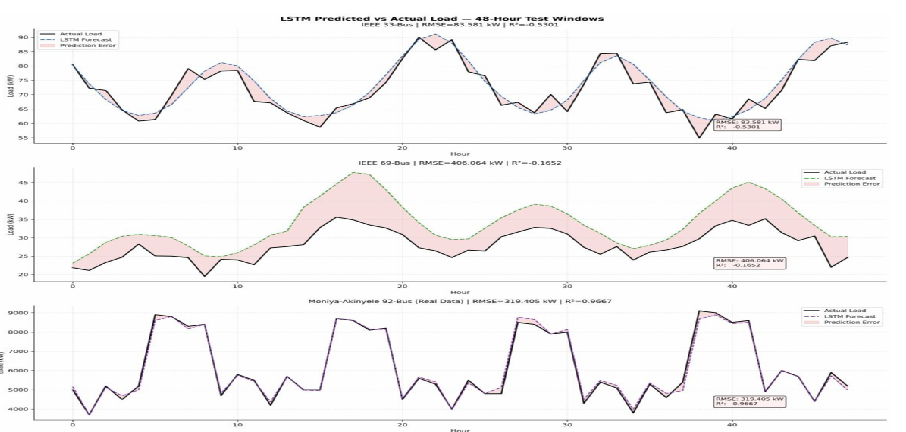
Electric power distribution networks in developing countries, particularly Nigeria, continue to experience high technical losses, poor voltage profiles, and increasing load demand on ageing, radially configured feeders. Although distributed generation is a proven technical solution to these challenges, its benefits depend heavily on optimal siting and sizing, a problem that is non-linear, multi-objective, and difficult to solve using conventional methods. This study developed and validated a hybrid intelligent framework that combines a Long Short-Term Memory neural network for load forecasting with a Grey Wolf Optimizer for distributed generation placement. The framework was tested on the IEEE 33-bus and IEEE 69-bus benchmark systems and, uniquely, on one hundred and twenty-five days of real operational data collected from the Moniya-Akinyele 33 kilovolt distribution feeder in Ibadan, Nigeria. Load flow analysis using the Newton-Raphson method identified weak buses through a composite priority index combining voltage deviation and loss sensitivity. On the benchmark system, the proposed framework reduced real power losses by 75.3 percent and improved the minimum bus voltage from 0.6746 to 0.6954 per unit following distributed generation installation of 243.88 kilowatts across seven priority buses. On the Nigerian feeder, the forecasting model achieved a coefficient of determination of 0.9667 and a mean absolute percentage error of 3.83 percent using real operating data, substantially outperforming its performance on synthesised benchmark data. The findings demonstrate that combining machine learning-based demand forecasting with meta-heuristic optimisation provides a practical and technically sound approach for intelligent network planning in developing-country distribution systems.
References
1) Alamaniotis, M., Bourbakis, N., & Tsoukalas, L. H. (2022). Deep learning models for electric load forecasting: A review. Energies, 15(4), 1377.
2) Ali, E. S., Abd Elazim, S. M., & Abdelaziz, A. Y. (2022). Optimal DG placement using hybrid meta-heuristic techniques. Energy Reports, 8, 1765–1778.
3) Babu, T. S., Ram, J. P., Sangeetha, K., Rajasekar, N., & Miyatake, M. (2021). Optimal allocation of distributed generation using hybrid PSO techniques. IEEE Access, 9, 121873–121889.
4) Baran, M. E., & Wu, F. F. (1989). Network reconfiguration in distribution systems for loss reduction and load balancing. IEEE Transactions on Power Delivery, 4(2), 1401–1407.
5) Bedi, J., & Toshniwal, D. (2022). Machine learning-assisted distributed generation planning in power systems. Applied Energy.
6) Boussaïd, I., Lepagnot, J., & Siarry, P. (2020). A survey on optimization metaheuristics. Information Sciences, 237, 82–117.
7) Chen, X., Wang, L., & Zhao, Y. (2023). Optimal distributed generation planning using benchmark distribution networks. IEEE Access.
8) Das, B., Mukherjee, V., & Dey, S. (2023). Voltage stability improvement in radial distribution systems using distributed generation. Energies, 16(5), 2101.
9) Dash, S. K., Mishra, S., Pati, L. R., & Satpathy, P. K. (2020). Optimal allocation of distributed generators using metaheuristic algorithms: An up-to-date bibliographic review. In Green Technology for Smart City and Society: Proceedings of GTSCS 2020 (pp. 553–561). Springer.
10) El-Fergany, A. A. (2020). Optimal allocation of distributed generation in radial distribution networks using Harris Hawks optimization. Energy Reports, 6, 742–751.
11) Fasina, T., Adebanji, B., Abe, A., & Ismail, I. (2021). Impact of distributed generation on the Nigerian power network. Indonesian Journal of Electrical Engineering and Computer Science, 21(3), 1263–1270.
12) Goudarzi, N., Rahimi, S., & Hasanvand, S. (2023). Artificial intelligence-based distributed generation planning in smart grids. Energies, 16(2), 845.
13) Kamel, S., Jurado, F., & Abdelaziz, A. Y. (2021). Optimal allocation of distributed generation using moth-flame optimization algorithm. Energies, 14(12).
14) Khan, Z., Ahmed, S., & Rahman, M. (2023). LSTM-based deep learning approach for short-term power demand forecasting. Sustainability, 15(9), 7034.
15) Kumar, D., Singh, P., & Sharma, R. (2024). Smart grid planning using distributed generation in practical networks. Energy Reports, 10, 1894–1905.
16) Liu, H., Mi, X., & Li, Y. (2020). Smart LSTM for short-term load forecasting. Energies, 13(3), 702.
17) Meraihi, Y., Gabis, A. B., Mirjalili, S., Ramdane-Cherif, A., & Entacher, K. (2021). A comprehensive survey of optimization algorithms for solving engineering problems: Benchmark functions and applications. Energies, 14(3), 728.
18) Mohamed, A. A., Hemeida, A. M., & Ibrahim, A. A. (2021). Optimal allocation of renewable distributed generation using salp swarm optimization. IEEE Access.
19) Nguyen, T., Truong, A., & Nguyen, P. (2020). Optimal distributed generation placement in radial distribution systems using improved particle swarm optimization. Energies, 13(21), 5739.
20) Rashid, M., & Singh, A. (2022). Optimal distributed generation placement using whale optimization algorithm. Sustainability, 14(9).
21) Rezk, H., Fathy, A., & Abdelaziz, A. Y. (2021). Optimal sizing and siting of distributed generation considering voltage stability and power loss reduction. Energies, 14(10), 2891.
22) Sharma, A., Verma, P., & Gupta, N. (2022). Hybrid PSO-GA approach for optimal distributed generation placement. Energies, 15(6), 2104.
23) Sultana, U., Khairuddin, A. B., & Aman, M. M. (2021). A review of optimum DG placement based on multi-objective optimization techniques. Energies, 14(2), 348.
24) Thurner, L., Scheidler, A., Schäfer, F., Menke, J.-H., Dollichon, J., Meier, F., Meinecke, S., & Braun, M. (2018). pandapower: An open-source Python tool for convenient modeling, analysis, and optimization of electric power systems. IEEE Transactions on Power Systems, 33(6), 6510–6521.
25) Yadav, A., & Kumar, R. (2022). Optimal placement and sizing of DG in distribution systems using improved PSO. Applied Sciences, 12(7), 3546.
26) Zhu, Y., Zhang, Z., Liu, H., Zhao, B., & Wang, T. (2024). Open capacity of distribution network including distributed power supply and network reconfiguration. Intelligent Decision Technologies, 18(4), 3301–3322.
Downloads
Published
Issue
Section
License
Copyright (c) 2026 Owolade Stephen Johnson, Ganiyu Adebayo Ajenikoko, Olusegun Bola Adesina (Author)

This work is licensed under a Creative Commons Attribution 4.0 International License.