Forecasting Rice Production in Northern Samar: A Multi-Model Analysis Using Cyclone Frequency and Harvested Area as Predictors
DOI:
https://doi.org/10.65150/EP-gjetr/V2E3/2026-01Keywords:
Rice production, forecasting models, Random Forest, Multiple Linear Regression, SARIMAX, Northern SamarAbstract
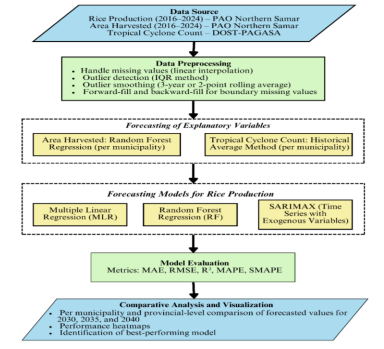
This study forecasted rice production in Northern Samar using three predictive models: Multiple Linear Regression (MLR), Random Forest Regression (RF), and Seasonal Autoregressive Integrated Moving Average with Exogenous Variables (SARIMAX). The analysis utilized cleaned datasets from 2016 to 2024, covering 23 municipalities after excluding San Vicente due to data insufficiency. Two explanatory variables—area harvested and tropical cyclone frequency—were used, with the former projected through Random Forest (SMAPE = 12.75%) and the latter using a constant mean approach. For rice production forecasts, MLR demonstrated steady upward trends and yielded the lowest MAPE in 4 municipalities, notably Catarman (5.48%) and Las Navas (3.91%). RF achieved the lowest MAPE in 17 municipalities, with exceptional accuracy in Lapinig (1.63%), Laoang (3.58%), and Lavezares (3.40%); however, it failed to capture long-term growth as it produced identical forecasts for 2030, 2035, and 2040—indicating limitations in trend sensitivity due to capped inputs. SARIMAX, while incorporating time-series structure and external factors, displayed inconsistent performance with the lowest MAPE in only 2 municipalities (Allen: 6.56%, Biri: 25.43%). Its trend outputs were often unstable in areas with irregular patterns, making it less suited for long-range forecasting. Among the three models, MLR proved most practical for long-term planning due to its interpretability and ability to reflect realistic growth. RF was best suited for short-term accuracy and baseline projections, while SARIMAX offered mixed results depending on data structure. These forecasts serve as valuable tools for local agricultural planning, guiding food security initiatives and resource allocation in Northern Samar.
References
1) Aderele, M. O., Srivastava, A. K., Butterbach-Bahl, K., & Rahimi, J. (2025). Integrating machine learning with agroecosystem modelling: Current state and future challenges. European Journal of Agronomy, 168, 127610. https://doi.org/10.1016/j.eja.2025.127610
2) Ahmad Hamdan, Kenneth Ifeanyi Ibekwe, Emmanuel Augustine Etukudoh, Aniekan Akpan Umoh, & Valentine Ikenna Ilojianya. (2024). AI and machine learning in climate change research: A review of predictive models and environmental impact. World Journal of Advanced Research and Reviews, 21(1), 1999–2008. https://doi.org/10.30574/wjarr.2024.21.1.0257
3) Cuyco, R., Balag, J., Castillo, M., Garbo, S., & Staff, M.-L. (2023). Climate and Disaster Risk Assessment (CDRA) Report 2021—Lavezares, Northern Samar.
4) Ensafi, Y., Amin, S. H., Zhang, G., & Shah, B. (2022). Time-series forecasting of seasonal items sales using machine learning – A comparative analysis. International Journal of Information Management Data Insights, 2(1), 100058. https://doi.org/10.1016/j.jjimei.2022.100058
5) Gulati, J. (2025, March 12). Mastering Time Series Forecasting: From ARIMA to LSTM. MachineLearningMastery.Com. https://machinelearningmastery.com/mastering-time-series-forecasting-from-arima-to-lstm/
6) Hia, S., Kuswanto, H., & Prastyo, D. D. (2023). Robustness of Support Vector Regression and Random Forest Models: A Simulation Study. In Y. B. Wah, M. W. Berry, A. Mohamed, & D. Al-Jumeily (Eds.), Data Science and Emerging Technologies (pp. 465–479). Springer Nature. https://doi.org/10.1007/978-981-99-0741-0_33
7) Ibañez, S., & Monterola, C. (2023, September 21). A Global Forecasting Approach to Large-Scale Crop Production Prediction with Time Series Transformers. https://www.mdpi.com/2077-0472/13/9/1855
8) Jabed, Md. A., & Azmi Murad, M. A. (2024). Crop yield prediction in agriculture: A comprehensive review of machine learning and deep learning approaches, with insights for future research and sustainability. Heliyon, 10(24), e40836.
https://doi.org/10.1016/j.heliyon.2024.e40836
9) Kolambe, M. (2024). Forecasting the Future: A Comprehensive Review of Time Series Prediction Techniques. Journal of Electrical Systems, 20, 575–586. https://doi.org/10.52783/jes.1478
10) Kontopoulou, V., Panagopoulos, A., Kakkos, I., & Matsopoulos, G. (2023). A Review of ARIMA vs. Machine Learning Approaches for Time Series Forecasting in Data Driven Networks. Future Internet, 15, 255. https://doi.org/10.3390/fi15080255
11) Kumari, P., Chandan, G., Agarwal, D., Joshi, S., & Vekariya, P. (2024). Combining predictive models: Hybrid approaches in crop recommendation systems. International Journal of Research in Agronomy, 7(11), 108–115.
https://doi.org/10.33545/2618060X.2024.v7.i11b.1951
12) Marticio, M. T. (2024, September 27). Manila Bulletin—Northern Samar, firm partner to hike rice production.
https://mb.com.ph/2024/09/27/northern-samar-firm-partner-to-hike-rice-production
13) Meinke, H., & Stone, R. C. (2005). Seasonal and Inter-Annual Climate Forecasting: The New Tool for Increasing Preparedness to Climate Variability and Change In Agricultural Planning And Operations. Climatic Change, 70(1–2), 221–253. https://doi.org/10.1007/s10584-005-5948-6
14) Northern Samar Farmers to enrol in Rice-to-Rise Program for Sustainable Farming | Province of Northern Samar. (2024, November 13). https://northernsamar.gov.ph/northern-samar-farmers-to-enrol-in-rice-to-rise-program-for-sustainable-farming/
15) Parreño, S. J. (2023). Forecasting quarterly rice and corn production in the Philippines: A comparative study of seasonal ARIMA and Holt-Winters models. ICTACT Journal on Soft Computing, 14, 3224–3231. https://doi.org/10.21917/ijsc.2023.0449
16) Parreño, S. J., & Anter, M. (2024). New approach for forecasting rice and corn production in the Philippines through machine learning models. Multidisciplinary Science Journal, 6, 2024168. https://doi.org/10.31893/multiscience.2024168
17) Rathod, S., Saha, A., Patil, R., Ondrasek, G., Gireesh, C., Anantha, M. S., Rao, D. V. K. N., Bandumula, N., Senguttuvel, P., Swarnaraj, A. K., Meera, S. N., Waris, A., Jeyakumar, P., Parmar, B., Muthuraman, P., & Sundaram, R. M. (2021). Two-Stage Spatiotemporal Time Series Modelling Approach for Rice Yield Prediction & Advanced Agroecosystem Management. Agronomy, 11(12), 2502.
https://doi.org/10.3390/agronomy11122502
18) Shah, D., & Thaker, M. (2024). A Review of Time Series Forecasting Methods. INTERNATIONAL JOURNAL OF RESEARCH AND
ANALYTICAL REVIEWS, 11, 749. https://doi.org/10.1729/Journal.38816
19) Shah, P., Pahari, S., Bhavsar, R., & Kwon, J. S.-I. (2025). Hybrid modeling of first-principles and machine learning: A step-by-step tutorial review for practical implementation. Computers & Chemical Engineering, 194, 108926.
https://doi.org/10.1016/j.compchemeng.2024.108926
20) Slater, L., Arnal, L., Boucher, M.-A., Chang, A. Y.-Y., Moulds, S., Murphy, C., Nearing, G., Shalev, G., Shen, C., Speight, L., Villarini, G., Wilby, R. L., Wood, A., & Zappa, M. (2022). Hybrid forecasting: Using statistics and machine learning to integrate predictions from dynamical models. https://doi.org/10.5194/hess-2022-334
21) Yadav, A. S. (2024). Unveiling Patterns in Time Series Forecasting Models—Arima, Arimax, Var. 11, 1335–1345.
Downloads
Published
Issue
Section
License
Copyright (c) 2026 Kyle Arthur P. Sabilao, Elvin L. Jarito, PhD (Author)

This work is licensed under a Creative Commons Attribution 4.0 International License.