Sustainable Packaging Innovations and Their Environmental Impact: A Global Systematic Review
DOI:
https://doi.org/10.65150/EP-gjetr/V2E6/2026-07Keywords:
Sustainable Packaging, Life Cycle Assessment, Global Warming Potential, Circular Economy, Reusable Packaging.Abstract
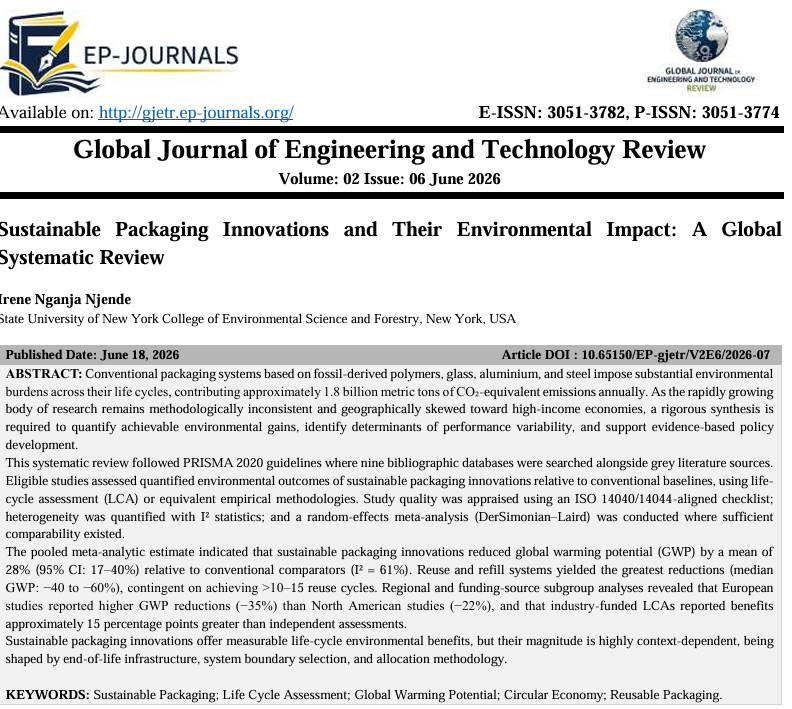
Conventional packaging systems based on fossil-derived polymers, glass, aluminium, and steel impose substantial environmental burdens across their life cycles, contributing approximately 1.8 billion metric tons of CO₂-equivalent emissions annually. As the rapidly growing body of research remains methodologically inconsistent and geographically skewed toward high-income economies, a rigorous synthesis is required to quantify achievable environmental gains, identify determinants of performance variability, and support evidence-based policy development.
This systematic review followed PRISMA 2020 guidelines where nine bibliographic databases were searched alongside grey literature sources. Eligible studies assessed quantified environmental outcomes of sustainable packaging innovations relative to conventional baselines, using life-cycle assessment (LCA) or equivalent empirical methodologies. Study quality was appraised using an ISO 14040/14044-aligned checklist; heterogeneity was quantified with I² statistics; and a random-effects meta-analysis (DerSimonian–Laird) was conducted where sufficient comparability existed.
The pooled meta-analytic estimate indicated that sustainable packaging innovations reduced global warming potential (GWP) by a mean of 28% (95% CI: 17–40%) relative to conventional comparators (I² = 61%). Reuse and refill systems yielded the greatest reductions (median GWP: −40 to −60%), contingent on achieving >10–15 reuse cycles. Regional and funding-source subgroup analyses revealed that European studies reported higher GWP reductions (−35%) than North American studies (−22%), and that industry-funded LCAs reported benefits approximately 15 percentage points greater than independent assessments.
Sustainable packaging innovations offer measurable life-cycle environmental benefits, but their magnitude is highly context-dependent, being shaped by end-of-life infrastructure, system boundary selection, and allocation methodology.
References
1) Abejón, R., Bala, A., Vázquez-Rowe, I., Aldaco, R., & Fullana-i-Palmer, P. (2020). When plastic packaging should be preferred: Life cycle analysis of packages for fruit and vegetable distribution in the Spanish peninsular market. Resources, Conservation and Recycling, 155, Article 104666. https://doi.org/10.1016/j.resconrec.2019.104666
2) Accorsi, R., Battarra, I., Guidani, B., Manzini, R., Ronzoni, M., & Volpe, L. (2022). Augmented spatial LCA for comparing reusable and recyclable food packaging containers networks. Journal of Cleaner Production, 375, Article 134027.
https://doi.org/10.1016/j.jclepro.2022.134027
3) Ahamed, A., Vallam, P., Iyer, N. S., Veksha, A., Bobacka, J., & Lisak, G. (2021). Life cycle assessment of plastic grocery bags and their alternatives in cities with confined waste management structure: A Singapore case study. Journal of Cleaner Production, 278, Article 123956. https://doi.org/10.1016/j.jclepro.2020.123956
4) Al Mahmud, M. Z., Mobarak, M. H., & Hossain, N. (2024). Emerging trends in biomaterials for sustainable food packaging: A comprehensive review. Heliyon, 10, Article e24122. https://doi.org/10.1016/j.heliyon.2024.e24122
5) Anh, T. T. Y., Herat, S., & Prasad, K. (2025). A review on extended producer responsibility schemes for packaging waste management and research gaps in the field. Nature Environment and Pollution Technology, 24(1). https://doi.org/10.46488/nept.2025.v24i01.d1662
6) Banerjee, S. (2022). Sustainability and life cycle assessment of thermoplastic polymers for packaging: A review on fundamental principles and applications. Macromolecular Materials and Engineering, 307(4), Article 2100794.
https://doi.org/10.1002/mame.202100794
7) Bishop, G., Styles, D., & Lens, P. N. L. (2021). Environmental performance of bioplastic packaging on fresh food produce: A consequential life cycle assessment. Journal of Cleaner Production, 317, Article 128377. https://doi.org/10.1016/j.jclepro.2021.128377
8) Bremenkamp, I., & Sousa Gallagher, M. J. (2024). Life cycle assessment methods for investigating novel food packaging systems. Environmental Science: Advances, 3(10), 1337–1350. https://doi.org/10.1039/d3va00380a
9) Civancik-Uslu, D., Puig, R., Voigt, S., Walter, D., & Fullana-i-Palmer, P. (2019). Improving the production chain with LCA and eco-design: Application to cosmetic packaging. Resources, Conservation and Recycling, 151, Article 104475.
https://doi.org/10.1016/j.resconrec.2019.104475
10) Cordeiro, A., Hussain, M., Ramachandran, T., Beemkumar, N., Kumar, R., Karthikeyan, A., & Patil, A. Y. (2025). Advancements in packaging materials: Trends, sustainability, and future prospects. Circular Economy and Sustainability, 5(4), 2959–2990.
https://doi.org/10.1007/s43615-025-00586-4
11) Cristóbal, J., Albizzati, P. F., Giavini, M., Caro, D., Manfredi, S., & Tonini, D. (2023). Management practices for compostable plastic packaging waste: Impacts, challenges and recommendations. Waste Management, 170, 166–176.
https://doi.org/10.1016/j.wasman.2023.08.010
12) Diggle, A., Walker, T. R., & Adams, M. (2023). Examining potential business impacts from the implementation of an extended producer responsibility program for printed paper and packaging waste in Nova Scotia, Canada. Circular Economy, 2(2), Article 100039. https://doi.org/10.1016/j.cec.2023.100039
13) Dolci, G., Puricelli, S., Cecere, G., Tua, C., Fava, F., Rigamonti, L., & Grosso, M. (2024). How does plastic compare with alternative materials in the packaging sector? A systematic review of LCA studies. Waste Management & Research: The Journal for a Sustainable Circular Economy, 43(3), 339–357. https://doi.org/10.1177/0734242X241241606
14) European Commission. (2018). Directive (EU) 2018/852 of the European Parliament and of the Council of 30 May 2018 amending Directive 94/62/EC on packaging and packaging waste. Official Journal of the European Union. https://eur-lex.europa.eu/legal-content/EN/TXT/?uri=CELEX%3A32018L0852
15) European Parliament and Council. (1994). Directive 94/62/EC on packaging and packaging waste. Official Journal of the European Communities. https://eur-lex.europa.eu/legal-content/EN/TXT/?uri=CELEX:31994L0062
16) Filella, M., & Turner, A. (2023). Towards the global plastic treaty: A clue to the complexity of plastics in practice. Environmental Sciences Europe, 35(1), Article 8. https://doi.org/10.1186/s12302-023-00801-9
17) Foschi, E., Zanni, S., & Bonoli, A. (2020). Combining eco-design and LCA as decision-making process to prevent plastics in packaging application. Sustainability, 12(22), Article 9738. https://doi.org/10.3390/su12229738
18) Herrmann, C., Rhein, S., & Sträter, K. F. (2022). Consumers' sustainability-related perception of and willingness-to-pay for food packaging alternatives. Resources, Conservation and Recycling, 181, Article 106219. https://doi.org/10.1016/j.resconrec.2022.106219
19) Higgins JPT, Thomas J, Chandler J, Cumpston M, Li T, Page MJ, et al, editor(s). Cochrane Handbook for Systematic Reviews of Interventions version 6.5 (updated August 2024). Cochrane, 2024. Available from www.cochrane.org/handbook.
20) Hottle, T. A., Bilec, M. M., & Landis, A. E. (2017). Biopolymer production and end of life comparisons using life cycle assessment. Resources, Conservation and Recycling, 122, 295–306. https://doi.org/10.1016/j.resconrec.2017.03.002
21) Hutchings, N., Smyth, B., Cunningham, E., Yousif, M., & Mangwandi, C. (2021). Comparative life cycle analysis of a biodegradable multilayer film and a conventional multilayer film for fresh meat modified atmosphere packaging — and effectively accounting for shelf-life. Journal of Cleaner Production, 327, Article 129423. https://doi.org/10.1016/j.jclepro.2021.129423
22) Ibrahim, I. D., Sadiku, E. R., Hamam, Y., Kupolati, W. K., Ndambuki, J. M., Jamiru, T., & Snyman, J. (2023). Recent recycling innovations to facilitate sustainable packaging materials: A review. Recycling, 8(6), Article 88.
https://doi.org/10.3390/recycling8060088
23) Ingrao, C., Tricase, C., Cholewa-Wójcik, A., Kawecka, A., Rana, R., & Siracusa, V. (2015). Polylactic acid trays for fresh-food packaging: A carbon footprint assessment. Science of the Total Environment, 537, 385–398.
https://doi.org/10.1016/j.scitotenv.2015.08.023
24) International Organization for Standardization. (2006a). ISO 14040:2006 — Environmental management — Life cycle assessment — Principles and framework. ISO. https://www.iso.org/standard/37456.html
25) International Organization for Standardization. (2006b). ISO 14044:2006 — Environmental management — Life cycle assessment — Requirements and guidelines. ISO. https://www.iso.org/standard/38498.html
26) International Organization for Standardization. (2013). ISO 18602:2013 — Packaging and the environment — Optimization of the packaging system. ISO. https://www.iso.org/standard/55870.html
27) Joltreau, E. (2022). Extended producer responsibility, packaging waste reduction and eco-design. Environmental and Resource Economics, 83(3), 527–578. https://doi.org/10.1007/s10640-022-00696-9
28) Kadac-Czapska, K., Knez, E., Gierszewska, M., Olewnik-Kruszkowska, E., & Grembecka, M. (2023). Microplastics derived from food packaging waste — Their origin and health risks. Materials, 16(2), Article 674. https://doi.org/10.3390/ma16020674
29) Kan, M., & Miller, S. A. (2022). Environmental impacts of plastic packaging of food products. Resources, Conservation and Recycling, 180, Article 106156. https://doi.org/10.1016/j.resconrec.2022.106156
30) Kapoor, D. D., Madaan, P., Kumar, J., Tiwari, S. K., Gupta, K. K., & Gupta, R. K. (2025). Transition towards renewable and biodegradable polymers: A comprehensive review. Journal of Polymer Research, 32(10), Article 278. https://doi.org/10.1007/s10965-025-04524-8
31) Keyes, A., Saffron, C. M., Manjure, S., & Narayan, R. (2024). Biobased compostable plastics end-of-life: Environmental assessment including carbon footprint and microplastic impacts. Polymers, 16(21), Article 3073. https://doi.org/10.3390/polym16213073
32) Kim, S. Y., Kang, D. H., Charoensri, K., Ryu, J. R., Shin, Y. J., & Park, H. J. (2023). Comparative life cycle assessment of reusable and disposable distribution packaging for fresh food. Sustainability, 15(23), Article 16448. https://doi.org/10.3390/su152316448
33) Kumrawat, A., & Unnikrishnan, S. (2025). Barriers hindering life cycle assessment implementation in packaging design to achieve carbon neutrality: A case study of emerging economy. Environment, Development and Sustainability, 27(10), 24083–24106. https://doi.org/10.1007/s10668-025-06304-2
34) Maga, D., Hiebel, M., & Aryan, V. (2019). A comparative life cycle assessment of meat trays made of various packaging materials. Sustainability, 11(19), Article 5324. https://doi.org/10.3390/su11195324
35) Mhaddolkar, N., Astrup, T. F., Tischberger-Aldrian, A., Pomberger, R., & Vollprecht, D. (2024). Challenges and opportunities in managing biodegradable plastic waste: A review. Waste Management & Research: The Journal for a Sustainable Circular Economy, 43(6), 911–934. https://doi.org/10.1177/0734242x241279902
36) Ncube, L. K., Ude, A. U., Ogunmuyiwa, E. N., Zulkifli, R., & Beas, I. N. (2021). An overview of plastic waste generation and management in food packaging industries. Recycling, 6(1), Article 12. https://doi.org/10.3390/recycling6010012
37) Page, M. J., McKenzie, J. E., Bossuyt, P. M., Boutron, I., Hoffmann, T. C., Mulrow, C. D., & Moher, D. (2021). The PRISMA 2020 statement: An updated guideline for reporting systematic reviews. BMJ, 372, Article n71. https://doi.org/10.1136/bmj.n71
38) Pålsson, H., & Olsson, J. (2023). Current state and research directions for disposable versus reusable packaging: A systematic literature review of comparative studies. Packaging Technology and Science, 36(6), 391–409. https://doi.org/10.1002/pts.2722
39) Pauer, E., Wohner, B., Heinrich, V., & Tacker, M. (2019). Assessing the environmental sustainability of food packaging: An extended life cycle assessment including packaging-related food losses and waste and circularity assessment. Sustainability, 11(3), Article 925. https://doi.org/10.3390/su11030925
40) Raźniewska, M. (2022). Compostable packaging waste management — Main barriers, reasons, and the potential directions for development. Sustainability, 14(7), Article 3748. https://doi.org/10.3390/su14073748
41) Rezvani Ghomi, E., Khosravi, F., Saedi Ardahaei, A., Dai, Y., Neisiany, R. E., Foroughi, F., Wu, M., Das, O., & Ramakrishna, S. (2021). The life cycle assessment for polylactic acid (PLA) to make it a low-carbon material. Polymers, 13(11), Article 1854. https://doi.org/10.3390/polym13111854
42) Sastre, R. M., de Paula, I. C., & Echeveste, M. E. S. (2022). A systematic literature review on packaging sustainability: Contents, opportunities, and guidelines. Sustainability, 14(11), Article 6727. https://doi.org/10.3390/su14116727
43) Silva, N., & Pålsson, H. (2022). Industrial packaging and its impact on sustainability and circular economy: A systematic literature review. Journal of Cleaner Production, 333, Article 130165. https://doi.org/10.1016/j.jclepro.2021.130165
44) Sokolova, T., Krishna, A., & Döring, T. (2023). Paper meets plastic: The perceived environmental friendliness of product packaging. Journal of Consumer Research, 50(3), 468–489. https://doi.org/10.1093/jcr/ucad008
45) Surendarnath, S., Flora, G., & Ramesh, G. (2025). Plastic waste: Management strategies and challenges in the developing world. In Solid Waste Management (pp. 441–452). Springer. https://doi.org/10.1007/978-3-031-78420-0_19
46) Thapliyal, D., Karale, M., Diwan, V., Kumra, S., Arya, R. K., & Verros, G. D. (2024). Current status of sustainable food packaging regulations: Global perspective. Sustainability, 16(13), Article 5554. https://doi.org/10.3390/su16135554
47) Torkelis, A., Dvarionienė, J., & Denafas, G. (2024). The factors influencing the recycling of plastic and composite packaging waste. Sustainability, 16(21), Article 9515. https://doi.org/10.3390/su16219515
48) United Nations Environment Programme. (2022). Turning off the tap: How the world can end plastic pollution and create a circular economy. UNEP. https://www.unep.org/resources/turning-off-tap-end-plastic-pollution-create-circular-economy
49) United Nations Environment Assembly. (2022). Resolution 5/14: End plastic pollution — Towards an international legally binding instrument (UNEP/EA.5/Res.14). UNEP. https://wedocs.unep.org/handle/20.500.11822/39812
50) Van Eygen, E., Laner, D., & Fellner, J. (2018). Circular economy of plastic packaging: Current practice and perspectives in Austria. Waste Management, 72, 55–64. https://doi.org/10.1016/j.wasman.2017.11.040
51) Wohner, B., Pauer, E., Heinrich, V., & Tacker, M. (2019). Packaging-related food losses and waste: An overview of drivers and issues. Sustainability, 11(1), Article 264. https://doi.org/10.3390/su11010264
Downloads
Published
Issue
Section
License
Copyright (c) 2026 Irene Nganja Njende (Author)

This work is licensed under a Creative Commons Attribution 4.0 International License.